Showing posts with label vanadium. Show all posts

Monday, May 18, 2015

374 - The Azotobacteriaceae

This was a very interesting review of the Azotobacter family from more than fifty years ago. It was interesting to see observations in this paper that I had made myself in my own research.

It discusses the taxonomy of Azotobacter somewhat: the genus includes A. chroococcum, A. beijerinckii, and A. vinelandii of course, and A. agile (which I'm not sure is considered a real separate species now); other alleged species (A. indicum for example) seemed like they should be separated into another genus, Beijerinckia. A. chroococcum was the first, discovered by Martius Beijerinck in 1901.

Characteristic features of Azotobacter are their large size, short thick rod-shaped cells (often found in pairs), nitrogen fixation (despite being obligate aerobes), and poor growth on digestions of meat extracts and such, like LB (something I've noticed myself). The cells change shape depending on their conditions though, which can be confusing. Worse, they can be difficult to isolate from contaminating strains. They also form resistant, dormant cysts in some conditions, though I don't think I've observed this personally. They also can form storage granules of different kinds which are observable under a microscope.

They're pretty versatile in their ability to use different carbon compounds. They can use alcohols (ethanol, propanol, butanol, etc), organic acids (acetate, citrate, butyrate, etc), and saccharides (glucose, fructose, galactose, sucrose, etc.). This depends on the species and strain somewhat; some seem to be able to use lactose, others not. Some can use starch and some other polysaccharides. Some can even use cyclic compounds (benzoic acid, phenol, salicylic acid) which are generally toxic. There are some things they can't use, such as xylose, methanol, and formic acid. Their respiration rate can be very high, the highest observed in nature (at that time, at least).

Their versatility regarding nitrogen compounds seems to be lower though. They can fix nitrogen, of course, and use basic inorganic forms (ammonia, nitrate) and some common organic forms (urea, glutamate, asparagine), but otherwise are limited. So they don't grow well on complex forms such as protein digestions (peptone, tryptone).

Otherwise, as represented in Burk medium, they need phosphorus, sulfur, potassium, calcium, magnesium, iron (amount depending on whether they were fixing nitrogen), and of course molybdenum or vanadium helped when fixing nitrogen too. Other trace elements or vitamins seem unnecessary, at least in many conditions.

The review suggests that azotobacters can produce compounds that stimulate or inhibit plant roots; I wonder if that is true.

The organisms are obligate aerobes, of course, capable of tolerating very high levels of oxygen, especially when not fixing nitrogen. They're mesophiles, preferring around 30ºC. Preferred pH depends on the strain, but around 6-8 is typical.

Some have actually reported that the weather can affect their growth, especially high-pressure areas, but this hasn't been confirmed.

Many have noticed that azotobacters seem to mutate fairly frequently; this is probably due to transposons and natural competence.

How much nitrogen do azotobacters actually fix in soils? It's hard to tell, of course, because it depends on many things and it's hard to measure the contribution of a single genus in such a complex environment, so it couldn't be said.
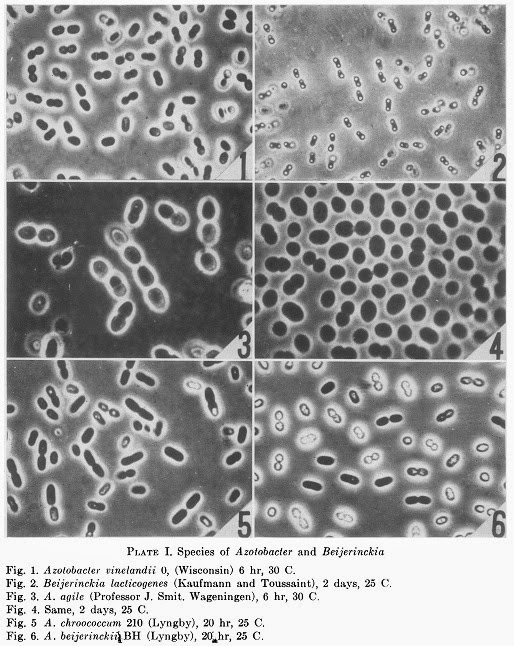
Jensen, 1954
Reference:
Jensen, H. L. The Azotobacteriaceae. Bacteriol. Rev. 18, 195–214 (1954).

Thursday, March 5, 2015

024 - Essential metals for nitrogen fixation in a free-living N2-fixing bacterium: chelation, homeostasis and high use efficiency

The molybdenum (Mo) nitrogenase in Azotobacter is preferred, of course, but molybdenum is not always easy to find, especially in nature. Vanadium and iron are more common and available, so the V and Fe nitrogenases probably see regular use.

What They Wanted to Know
J.P. Bellenger and colleagues had already showed how bacteria capture and take up the metals they need with metallophores and transporters, but they wanted to figure out how much of each metal the organisms actually need.

What They Did
They studied A. vinelandii strain CA as a wild-type, and several mutants with various nitrogenases deleted: CA1.70 only has the Mo nitrogenase, CA11.70 only the V, and RP1.11 only the Fe. They also tested A. chroococcum.

They grew these with all the nutrients they needed except nitrogen and with varied concentrations of Mo, V, or Fe, measuring growth rate (by optical density), metallophore production, nitrogen fixation (by acetylene reduction and 15N uptake), intracellular metal/phosphorus, short-term metal uptake (with metal heavy/radioactive isotopes), nitrogenase gene expression (by RT-qPCR of nifD and vnfD), and actual nitrogenase protein levels (by Western blot on NifH).

What They Observed
Growth Rates
Not surprisingly, growth rates for each mutant were lower when given sub-optimal amounts of the metals they needed to fix nitrogen (Fe and sometimes Mo or V). But instead of an exponential growth phase in the curve like one expects, they saw initial fast growth, then a second phase of slower growth before stationary phase. Growth rates were also proportional to intracellular metal levels and nitrogen fixation.

For optimal growth, the Mo-only mutant needed 10-7 to 10-6 M Mo initially. The same was true of V and Fe. Levels higher than that seemed somewhat toxic, but extra Fe helped reduce that effect.

Growth rates of the V-only mutant maxed about 15% less than Mo-only (0.23 vs. 0.27 h-1). Fe-only only got up to 0.12.

Metallophores and Metal Uptake
A. vinelandii produces azotochelin and protochelin to bind useful metals and make them easier to obtain. The authors observed that at the highest Mo/V concentration, these metallophores were much more concentrated (possibly to reduce the metal toxicity). These are produced mostly during early exponential phase (which makes sense).

Though actually, measuring V uptake rates with V either free or bound to metallophores, they found that bound V uptake is slower than uptake of free V. This could be intentional (in a non-anthropomorphic sense); that is, differentially regulated. The maximum rate is always found in intermediate concentrations though. Rates for bound V are very slow at high V levels.

It seemed like intracellular levels of each metal didn't have much effect on levels of other metals; they were mainly regulated based on concentrations in the environment. A. vinelandii keeps taking up Mo as long as it is available (A. chroococcum stops at a much lower value though). This matches with other research on A. vinelandii (014).

With V, A. vinelandii levels increase up to a plateau in intermediate concentrations, but at higher concentrations the levels increase beyond the plateau. Similar with Fe, except Fe-only mutants might have a higher plateau than others. Which makes sense.

Metal Levels and Growth/Nitrogen Fixation
In wild-type A. vinelandii, when growing with V and limited amounts of Mo, the cells start by taking up Mo and growing constantly; when outside Mo runs out, they start taking up V. When that is depleted, the growth rate slows down.

Correspondingly, V-nitrogenase gene expression starts up when Mo runs out, though not all Mo-nitrogenase genes necessarily stop expression at that point.

And finally, overall nitrogenase protein levels stay fairly constant until both Mo and V run out, and then they rise a lot.

What This Means
The two phases can be explained this way: after all the necessary metals have been taken up, no more functional nitrogenase can be made, but what's already there can still fix nitrogen, so the cells can still produce biomass but not at maximum capacity. It's like if you have a big factory that can hold 50 assembly lines but you only have enough equipment for 20; you still produce, but not at your maximum.

The rise in nitrogenase levels after Mo and V run out could indicate that the cells produce extra iron-only nitrogenase when necessary because it will take extra to fix as much nitrogen as they were fixing before, since it's less efficient. That's an interesting, clever regulatory effect, though it isn't entirely clear that's what's happening.

At lower metal concentrations, metallophores seem important in part because they allow the cells to capture metals and make them more available, but also because they make metal uptake easier to regulate so they don't become toxic. This isn't as easy at high levels, as shown by lower growth rates.

The molybdenum and vanadium toxicity could be due to inhibition of iron uptake, causing limitation; the observation that more iron helps alleviate toxicity supports this hypothesis. On the other hand, they didn't really see a drop in iron levels in lower-iron conditions.

They saw Mo storage, but strangely not Fe storage, despite A. vinelandii seeming to have iron-storing mechanisms. It could just be the growth conditions (exponential, nitrogen-fixing).

Overall, it's a lot of data about a pretty complex system. I liked this quote from the conclusions:
"Azotobacter vinelandii thus seems to be well adapted for diazotrophic growth in a soil environment where low availability, large spatiotemporal heterogeneity and strong competition may contribute to metal limitation."

Reference:
Bellenger, J.-P., Wichard, T., Xu, Y. & Kraepiel, A. M. L. Essential metals for nitrogen fixation in a free-living N2-fixing bacterium: chelation, homeostasis and high use efficiency. Environ. Microbiol. 13, 1395–1411 (2011).

Wednesday, October 9, 2013

015 - Characterization of genes involved in molybdenum transport in Azotobacter vinelandii

It is known that molybdenum (Mo) represses A. vinelandii's alternative nitrogenases, at least in the wild-type. What is not exactly known is the mechanism of this repression. Concentrations of Mo as low as 10 μM repress the alternatives, but some strains (such as CA6) produce the alternatives even with high concentrations of Mo. The question is, is this because Mo is not being transported into the cell, or because the protein that represses the alternatives is not functioning properly somehow?

So in the current study, they took a strain of A. vinelandii that can't make the primary nitrogenase but still represses the alternatives when Mo is present, and created mutants using a transposon, Tn5, then grew it on medium with Mo but without nitrogen, so that only those that had a mutation in a relevant gene could grow. And they found two Tn5-induced mutants, and also some that had mutated spontaneously to be able to grow in such conditions.

They named the two transposon mutants FL2 and FL4, focusing on them because the transposon insertion allowed them to locate and study the genes of interest. The mutants could grow pretty much just as fast with Mo present as the parent strain could grow with Mo absent (though these rates were all somewhat slow because they all needed to use the alternative nitrogenases, which are less efficient). Actually FL4 grew a bit faster than the parent.

They isolated and sequenced the section of the genome that the transposons had inserted themselves into, and it turned out that it was the mod operon that I've discussed before (012). FL2 had an insertion in modE, the regulatory gene, and FL4 had an insertion near the end of modB. So it seems like these genes are important for Mo-induced repression of alternative nitrogenases.

Citation: Luque, F., Mitchenall, L. A., Chapman, M., Christine, R. & Pau, R. N. Characterization of genes involved in molybdenum transport in Azotobacter vinelandii. Mol. Microbiol. 7, 447–459 (1993).

Wednesday, October 2, 2013

012 - Mutational analysis of genes of the mod locus involved in molybdenum transport, homeostasis, and processing in Azotobacter vinelandii

So Azotobacter vinelandii CA6 has impaired molybdenum (Mo) uptake (003). This paper studies the Mo transport system of A. vinelandii, encoded by the mod genes, modEABC. It seems like ModA is a protein that binds Mo outside the cell, ModB brings them inside across the membrane, and ModC powers this process. ModE's role is unknown at this point.

The scientists generated a number of mutant strains of A. vinelandii, knocking out a given gene while also fusing it with lacZ to quantify its expression. They also discovered another mod gene, modG, adjacent to the others but in the opposite strand direction. It looks similar to half of modE, so the protein may have a similar function.

Another enzyme in A. vinelandii that requires Mo is nitrate reductase; the authors measured activity of this enzyme as a proxy for Mo transport activity. The wild-type's activity rises quickly as concentration of Mo in the environment increases, levels off, then rises quickly again at higher concentrations (supporting the idea of two different Mo transport systems). With mutants of modA, modB, and modC, the pattern was always the same: no activity until the concentration reached a certain point (the same point when the wild-type's activity started rising quickly the second time).

Other results were more puzzling: when modE was knocked out in a way that didn't inhibit expression of the other mod genes, it seemed to have good transport activity at lower Mo concentrations but not at higher; and the opposite when its knockout inhibited the other genes.
Strain CA11.6, which genetically combined the lack of Mo nitrogenase in CA11 (002) with the tungsten-tolerant phenotype of CA6 (003), showed good Mo uptake at low concentrations but not at higher. When the modB gene was specifically knocked out of CA11.6, there was hardly any uptake activity at any concentration. Considering my own research, it's difficult to say what is going on genetically in these cases.

When modG was targeted for knockout, it looked pretty much the same as wild-type activity, except when both modG and modE were deleted, in which case it showed activity at much lower concentrations even than wild-type. Explain that, science!

They also directly measured uptake of a radioactive isotope of molybdenum (99Mo) in the wild-type and modA or modB mutants. The rate of transport in the wild-type and modB mutant were pretty much constant, though the latter was slower than the former. In the modA mutant though, there was very little transport. They tried adding nonradioactive compounds (Mo, vanadium, sulfate, or tungsten) to compete with transport of radioactive Mo, and found that only Mo and tungsten inhibited radioactive Mo transport by competition. Evidence that the mod genes transport tungsten in addition to Mo.

Lastly, the scientists tested the nitrogen-fixing abilities of mod mutants. With Mo present, nitrogen-fixing growth of modE and G mutants was similar to wild-type. When it was absent, modG knockout grew more slowly and modE more quickly. A double mutant didn't grow hardly at all in either condition, in normal aerobic conditions, but with lower levels of oxygen it grew as well as the wild-type (both very slowly). It could also grow using vanadium (V) and the V-containing alternative nitrogenase.

The conclusions, I suppose, are that modABC are all important for Mo transport, especially at low concentrations. modE's role is not exactly clear, but it may regulate which Mo transporter system is working at a given time (possibly by repressing one and activating the other at low concentrations, and vice versa at high). modG's role is even less clear.

Citation: Mouncey, N. J., Mitchenall, L. A. & Pau, R. N. Mutational analysis of genes of the mod locus involved in molybdenum transport, homeostasis, and processing in Azotobacter vinelandii. J. Bacteriol. 177, 5294–5302 (1995).

Tuesday, October 1, 2013

003 - Phenotypic characterization of a tungsten-tolerant mutant of Azotobacter vinelandii

One tungsten-tolerant strain from 001 in particular caught the attention of the researchers. Azotobacter vinelandii strain CA6 just happened to mutate spontaneously to be able to fix nitrogen in the presence of tungsten (W).

Later research showed that A. vinelandii possesses three nitrogenase system, actually: the primary, molybdenum-containing one, and two alternatives: one with vanadium instead of molybdenum, and a third with iron. The third is least efficient, but iron is most likely to be available, so it is the most versatile.

But CA6 was still interesting, because somehow it was able to overcome the repressive effect that molybdenum (Mo) and W have on the alternative nitrogenases. So in order to study it, among other things, the scientists made a number of recombinant strains of A. vinelandii, to test the functions of different nitrogenase genes.

They tried growing wild-type strain CA and mutant strain CA6 with different concentrations of W. All tested concentrations of W inhibited CA, and above 1 μM (0.184mg W per liter) all concentrations inhibited it the same amount. With CA6, however, no amount of W seemed to affect its growth. However, when Mo was present (and no W), CA grew about twice as fast as CA6.

To figure out why, they deleted the genes for the alternative nitrogenases to create strain CA6.1.71 (sounds like software versions, heh). Obviously this couldn't fix nitrogen or grow without Mo present for its primary nitrogenase. But when Mo was present, it could grow just as fast as the wild-type, showing that the difference in growth rate is probably because CA6 wastes its energy producing less efficient nitrogenases instead of focusing on the efficient primary one.

They also made some genetic fusions of nitrogenase genes with a gene called lacZ, which codes for an enzyme that breaks the bond between the two sugar molecules of lactose, resulting in one molecule of glucose and one galactose. The purpose of this is that this enzyme also breaks the bond in a molecule called o-nitrophenyl-β-galactoside (ONPG), which releases a molecule of galactose but also o-nitrophenyl, which is a bright yellow color. So when you add ONPG to liquid containing the enzyme, you can tell how much enzyme is present by how yellow the liquid becomes. And by fusing lacZ to other genes, you can get an idea of how much those other genes are expressed in the cell.

So this way, they found that, in the wild-type strain CA, Mo-nitrogenase genes are expressed when Mo or W are present (not surprisingly), and alternative nitrogenase genes are only expressed when Mo or W is absent. In CA6, the iron-nitrogenase is produced with or without Mo or W; only vanadium represses it. And the vanadium nitrogenase in both is expressed only when vanadium is present. They confirmed these results with 2-D gels (described in 001).
(Side note: vnfH, vanadium dinitrogenase reductase, is expressed in CA whenever Mo or W is absent, whether or not V is present; in CA6, it is always expressed regardless of the metals in question.)

One possible reason for the difference between CA and CA6 is the latter's ability to take Mo into its cells; if its uptake of Mo is impaired, that could result in the observed phenotype. So the scientists tested that. They found that, not only was CA6's Mo uptake slower than CA's, but it ceased to take up more above a certain concentration, whereas for CA, the more that was available, the more CA took up. It seemed like there were two separate Mo-uptake systems, one that worked better in low concentrations and one in higher, and CA6 lacked the latter. However, there was still enough Mo present in CA6 that it should have repressed the alternative nitrogenases, so this explanation didn't quite work; there must be something else. These observations just add to the mystery of A. vinelandii CA6.

Citation: Premakumar, R., Jacobitz, S., Ricke, S. C. & Bishop, P. E. Phenotypic characterization of a tungsten-tolerant mutant of Azotobacter vinelandii. J. Bacteriol. 178, 691–696 (1996).