Showing posts with label respiratory protection. Show all posts

Thursday, May 28, 2015

216 - Effect of Dissolved Oxygen on Growth Yield and Aldolase Activity in Chemostat Culture of Azotobacter vinelandii

This study looked at carbon- or oxygen-limited cultures of Azotobacter vinelandii and the effects on enzymes of the TCA cycle: aldolase, glyceraldehyde-3-phosphate dehydrogenase, isocitrate dehydrogenase, and isocitrate lyase.

What They Saw
They grew A. vinelandii in chemostats with Burk medium with glucose at different agitation speeds and different dilution rates.

At the second-lowest agitation, dissolved oxygen was low and a bit of glucose was residual in the outflow (about 0.44 g/L); this increased as D increased. Growth yield and carbon dioxide production didn't change much as D changed. Things were similar in the lowest agitation, except there was less biomass and presumably more residual sugar.

At the second-highest agitation, residual glucose was very low up to D = 0.2, then went up, so the culture seemed to switch from glucose-limited to oxygen-limited at that point. Biomass increased up to that point too, and then decreased. Growth yield and CO2 production changed inversely, with yield increasing up to a certain D before 0.2 and then leveling off. Once leveled off, values were similar to those from lower aerations.

So overall for all aerations, as dissolved oxygen increased, growth yield from glucose decreased; growth became less efficient. Carbon dioxide production increased though, indicating that the carbon was being consumed but going toward that gas, complete oxidation.

In terms of enzyme activities, of the four tested enzymes, only aldolase increased as oxygen increased. Below is their model of what effect this has:
Fig 4, Nagai et al. 1971
The rise in aldolase activity meant that carbon was cycling through the pentose cycle more instead of moving on to the TCA cycle (which could lead to greater ATP generation and anabolism), so that explains the increase in CO2 production and decreased growth yield.

Reference:
Nagai, S., Nishizawa, Y., Onodera, M. & Aiba, S. Effect of Dissolved Oxygen on Growth Yield and Aldolase Activity in Chemostat Culture of Azotobacter vinelandii. J Gen Microbiol 66, 197–203 (1971).

Wednesday, May 27, 2015

215 - Respiratory protection of nitrogenase in Azotobacter vinelandii

This study is pretty similar to 214, on how oxygen levels influence the respiratory chain of Azotobacter vinelandii.

What They Saw
They grew cells in batch at low aeration, and then increased the aeration to expose cells to excess oxygen.

The results were similar to 214: when aeration increased, cells stopped growing until respiration had ramped up and leveled off. Despite the large increase in respiration, cellular ATP levels dropped 40%. P/O ratios decreased as respiration increased to accommodate the increased oxygen, at least for NADH dehydrogenase.

They tried adding chloramphenicol again, since last time it didn't affect the growth lag, but this time observed that it lessened the increase in respiration about half, and prevented cytochrome a2 and other dehydrogenase increases.

What This Means
The M/N ratio, meaning maintenance M (moles ATP consumed per weight of cells over time) over phosphorylating efficiency N (P/O ratio x 2), explains doubling of respiratory activity upon increase in oxygen only if M increases or N decreases. It doesn't seem like M does increase, so N seems to be decreasing, because respiration uncouples from phosphorylation.

A. vinelandii seems to have different branches in its respiratory chain, which allows it to tolerate different and suddenly changing levels of oxygen.

Reference:
Jones, C. W., Brice, J. M., Wright, V. & Ackrell, B. A. C. Respiratory protection of nitrogenase in Azotobacter vinelandii. FEBS Letters 29, 77–81 (1973).

214 - The Respiratory System of Azotobacter vinelandii 2. Oxygen Effects

This study looks at how oxygen levels influence the respiratory chain in Azotobacter vinelandii.

What They Saw
They grew cells with high or low aeration (based on volume of culture in the same size flask), then isolated respiratory membranes and measured P/O ratios.

The cells grew and quickly used up all the dissolved oxygen. With high aeration, they grew much faster and leveled off once the oxygen was gone, and with low aeration the growth was slower (not even really logarithmic) but continued long after the oxygen was gone. Respiratory activities were 2-5x higher when cells were growing logarithmically with excess oxygen than when oxygen was limited.

If they suddenly increased the aeration when oxygen had run out, respiratory activity increased back up to high levels (1000 μl/h/mg dry weight). Cells didn't start growing again until it had leveled off. This lag was the same when chloramphenicol (which inhibits protein synthesis) was present, suggesting that it wasn't due to the synthesis of new enzymes for respiration.

When oxygen was being consumed, cytochrome and oxidase levels were pretty constant (except cyt o oxidase, which increased), but when oxygen ran out, levels of c4, c5, and b1 increased quickly and a2 more slowly. Cytochrome o oxidase and a2 oxidase also increased a lot, a1 less so. The increase of o was fastest and greatest.

P/O ratios were similar to those seen before at maximum, but they didn't reach this maximum until oxygen was mostly used up late in the logarithmic growth phase, at least for NADH dehydrogenase.

With low aeration, cytochrome levels were pretty constant (since oxygen ran out almost immediately), increasing just a little, except for cyt a2 oxidase which went up pretty constantly. P/O ratios were pretty level too, and fairly high, similar to when oxygen ran out in high aeration.

What This Means
This kind of pattern fits in well with those seen in other obligate aerobes. Cytochromes probably increase during oxygen limitation to try to compensate for the limitation. But the low P/O ratios at high oxygen makes sense in light of respiratory protection; respiration is uncoupled from energy generation.

Reference:
Ackrell, B. A. C. & Jones, C. W. The Respiratory System of Azotobacter vinelandii 2. Oxygen Effects. Eur. J. Biochem. 20, 29–35 (1971).

Friday, May 22, 2015

198 - Oxidation of nitrogenase iron protein by dioxygen without inactivation could contribute to high respiration rates of Azotobacter species and facilitate nitrogen fixation in other aerobic environments

This study looks at oxygen interactions with dinitrogenase reductase (DNR) in Azotobacter chroococcum (and Klebsiella pneumoniae) to see if it's possible that the enzyme can be oxidized without being totally inactivated.

When the DNR was present in high enough levels relative to the amount of oxygen (4-fold molar excess), it was protected from inactivation by oxygen: it seemed to reduce superoxides to peroxide (and then water if catalase doesn't get to it first) before the reactive oxygen species could harm it. Superoxide seems to be the harmful form of oxygen for DNR. They suggest this helps with high respiration rates (i.e. consumption of oxygen). They calculated that if 10% of the cell's protein were DNR, it could account for pretty much all of the oxygen consumption. This is unlikely, but it could still be a significant part of respiratory protection. They call this "autoprotection."

Reference:

197 - Superoxide dismutase and catalase in Azotobacter vinelandii grown in continuous culture at different dissolved oxygen concentrations

Considering how oxygen-sensitive nitrogenase is, it might be expected that enzymes specifically involved in oxygen detoxification (such as catalase and superoxide dismutase (SOD)) might be involved in protecting such oxygen-sensitive enzymes, especially since ramping up respiration in response to increased oxygen might also ramp up the production of reactive oxygen species. This study investigates the activity of SOD and catalase in Azotobacter vinelandii at different oxygen levels.

What They Saw
They grew A. vinelandii OP (aka CA) in chemostats with different levels of oxygen, with 3 or 15 g/L sucrose. They extracted enzymes from samples and assayed them for SOD or catalase activity, and also by electrophoresis.

As oxygen saturation increased from 1% to 90%, SOD activity increased linearly (when standardized to total protein); the increase was slightly faster at lower oxygen when standardized by number of cells (probably because cell size increases as oxygen increases, 098). The sucrose concentration didn't affect things. When cells were given ammonia, SOD activity was about 2x lower.

Based on electrophoresis, they concluded that the SOD is iron-containing, rather than manganese. They tried adding manganese but still didn't see any Mn-SOD.

It didn't seem like catalase activity increased with increasing oxygen, standardized by protein. The increase standardized by cells was much more apparent.

What This Means
It seems like SOD at least might contribute to A. vinelandii's protection of its nitrogenase enzyme from oxygen.

Reference:

Wednesday, May 20, 2015

099 - Oxygen and Hydrogen in Biological Nitrogen Fixation

Oxygen is pretty toxic to nitrogen fixation enzymes, so organisms or the people studying them need to take steps to protect them. They lose more than half their activity within minutes exposed to air. The dinitrogenase reductase is more sensitive than the dinitrogenase itself, at least the Mo version. Some can retain some activity even up to an hour in air. But the FeMo-cofactor, when extracted, is even more sensitive than the dinitrogenase reductase. Overall, it seems that the metal-sulfur centers are the most sensitive parts.

And yet, there are nitrogen-fixing species that are obligate aerobes, or even oxygenic. How do they do it?

Azotobacter has been shown to increase its respiration while its growth efficiency decreases as oxygen increases, seeming to waste the oxygen: this has been called "respiratory protection." The mechanism for this is not simple though; it involves carefully regulated shifts in respiratory components throughout the whole catabolic system.

Azotobacter also has the ability to reversibly inactivate its nitrogenase if respiratory protection is not possible (such as in carbon-limited conditions, or upon a sudden increase in oxygen). This seems to depend on FeSII protein (aka Shethna), though it is suggested that there may be other mechanisms.

When oxygen is too high and cells' supply of fixed nitrogen runs out, production of nitrogenase may be regulated (no sense making an enzyme when it can't function). This regulation may be done by the products of nifAL genes.

Azotobacter also produces gummy alginate which might have a role in protection from oxygen, but non-gummy strains (such as CA) have been isolated that don't seem especially oxygen-sensitive. I wonder if they have higher rates of respiration though, or if they might be more sensitive in carbon-limited conditions.

Nitrogenase also produces hydrogen gas, whether or not it's reducing anything else. This reaction seems separate from the nitrogen fixation reaction, since some things can inhibit the latter without inhibiting the former. Acetylene seems to inhibit hydrogen production though. Nitrogen can't compete with hydrogen for electrons completely, even with pure pressurized nitrogen; the enzyme always produces at least 1 mol hydrogen for each mol nitrogen gas fixed.

Of course, this hydrogen usually doesn't just escape; Azotobacter and other diazotrophs recapture it with their uptake hydrogenase. The exact purpose this serves is not clear though.

Reference:
Robson, R. L. & Postgate, J. R. Oxygen and Hydrogen in Biological Nitrogen Fixation. Ann Rev Microbiol 34, 183–207 (1980).

Monday, May 18, 2015

374 - The Azotobacteriaceae

This was a very interesting review of the Azotobacter family from more than fifty years ago. It was interesting to see observations in this paper that I had made myself in my own research.

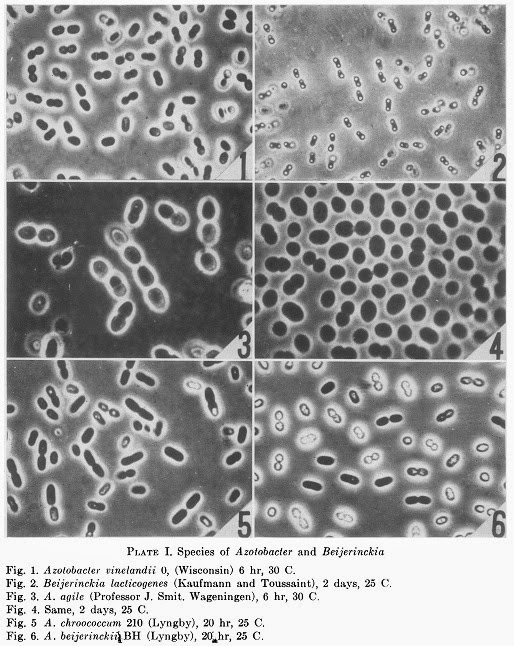
It discusses the taxonomy of Azotobacter somewhat: the genus includes A. chroococcum, A. beijerinckii, and A. vinelandii of course, and A. agile (which I'm not sure is considered a real separate species now); other alleged species (A. indicum for example) seemed like they should be separated into another genus, Beijerinckia. A. chroococcum was the first, discovered by Martius Beijerinck in 1901.

Characteristic features of Azotobacter are their large size, short thick rod-shaped cells (often found in pairs), nitrogen fixation (despite being obligate aerobes), and poor growth on digestions of meat extracts and such, like LB (something I've noticed myself). The cells change shape depending on their conditions though, which can be confusing. Worse, they can be difficult to isolate from contaminating strains. They also form resistant, dormant cysts in some conditions, though I don't think I've observed this personally. They also can form storage granules of different kinds which are observable under a microscope.

They're pretty versatile in their ability to use different carbon compounds. They can use alcohols (ethanol, propanol, butanol, etc), organic acids (acetate, citrate, butyrate, etc), and saccharides (glucose, fructose, galactose, sucrose, etc.). This depends on the species and strain somewhat; some seem to be able to use lactose, others not. Some can use starch and some other polysaccharides. Some can even use cyclic compounds (benzoic acid, phenol, salicylic acid) which are generally toxic. There are some things they can't use, such as xylose, methanol, and formic acid. Their respiration rate can be very high, the highest observed in nature (at that time, at least).

Their versatility regarding nitrogen compounds seems to be lower though. They can fix nitrogen, of course, and use basic inorganic forms (ammonia, nitrate) and some common organic forms (urea, glutamate, asparagine), but otherwise are limited. So they don't grow well on complex forms such as protein digestions (peptone, tryptone).

Otherwise, as represented in Burk medium, they need phosphorus, sulfur, potassium, calcium, magnesium, iron (amount depending on whether they were fixing nitrogen), and of course molybdenum or vanadium helped when fixing nitrogen too. Other trace elements or vitamins seem unnecessary, at least in many conditions.

The review suggests that azotobacters can produce compounds that stimulate or inhibit plant roots; I wonder if that is true.

The organisms are obligate aerobes, of course, capable of tolerating very high levels of oxygen, especially when not fixing nitrogen. They're mesophiles, preferring around 30ºC. Preferred pH depends on the strain, but around 6-8 is typical.

Some have actually reported that the weather can affect their growth, especially high-pressure areas, but this hasn't been confirmed.

Many have noticed that azotobacters seem to mutate fairly frequently; this is probably due to transposons and natural competence.

How much nitrogen do azotobacters actually fix in soils? It's hard to tell, of course, because it depends on many things and it's hard to measure the contribution of a single genus in such a complex environment, so it couldn't be said.
Jensen, 1954
Reference:
Jensen, H. L. The Azotobacteriaceae. Bacteriol. Rev. 18, 195–214 (1954).

Wednesday, May 13, 2015

178 - Dependence of nitrogenase switch-off upon oxygen stress on the nitrogenase activity in Azotobacter vinelandii

This study looks at what it takes for oxygen stress to induce Azotobacter vinelandii to shut off its nitrogenase.

What They Saw
They grew A. vinelandii OP (aka CA) in chemostats, fixing nitrogen, with limited carbon (3 g/L of sucrose, acetate, or citrate). They stressed the culture with oxygen by increasing the aeration for 6-minute periods. They measured acetylene reduction, and nitrogen fixation directly (by fixed nitrogen increase). They also measured oxygen levels going in and coming out, to determine consumption.

As usual, with sucrose, they observed that respiration rates increased as oxygen levels rose. At a given oxygen level, respiration also increased as the dilution rate D increased. The amount of respiration increase wasn't the same at different dilution rates though, even with the same change in oxygen. The oxygen maintenance requirement increases as oxygen increases, but not linearly (the rate of increase goes down).

With acetate or citrate, the oxygen maintenance coefficient (and respiration at a given oxygen level) was much lower than with sucrose. Also as D increased, respiration with citrate increased linearly, but with acetate it leveled off at some point.

The rate of nitrogen fixation depended only on D, and increased linearly with D. The carbon source didn't affect it.

When they did the oxygen challenges, they found that up to D = 0.15 h-1, increasing the oxygen shut off nitrogenase completely. Above that D, the shut-off was less severe. With a less severe challenge, there was less shut-off at the same D too, as expected. Substrate didn't seems to matter.

They couldn't measure a change in respiration from oxygen stress directly, because it was too short, but they knew that cultures grown in acetate or citrate couldn't increase their respiration because they had already consumed all the substrate. There was still residual sucrose though, but the amount didn't seem to change with oxygen challenge, so they concluded that respiration didn't suddenly increase.

Finally they tried controlling nitrogenase activity by giving cells small amounts of ammonium, not enough to repress nitrogen fixation, just reduce it. So giving cells 1 mM ammonium when D = 0.16 resulted in the same nitrogenase activity as when D = 0.06 with no ammonium. And they found that an equivalent oxygen challenge led to the same amount of nitrogenase shut-off.

What This Means
So the rate of oxygen consumption doesn't affect how severe the nitrogenase shut-off is, only the rates of substrate feeding and nitrogenase activity, and more so the latter.

This is kinda weird, because if respiration is how the cells protect nitrogenase from oxygen by removing it (respiratory protection), then higher respiration should correlate with higher nitrogenase activity, but it doesn't seem to here. Also, oxygen level and oxygen consumption should correlate linearly, but they don't, especially considering different carbon substrates.

The authors propose that, instead of respiratory protection, the cells' redox state is what matters: nitrogenase requires a reduced state to function, and more oxygen leads to a more oxidized state. Reduction is made possible by the carbon substrate, which provides energy and electrons; at higher dilution rates, more reduction is possible, so the nitrogenase activity can be higher. That also explains why at higher D, the same oxygen challenge leads to less nitrogenase shut-off, because the change in the redox state is less severe. That way, the cells don't need to create an anaerobic environment in their cytoplasm, just maintain a low redox potential and good flow of electrons.

Respiratory protection as a concept is still useful, since it is still true that the cells' respiration increases as oxygen increases when fixing nitrogen, to allow nitrogenase to function; it's just the details that have been challenged here.

Reference:

Tuesday, May 12, 2015

175 - Regulation of the Tricarboxylic Acid Cycle and Poly-β-hydroxybutyrate Metabolism in Azotobacter beijerinckii Grown under Nitrogen or Oxygen Limitation

When Azotobacter grows in oxygen-limited conditions, one expects that reducing equivalents such as NADH and NADPH would accumulate (since the electrons have no good acceptor). This could inhibit the TCA cycle. This study looked at different catabolic enzymes and their behavior under different nutrient limitations.

What They Saw
They grew A. beijerinckii in a chemostat with oxygen or (alleged) nitrogen limitations. As seen before, low oxygen induced PHB formation to store the carbon and as an electron sink. Adding extra oxygen caused a drop in PHB and dry weight, and then removing it reversed the effect. Enzymes for PHB synthesis showed a similar pattern.

NADH oxidase and enzymes involved in the TCA cycle of carbon catabolism (2-oxoglutarate dehydrogenase and isocitrate dehydrogenase) tended to increase activity as oxygen increased, and vice versa. NADH oxidase (part of the electron transport chain), though, fell after the initial increase and then rose again at the second increase. This enzyme seems like an important part of the genus's respiratory protection.

Some other TCA enzymes, citrate synthase and pyruvate dehydrogenase, didn't change much with oxygen changes.

They saw again that the lower the oxygen, the higher the growth yield (amount of biomass produced per unit sucrose), though probably some of this was due to PHB formation increasing the dry weight. The amount of sucrose consumed increased as oxygen increased, indicating less efficient growth.

With NADH/NAD+, when oxygen limitation was first imposed, the ratio rose greatly but then went down again quickly, and remained mostly steady with some fluctuations.

What This Means
The recovery of NADH/NAD+ ratio is likely due to the formation of PHB acting as an electron sink.

Azotobacter is kind of an interesting mix of aerobic and facultative organisms; they need oxygen, but not too much, and excess is harmful, so their respiratory systems are tightly regulated to deal with multiple different levels. The ability to fix nitrogen puts them in kind of a different category.

Reference:
Jackson, F. A. & Dawes, E. A. Regulation of the Tricarboxylic Acid Cycle and Poly-β-hydroxybutyrate Metabolism in Azotobacter beijerinckii Grown under Nitrogen or Oxygen Limitation. J. Gen. Microbiol. 97, 303–312 (1976).

Monday, May 11, 2015

165 - The Behaviour of Azotobacter chroococcum in Oxygen- and Phosphate-limited Chemostat Culture

This study looked at Azotobacter chroococcum behavior when limited in oxygen or phosphate.

What They Saw
They grew A. chroococcum in chemostats, similar to previous studies (163). In their allegedly oxygen-limited culture, biomass levels fell as dilution rate increased, while carbon dioxide production fell and then rose again for some reason; they claim it's just random, and that CO2 was actually fairly constant (or blame it on consistency of electricity in Britain). They also observed that as dilution rate decreased, the amount of PHB in the cells rose. They could tell the cells were oxygen-limited because when more oxygen was added, it disappeared pretty quickly.

When cells were phosphate-limited, extra oxygen was pretty toxic; the cells couldn't handle it. Plating cells out after this challenge revealed that there was very little viability, if any. In contrast, cells that had been oxygen-limited didn't seem to mind extra oxygen much, especially when they were grown on medium with fixed nitrogen.

What This Means
It fits pretty well with previous results. PHB seems to be an electron sink, useful when cells don't have enough oxygen to receive all their electrons.

The fact that oxygen didn't reduce cells' viability when plated on medium with fixed nitrogen suggests that the cells' problem with extra oxygen is lack of ability to fix nitrogen immediately, rather than loss of viability. Then the cells ramp up respiration to consume the extra oxygen—respiratory protection.

Reference:
Lees, H. & Postgate, J. R. The Behaviour of Azotobacter chroococcum in Oxygen- and Phosphate-limited Chemostat Culture. J Gen Microbiol 75, 161–166 (1973).

Friday, May 8, 2015

164 - Reassessment of Maintenance and Energy Uncoupling in the Growth of Azotobacter vinelandii

Maintenance energy reflects a cell's inefficiency, the energy it needs but that does not go toward growth; it may go toward maintaining cellular components somehow, or just reflect waste. These possibilities aren't easily distinguishable.

Previous results looked weird for A. vinelandii when its glucose feed was suddenly changed, so Nagai and Aiba wanted to clarify their understanding of this bacterium's maintenance and yield values.

They grew A. vinelandii ATCC9046 in chemostats with 5 or 8 g/L glucose, 0.05 g/L sodium citrate, and other things in Burk medium, limited either in glucose or oxygen.

The important equations are:

1: v = m + μx/YG

and

2: QO2 = mo + μx/YGO

which, being interpreted, mean that 1) the specific rate of glucose use (mmol glucose/mg bacteria/h) = maintenance (same units) + biomass growth rate/true yield (g bacteria/mol glucose). Which makes sense: maintenance takes glucose, and growth takes more, so adding them together with the growth rate you get the total glucose use;

and 2) the specific rate of respiration (mmol oxygen/mg bacteria/h) = respiration maintenance (same units) + biomass growth rate/true oxygen yield (mg bacteria/mmol oxygen). Which is parallel to the first, except with oxygen instead of glucose.

So with these equations in mind, they measured specific glucose use and specific respiration rate over a series of dilution rates (equivalent to growth rates):
Positive slopes indicate oxygen-limited points, negative slopes glucose-limited points, at different agitation speeds.
Nagai and Aiba, 1972
So from these graphs and the equations, v and QO2 can be the y in the equation of a line (y = mx + b), while D is the x, and so 1/YGO or 1/YG become the slopes, and the y-intercept is m, maintenance.

What's weird is with the glucose-limited points, the slope of the line (and thus the growth yield) is negative (so the amount of biomass should decrease as the glucose or oxygen increases); are glucose and oxygen toxic in this case? The other thing is m, which is within a reasonable range when oxygen-limited (around 0.8 mmol glucose/g bacteria/h, comparable to other organisms), gets super-high when carbon-limited: between about 19.5 and 26 mmol glucose/g bacteria/h, depending on the agitation speed and glucose concentration. The explanation for this is likely energy-uncoupled growth: when cells increase their use of substrates without increasing their growth rate (like with respiratory protection, and oxygen-wasting system).

The maintenance requirement of oxygen, or oxygen wasting, increases almost linearly as the amount of oxygen present increases. So the reason that the yields were negative when carbon-limited was that the cells receive more carbon per hour as D increases, so they produce more cells, but the rate of consumption remains the same. Therefore a lower proportion is being wasted per cell, but the same amount overall. So increasing the amount of substrate doesn't decrease the amount of biomass, but rather the 1/YGO term encompasses both actual yield and substrate-wasting values, and the latter is negative because it goes down proportional to the number of cells as D increases, and the negative outweighs the positive in this case. So the true growth yield is still positive.


Reference:
Nagai, S. & Aiba, S. Reassessment of Maintenance and Energy Uncoupling in the Growth of Azotobacter vinelandii. J Gen Microbiol 73, 531–538 (1972).

Thursday, May 7, 2015

097 - Aeration in fermentations

Providing oxygen in culture conditions can be tricky. It should be done homogeneously across time and space in the reactor, so all cells experience the same levels all the time. But homogenizing aeration adequately and measuring real-time dissolved oxygen levels are difficult tasks, because oxygen is not very soluble in aqueous solutions.

Azotobacter vinelandii, for example, is an obligate aerobe, so it needs some level of oxygen, but too much can be harmful when the cells are fixing nitrogen (or, at least, reduces the efficiency of the cells' product formation). So optimizing A. vinelandii culture requires determining the optimal oxygen level and how to reach that level.

What They Did
Phillips and Johnson had a reactor with pH and dissolved oxygen electrodes, aerated by agitation and sparging, and sensors of oxygen and CO2 in the exhaust gas. So a pretty nice setup.

They grew various organisms, including A. vinelandii strain O, in media with 5% glucose and measured their oxygen demands. Sometimes they added ammonia as fixed nitrogen, sometimes they didn't.

It seemed like A. vinelandii's oxygen utilization rate was the lowest, compared to E. coli, Aspergillus, and Penicillium; all of these remained constant as oxygen tension increased. It seems odd though.

In the reactor, when fixing nitrogen, A. vinelandii seemed to use excess sugar just to get rid of oxygen; its oxygen demand was much higher than expected for the growth, yield, and number of cells observed. When they added ammonia so the cells didn't fix nitrogen, they claim the same effect was observed, but I don't really understand how they reached that conclusion. Their graphs seem kind of messed up, not fitting their descriptions very well.

What This Means
Overall, the conclusion was that cells don't need more oxygen than just enough to keep the level above a critical threshold. Measuring dissolved oxygen is good for keeping above this threshold, but it doesn't help determine how much extra oxygen is needed if levels drop below measurable amounts. But when oxygen demand and uptake rates are measured, the oxygen deficit can be measured, except maybe with A. vinelandii which is more complicated.

Reference:
Phillips, D. H. & Johnson, M. J. Aeration in fermentations. Journal of Biochemical and Microbiological Technology and Engineering 3, 277–309 (1961).

161 - On the Efficiency of Oxidative Phosphorylation in Membrane Vesicles of Azotobacter vinelandii and of Rhizobium leguminosarum Bacteroids

The authors wanted to study oxidative phosphorylation (generating ATP through respiration) in Azotobacter vinelandii and another related to oxygen, nitrogen fixation, and hydrogen oxidation by hydrogenase.

What They Saw
They grew A. vinelandii strain OP (aka CA) in chemostats, at D = 0.1 h-1, limited in oxygen or nitrogen, then broke up the cells and isolated membrane vesicles anaerobically.

The P/O ratio is how much ATP is produced by moving 2 electrons through the electron transport chain to reduce one oxygen atom. The pattern of P/O over a range of oxygen levels is similar for different electron donors (NADH, malate, hydrogen, and NADH + hydrogen): it goes up to a peak, then falls as dissolved oxygen levels rise above the limit of detection. ATP production mostly levels off near that peak too (except with hydrogen, where it declines). The peak occurs at higher oxygen levels with NADH and malate than with hydrogen though. The height of the peak is 0.7 (ATPs per O reduced) for NADH and hydrogen, but only 0.5 with malate.

They tried adding acetylene up to 20%, but didn't see any indication that hydrogenase was inhibited. Previous studies showed that 40% acetylene was required to show inhibition, so it's not surprising. They also found that the hydrogen branch seemed to be very efficiently coupled to phosphorylation, and doesn't seem to involve flavoproteins.

What This Means
The lower values from hydrogen at high oxygen is probably due to inactivation of the hydrogenase, which is sensitive to oxygen.

The fall in P/O ratio is likely due to excess oxygen going through a different cytochrome branch, with cytochrome b to cytochrome d, which isn't involved in ATP production, so respiration and ATP are decoupled.

It also appears that the electrons from hydrogen oxidation don't travel through the same branch of the electron transport chain as electrons from carbon sources; hydrogenase has its own branch.

Reference:
Laane, C., Haaker, H. & Veeger, C. On the Efficiency of Oxidative Phosphorylation in Membrane Vesicles of Azotobacter vinelandii and of Rhizobium leguminosarum Bacteroids. European Journal of Biochemistry 97, 369–377 (1979).

Friday, April 24, 2015

136 - Effect of Oxygen Concentration and Growth Rate on Glucose Metabolism, Poly-β-Hydroxybutyrate Biosynthesis and Respiration of Azotobacter beijerinckii

This is a study on Azotobacter beijerinckii and the effects of oxygen levels on its respiration, PHB production, and other parameters.

They varied the oxygen in the inflowing gas between 0 and atmospheric (20%), and also varied dilution rates (when not holding D at 0.1 h-1).

What They Saw
As oxygen decreased, the PHB content of cells increased up to about 50% of the dry weight near 0% oxygen. Activities of PHB-producing enzymes increased also, while glucose-6-phosphate dehydrogenase activity remained constant. Below about 5% oxygen, the culture seemed oxygen-limited (no dissolved oxygen was detectable). They also saw increased respiratory activity and carbon dioxide production as oxygen increased, and indication of respiratory protection of nitrogenase.

When they increased the dilution rates (from 0.1 up to 0.2), they saw an increase in the activity of each enzyme tested. PHB content decreased as D increased, which is inconsistent with the increase in PHB enzyme activities, but it's likely that enzymes breaking down PHB were more active too.

The Entner-Doudoroff pathways seems to be the main glucose metabolism pathway in A. beijerinckii.

Reference:
Carter, I. S. & Dawes, E. A. Effect of Oxygen Concentration and Growth Rate on Glucose Metabolism, Poly-β-Hydroxybutyrate Biosynthesis and Respiration of Azotobacter beijerinckii. J. Gen. Microbiol. 110, 393–400 (1979).

Wednesday, April 22, 2015

163 - Effect of Oxygen on Growth of Azotobacter chroococcum in Batch and Continuous Cultures

This is another chemostat study of Azotobacter chroococcum and the effects of oxygen on various physiological parameters.

They grew the bacteria on mannitol B medium (apparently Burk medium but with mannitol in place of sucrose) or B6 (B, modified for chemostats by adding some trace elements and nitrilotriacetic acid (to keep everything in solution). They measured oxygen with an electrode and regulated the gases flowing through.

A nutrient was considered limiting if decreasing its feed decreased bacterial growth proportionally, except for nitrogen gas, whose limitation was diagnosed by exclusion (i.e. no other nutrient addition could increase growth).

They measured dry weights and mannitol consumed.

What They Saw
In initial batch cultures, inoculated A. chroococcum grew only those with low aeration (or low oxygen exposure) when fixing nitrogen, but given ammonium it could grow in up to 40% oxygen with high aeration.

Then they tried continuous culture with different oxygen levels, between about 1% and 60% of the gas flow (with the rest nitrogen), at D = 0.2 h-1. They saw the highest yield of biomass remain fairly constant between 10 to almost 60% oxygen. Nitrogenase efficiency (fixed N per substrate consumption) was highest at lowest oxygen, dropped some up to 20%, and then dropped very low at 30% or higher.
Dalton and Postgate 1968, fig 1
Respiratory activity plateaued between 20 and 50%.

Then they tried limiting the carbon at 20% oxygen. This led to inhibitory oxygen levels quickly when oxygen was increased (by raising agitation from 680 to 1100rpm or raising oxygen from 20 to 50%). So carbon limitation led to oxygen hypersensitivity, when fixing nitrogen. The same was true of phosphate limitation.

What This Means
It supports the idea of respiratory protection (respiring carbon quickly and inefficiently to reduce oxygen to protect oxygen-sensitive nitrogenase); when carbon is unavailable, the cells are more sensitive to oxygen when fixing nitrogen. Also the efficiency increases as oxygen levels decrease.

Reference:
Dalton, H. & Postgate, J. R. Effect of Oxygen on Growth of Azotobacter chroococcum in Batch and Continuous Cultures. J. Gen. Microbiol. 54, 463–473 (1968).

Tuesday, April 21, 2015

114 - The growth of nitrogen-fixing Azotobacter chroococcum in continuous culture under intense aeration

This study attempted to precisely define the transition from oxygen limitation to oxygen sufficiency in Azotobacter chroococcum.

They grew the bacteria in a chemostat with agitation up to 1750 rpm and different dilution rates of 0.1-0.3 h-1 in a liquid volume of 200 mL, measuring dissolved oxygen with a probe, in mannitol-containing B6 medium.

At such high feeding rates, the culture could be adapted to any level of oxygen (up to the 1750-rpm agitation limit with 20% oxygen in the flow), so that the probe was reading 0% (since it was all consumed). They tried increasing the proportion of oxygen in the flow up to 50%, but this was too much; the cells couldn't tolerate it.

What They Saw
As oxygen increased above atmospheric levels (20%) the carbon dioxide produced increased also, at all dilution rates, up to the 50% oxygen mark, when some of the cultures couldn't take it anymore. This was still true when proportional to biomass.

Biomass didn't change much with higher oxygen at lower dilution rates, though at higher rates the higher oxygen levels resulted in greater biomass. The composition of biomass didn't change much with dilution rate or oxygen level; at a low dilution rate and 20% oxygen, PHB production was about 19% of the biomass, but no more than 6% in any other condition. RNA also decreased from around 20% to closer to 10%. "Polysaccharide" was 3-4% in lower D values but 7-12% in higher, and protein increased from around 60-70 to 70-80%.

Carbon inputs and outputs were pretty balanced over different D and oxygen values; when outputs were noticeably less than inputs, there was a noticeable drop in pH (seeming to indicate incomplete oxidation of substrate).

For some reason, cells didn't do as well at lower D values; there was a loss of viability.

What This Means
The authors thought that measuring dissolved oxygen or oxygen transfer directly was not adequate to determine how much oxygen was actually getting to cells, because neither measure matched well with the amount of carbon dioxide being produced (which should correlate well with oxygen consumption). Only CO2 production, O2 consumption, or growth are reliable to measure oxygen transfer.

Still, it's hard to know exactly what "oxygen limitation" means; does it start when increasing the oxygen leads to an increase in biomass? Or when cells start producing PHB (which apparently is a much lower level)? The authors suggest the former as the better definition; this seems odd though, because they observed that biomass increased as oxygen increased up to the point when oxygen became intolerable and the cells washed out.

And yet, the cultures did seem to be oxygen-limited at 20% oxygen. The maintenance coefficient calculated from CO2 production at 20% oxygen corresponded to that which others calculated in A. vinelandii in oxygen-limited cultures (0.0055 mmol O2/mg dry weight per hour), and the respiratory index (mmol CO2 produced per mg cell growth) approached the value indicative of oxygen limitation. Above this value, excess carbon dioxide is produced, indicating respiratory protection in the cells (oxidizing the substrate to use up all the oxygen).

Reference:
Hine, P. W. & Lees, H. The growth of nitrogen-fixing Azotobacter chroococcum in continuous culture under intense aeration. Can. J. Microbiol. 22, 611–618 (1976).

Monday, April 20, 2015

112 - The Effect of Nutrient Limitation on Hydrogen Production by Nitrogenase in Continuous Cultures of Azotobacter chroococcum

That nitrogenase produces hydrogen gas had been known for a while; this study wanted to see how different nutrient limitations affected this phenomenon.

They grew Azotobacter chroococcum on mannitol B medium in continuous culture, with limitations in carbon, sulfate, oxygen, or dinitrogen. Then they measured acetylene reduction, hydrogen production, and oxygen consumption in vivo and the former two on purified nitrogenase. Also update hydrogenase activity directly.

What They Saw
There was very little hydrogen evolved by oxygen-limited cultures in air, unless the uptake hydrogenase was inhibited by acetylene first. Replacing air with an argon/oxygen/CO2 mix (without nitrogen) also increased hydrogen evolution to a similar level. With both treatments, the hydrogen seen was much higher.

When limited in sulfate, the hydrogen produced under air (with hydrogenase active) or under argon mix seemed much higher (at least proportional to the amount of protein in cells).

Under argon mixes with different proportions of oxygen, hydrogen evolution seemed highest around 10% oxygen. With nitrogen instead of argon, the peak was similar. Too much or too little oxygen was not good. And despite the high amount of hydrogen, around 10% (actually between 6-12%) was when the most nitrogen was being fixed too, such that the ratio of hydrogen produced to nitrogen fixed was as low as 1 (or 0.5, when sulfate-limited).

In carbon-limited cultures, though, the optimum oxygen value was 3%, though oxygen consumption increased as oxygen increased, at least up to 6%.

In vitro, the hydrogen-nitrogen ratio increased as the ratio of dinitrogenase to dinitrogenase reductase increased, though higher levels of ATP decreased this effect. Sulfate limitation didn't really affect this finding.

What This Means
This makes sense; some oxygen is required to generate ATP to power the nitrogenase, but too much oxygen requires extra carbon to detoxify it, so there's less energy for nitrogenase.

It seems like a lack of dinitrogenase reductase or ATP reduces the ability to fix nitrogen instead of just producing hydrogen. I wonder if dinitrogenase has any effect on its own in the absence of ATP or its other component.

Chemically it's unclear how or why nitrogenase produces hydrogen, but it seems to be an essential part of the nitrogen fixation process.

Reference:
Walker, C. C., Partridge, C. D. P. & Yates, M. G. The Effect of Nutrient Limitation on Hydrogen Production by Nitrogenase in Continuous Cultures of Azotobacter chroococcum. J. Gen. Microbiol. 124, 317–327 (1981).

Friday, February 20, 2015

022 - The Influence of Fixed Nitrogen on Azotobacter

Azotobacter fixes nitrogen very well, but if fixed nitrogen is already available, it'll use that first. Makes sense; why waste the energy?

Others had already found that Azotobacter could use nitrogen in various forms—nitrates, ammonium, peptides. But their methods were somewhat coarse and clumsy.

What They Wanted to Know
Burk and Lineweaver wanted to use better techniques (for the time) to investigate Azotobacter's nitrogen physiology more thoroughly.

What They Did
They measured oxygen consumption by organisms grown in something pretty close to what is called Burk medium today. They also measured cell growth by direct cell counting. This experiment was done with both A. chroococcum and A. vinelandii.

They claim that changes in growth rate correlate well with changes in oxygen consumption. This means oxygen consumption can be a proxy for growth/nitrogen fixation, though the correlation is not the same in all conditions for all strains. Also, growth efficiency increases as growth rate increases, so less oxygen is consumed. So it's hard to extrapolate much.

Then, with some cultures, they added humic acid to influence the growth rate (it seemed to increase it). And measured growth rate and respiration rate in various atmospheres, each with 20% oxygen, varying concentrations of nitrogen, and the remainder hydrogen.

They also tried growing cultures with different forms of fixed nitrogen to see which inhibited nitrogen fixation.

What They Observed
The Relation of Growth and Respiration
With or without humic acid, the respiration rate increased as the proportion of nitrogen gas in the headspace increased, though the final value was a lot higher when humic acid was present. In terms of the ratio of the increase of growth over the increase of respiration rate, this also increased as nitrogen proportion increased, and when humic acid was present it increased more. So as nitrogen increased, the proportionality of growth and respiration changed.

It also seemed like the more humic acid, the better the growth and respiration, up to about 0.5 mg/mL (above which the effect leveled off). And adding fixed nitrogen in the form of ammonia definitely helped, the more the better up to 0.05 mg/mL; and the ratio of growth increase to respiration increase was much higher than with humic acid or nitrogen gas. So the type of nitrogen provided affects this ratio.

Growth Efficiency Depends on Oxygen Concentration
They also noticed that this ratio increases greatly as the oxygen concentration goes down. This makes sense, since less oxygen is being consumed, but it means the efficiency of growth goes up, as we've seen in other studies (090, 105). Presence or lack of ammonia doesn't seem to affect this.

Inhibition of Nitrogen Fixation
In 21% oxygen, with the remainder either nitrogen or hydrogen (man, 21:79% oxygen:hydrogen seems like a recipe for explosions), the type of gas didn't affect the respiration of cells when added fixed nitrogen was above 5 mg/L; below this amount, the cells started fixing nitrogen, and then growth and respiration increased more with nitrogen gas than with hydrogen.

When they added nitrate instead of ammonia, they observed the same thing: 5mg/L was sufficient to inhibit nitrogen fixation, at least as measured by amount of growth.

And in either case, the amount of nitrogen in the cells remains pretty constant regardless of whether cells are fixing it or just taking it up already fixed.

What This Means
Azotobacter's ratio of growth to respiration probably varies so much because its respiration rate can vary so much, up to 3 times its own dry weight in glucose per hour, which is 25 times more than yeast. It's just interesting that growth and respiration are so loosely connected; in some conditions, growth can change 89-fold while respiration only changes 5-fold.

I'm not really clear on why the humic acid has the effect it does.

It seems that the type of fixed nitrogen doesn't matter when it comes to inhibiting nitrogen fixation, at least between ammonia and nitrate. Other forms might be different; the authors cite some other work that showed that peptone might have less inhibitory effect (or perhaps just as much).

Overall, some interesting basic observations of Azotobacter physiology, made only a few decades after A. vinelandii was discovered.

Reference:
Burk, D. & Lineweaver, H. The Influence of Fixed Nitrogen on Azotobacter. J. Bacteriol. 19, 389–414 (1930).

Tuesday, September 30, 2014

106 - Control of dinitrogen fixation in ammonium-assimilating cultures of Azotobacter vinelandii

What They Wanted to Know
As mentioned last time (105), as the carbon-to-nitrogen ratio of culture medium increases (and the carbon becomes a lot more available than fixed nitrogen), Azotobacter vinelandii biomass stays fairly level for a time, and then starts increasing; it's like two different phases. This depends on the oxygen exposure somewhat (at low oxygen, biomass increases more linearly; at high oxygen, it doesn't increase much at all, at least at the C/N ratios tested), but is a definite phenomenon at some levels.

The hypothesis is that, when there's not much more carbon than fixed nitrogen, there's not enough nitrogen to produce much more biomass (nitrogen is limiting), and there's not enough carbon to make the cells start fixing nitrogen (because that takes a lot of energy; so carbon is also limiting). But as carbon increases, the cells start up their nitrogenase, and nitrogen stops being limiting, so biomass increases.

In this paper, Bühler, Oelze, and colleagues wanted to see if this was actually what was happening in the cells, by testing nitrogenase activity directly.

What They Did

As before, they grew A. vinelandii CA in a chemostat, but this time they measured nitrogenase activity by acetylene reduction (nitrogenase can reduce acetylene/ethyne to ethylene/ethene, which is easy to measure). They also measured total nitrogen and protein contents of the culture, corrected for added ammonium. And to make triple-sure, they did Western blots on samples of culture, using antibodies targeting nitrogen-fixing proteins.

What They Observed
As in 105, protein/nitrogen content remained fairly constant at a mid-range oxygen level up to a point as sucrose increased, and beyond that point, it increased proportionally along with dry weight.

For nitrogenase activity, they saw that the higher the oxygen, the higher the C/N ratio had to be before the cells had detectable nitrogenase activity (and the lower the peak activity at the highest carbon level). After nitrogenase started, it increased up to a certain C/N level, then leveled off. 

They give a formula for how to calculate the C/N ratio when nitrogenase starts working. And based on that, they figured out that cells started fixing nitrogen when the ammonium they were given was not enough for production of biomass from the sucrose they were given. Which makes sense. That happens at about 14 mmol ammonium per gram of protein.

Finally, they wanted to figure out whether nitrogenase proteins needed to be synthesized from scratch in ammonium-grown cells, or whether they were already present to some extent, just not active. So they used Western blots to look at nitrogenase proteins from cells at various C/N ratios. The lowest ratio showed no nitrogenase activity and no visible nitrogenase protein on the blot; mid-range showed slight activity and the faintest of bands; and the highest showed good activity and solid, visible bands. Flavodoxin proteins, related to electron transport to nitrogenase, showed up at all ratios, interestingly.

What This Means
It appears from this that cells have to produce nitrogenase proteins from scratch as C/N ratios increase, but I'm not sure it's clear that inactive versions of the proteins would show up on the blot. Maybe the antibodies they used to detect the active versions don't work well on inactive versions. It's possible.

The other possibility is that A. vinelandii does keep inactive nitrogenase around for short periods, but eventually breaks it down, and the cells in this study were kept too long in nitrogen-sufficient conditions, so they had to re-synthesize nitrogenase. This would make sense too.

In order to explain the nitrogenase regulation, the authors say it's tempting to say the need for respiratory protection is why cells don't fix nitrogen until C/N ratios are high enough, but clarify that another explanation could be that the cells just have enough fixed nitrogen until a certain point. A tricky conclusion to a tricky series of studies. Perhaps I will revisit later.

Citation: Bühler, T. et al. Control of dinitrogen fixation in ammonium-assimilating cultures of Azotobacter vinelandii. Archives of Microbiology 148, 247–251 (1987).

105 - Control of respiration and growth yield in ammonium-assimilating cultures of Azobacter vinelandii

What They Wanted to Know
As discussed in the previous posts, Bühler, Oelze, and others knew that Azotobacter vinelandii could fix nitrogen at high oxygen levels, but weren't sure how: the respiratory protection hypothesis, that the cells increased their respiration to consume all the oxygen, only seemed to make sense at relatively low levels of oxygen (below 30% saturation); respiratory activity doesn't increase very much beyond a certain point.

Also, since nitrogenase requires a large amount of energy, it's possible the respiration might just be increasing to provide for it. In 089, this lab showed that increasing the fixed nitrogen provided to A. vinelandii led to lower respiratory activity. So, similar to 090 which looked at substrate use efficiency in nitrogen-fixing conditions, here they wanted to see how the efficiency changed when fixed nitrogen was provided.

What They Did
As in previous, they grew A. vinelandii OP (aka CA) in chemostats. They added various levels of sucrose as a substrate and ammonium chloride as fixed nitrogen. They also added sodium citrate, 0.05g/L, to keep the iron they provided from precipitating.

They measured respiratory activities in different states based on oxygen consumption, and also cell dry weights and protein contents, as well as residual sucrose and ammonium.

What They Observed
At the lowest oxygen level (5%), biomass increased almost linearly with increasing sucrose. But as oxygen increased, biomass stayed constant at lower sucrose levels (up to 13-20 mM), and then rose linearly but not as steeply as at low oxygen. At high oxygen (60%), biomass barely rose at all. This was all with the same amount of ammonium added. So, at a given sucrose level, more oxygen meant less biomass. This is consistent with previous studies (090).

They also tried keeping the sucrose constant and varying the amount of ammonium, which affected the carbon-to-nitrogen ratio. They saw similar patterns of biomass vs. C/N ratio, with shifts in the biomass increase at higher ratios, as they had seen when varying the sucrose.

Residual sucrose and ammonium were always very low, so it was all being consumed, and thus limiting. Ratios of dry weight to protein contents were always constant, so there didn't seem to be any nutrient storage going on, even at high sucrose levels.

In nitrogen-limited states at low C/N ratios, yields of biomass were higher, though they decreased as sucrose increased. This is sorta the opposite of what was seen in purely nitrogen-fixing cultures (090), where yield increased as dilution rate (and thus, amount of sucrose) increased. They leveled off when cultures started fixing nitrogen. Even with ammonium though, higher oxygen meant lower yields.

Similarly, respiratory activity increased as C/N ratio increased, up until nitrogen-fixing started; the higher the oxygen, the higher the respiration. Though at a given C/N, higher oxygen always meant higher respiration, unlike in previous studies where it leveled off, though maybe the ranges of sucrose concentrations were different. Also, they measured both respiratory capacity and actual respiration, and cells always seemed to be using only about 50% of their capacity.

What This Means
The way to understand this is that at low sucrose levels, there's only enough ammonium to support a certain amount of biomass production, and not enough sucrose to make it worth turning on nitrogenase, but as the sucrose increases (or ammonium decreases), it becomes more worthwhile.

So C/N ratios seem to control respiratory capacity and activity. That kinda explains why respiration might level off at higher C/N ratios, when nitrogen-fixing activity has started: cells fix as much nitrogen as the carbon level permits, keeping the C/N ratio constant, so the respiration level is constant also. I guess. Look for more discussion about that in the next post.

One last cool thing about this paper: they give the ratios of the main components of A. vinelandii cells, based on the thesis of one H.W. van Verseveld in 1979. The composition is C6H10.8N1.5O2.9. Useful for calculating molar yields.

Given this, it appeared that the cells converted between 20-30% of the sucrose they consumed into biomass, getting rid of the rest of it, at the lowest oxygen level (5%). At 60% oxygen saturation, they only assimilated 5-10%. Overall, the results aren't really consistent with respiratory protection of nitrogenase, since these were cells grown with ammonium. Interesting.

Citation: Bühler, T. et al. Control of respiration and growth yield in ammonium-assimilating cultures of Azotobacter vinelandii. Arch. Microbiol. 148, 242–246 (1987).