This was a very interesting review of the Azotobacter family from more than fifty years ago. It was interesting to see observations in this paper that I had made myself in my own research.
It discusses the taxonomy of Azotobacter somewhat: the genus includes A. chroococcum, A. beijerinckii, and A. vinelandii of course, and A. agile (which I'm not sure is considered a real separate species now); other alleged species (A. indicum for example) seemed like they should be separated into another genus, Beijerinckia. A. chroococcum was the first, discovered by Martius Beijerinck in 1901.
Characteristic features of Azotobacter are their large size, short thick rod-shaped cells (often found in pairs), nitrogen fixation (despite being obligate aerobes), and poor growth on digestions of meat extracts and such, like LB (something I've noticed myself). The cells change shape depending on their conditions though, which can be confusing. Worse, they can be difficult to isolate from contaminating strains. They also form resistant, dormant cysts in some conditions, though I don't think I've observed this personally. They also can form storage granules of different kinds which are observable under a microscope.
They're pretty versatile in their ability to use different carbon compounds. They can use alcohols (ethanol, propanol, butanol, etc), organic acids (acetate, citrate, butyrate, etc), and saccharides (glucose, fructose, galactose, sucrose, etc.). This depends on the species and strain somewhat; some seem to be able to use lactose, others not. Some can use starch and some other polysaccharides. Some can even use cyclic compounds (benzoic acid, phenol, salicylic acid) which are generally toxic. There are some things they can't use, such as xylose, methanol, and formic acid. Their respiration rate can be very high, the highest observed in nature (at that time, at least).
Their versatility regarding nitrogen compounds seems to be lower though. They can fix nitrogen, of course, and use basic inorganic forms (ammonia, nitrate) and some common organic forms (urea, glutamate, asparagine), but otherwise are limited. So they don't grow well on complex forms such as protein digestions (peptone, tryptone).
Otherwise, as represented in Burk medium, they need phosphorus, sulfur, potassium, calcium, magnesium, iron (amount depending on whether they were fixing nitrogen), and of course molybdenum or vanadium helped when fixing nitrogen too. Other trace elements or vitamins seem unnecessary, at least in many conditions.
The review suggests that azotobacters can produce compounds that stimulate or inhibit plant roots; I wonder if that is true.
The organisms are obligate aerobes, of course, capable of tolerating very high levels of oxygen, especially when not fixing nitrogen. They're mesophiles, preferring around 30ºC. Preferred pH depends on the strain, but around 6-8 is typical.
Some have actually reported that the weather can affect their growth, especially high-pressure areas, but this hasn't been confirmed.
Many have noticed that azotobacters seem to mutate fairly frequently; this is probably due to transposons and natural competence.
How much nitrogen do azotobacters actually fix in soils? It's hard to tell, of course, because it depends on many things and it's hard to measure the contribution of a single genus in such a complex environment, so it couldn't be said.
Reference:
It discusses the taxonomy of Azotobacter somewhat: the genus includes A. chroococcum, A. beijerinckii, and A. vinelandii of course, and A. agile (which I'm not sure is considered a real separate species now); other alleged species (A. indicum for example) seemed like they should be separated into another genus, Beijerinckia. A. chroococcum was the first, discovered by Martius Beijerinck in 1901.
Characteristic features of Azotobacter are their large size, short thick rod-shaped cells (often found in pairs), nitrogen fixation (despite being obligate aerobes), and poor growth on digestions of meat extracts and such, like LB (something I've noticed myself). The cells change shape depending on their conditions though, which can be confusing. Worse, they can be difficult to isolate from contaminating strains. They also form resistant, dormant cysts in some conditions, though I don't think I've observed this personally. They also can form storage granules of different kinds which are observable under a microscope.
They're pretty versatile in their ability to use different carbon compounds. They can use alcohols (ethanol, propanol, butanol, etc), organic acids (acetate, citrate, butyrate, etc), and saccharides (glucose, fructose, galactose, sucrose, etc.). This depends on the species and strain somewhat; some seem to be able to use lactose, others not. Some can use starch and some other polysaccharides. Some can even use cyclic compounds (benzoic acid, phenol, salicylic acid) which are generally toxic. There are some things they can't use, such as xylose, methanol, and formic acid. Their respiration rate can be very high, the highest observed in nature (at that time, at least).
Their versatility regarding nitrogen compounds seems to be lower though. They can fix nitrogen, of course, and use basic inorganic forms (ammonia, nitrate) and some common organic forms (urea, glutamate, asparagine), but otherwise are limited. So they don't grow well on complex forms such as protein digestions (peptone, tryptone).
Otherwise, as represented in Burk medium, they need phosphorus, sulfur, potassium, calcium, magnesium, iron (amount depending on whether they were fixing nitrogen), and of course molybdenum or vanadium helped when fixing nitrogen too. Other trace elements or vitamins seem unnecessary, at least in many conditions.
The review suggests that azotobacters can produce compounds that stimulate or inhibit plant roots; I wonder if that is true.
The organisms are obligate aerobes, of course, capable of tolerating very high levels of oxygen, especially when not fixing nitrogen. They're mesophiles, preferring around 30ºC. Preferred pH depends on the strain, but around 6-8 is typical.
Some have actually reported that the weather can affect their growth, especially high-pressure areas, but this hasn't been confirmed.
Many have noticed that azotobacters seem to mutate fairly frequently; this is probably due to transposons and natural competence.
How much nitrogen do azotobacters actually fix in soils? It's hard to tell, of course, because it depends on many things and it's hard to measure the contribution of a single genus in such a complex environment, so it couldn't be said.
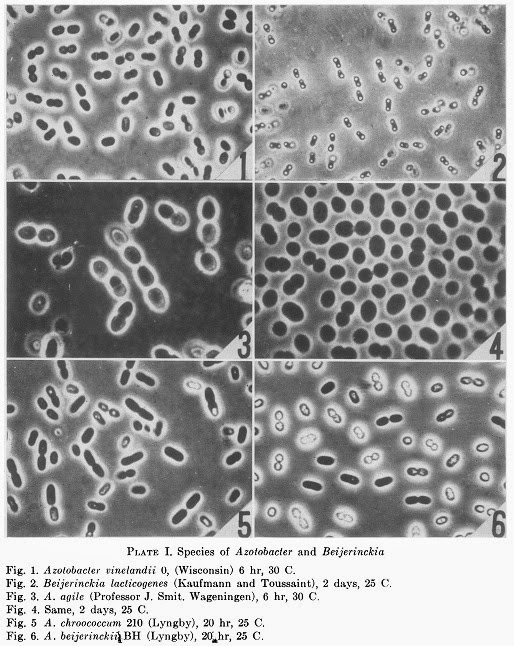 |
| Jensen, 1954 |
Jensen, H. L. The Azotobacteriaceae. Bacteriol. Rev. 18, 195–214 (1954).
