Showing posts with label molybdenum. Show all posts

Thursday, August 13, 2015

563 - Construction and Characterization of Hybrid Component 1 from V-Nitrogenase Containing FeMo Cofactor

This study looked at a purified V nitrogenase from Azotobacter vinelandii with the FeMo cofactor instead of FeVco.

What They Saw
They detected only Mo, no V, in the preparation. The activities they saw were pretty weird in some ways: the electron flux going to nitrogen was almost as much as in the Mo nitrogenase (~70%, with the rest going to hydrogen), whereas with the normal FeVco, 50% went to each; in previous studies, V nitrogenase with FeMoco couldn't fix nitrogen at all. On the other hand, with acetylene, almost all electrons went to ethylene in the Mo nitrogenase, whereas only 30-35% did in the V nitrogenase with either cofactor, while 3% went to ethane with FeVco but 10% did with FeMoco, which is consistent with previous studies. So I'm confused.

When they added carbon monoxide, there was inhibition of all nitrogenase versions, as expected.

What This Means
I think something was weird in this study, but I don't know what. It seems very questionable. However, most of the later studies citing this one either accept it without question, or confirm its results, so maybe it's not as questionable as it seems.

Also, it's worth noting that the results only show the electron flux going to each substrate, not the total electron flux, so even if most electrons go to nitrogen in the FeMoco-substituted V nitrogenase, it's still possible that it's fixing a lot less nitrogen overall than either Mo or V versions proper.

Reference:
Moore, V. G., Tittsworth, R. C. & Hales, B. J. Construction and Characterization of Hybrid Component 1 from V-Nitrogenase Containing FeMo Cofactor. J. Am. Chem. Soc. 116, 12101–12102 (1994).

Monday, August 10, 2015

557 - Detection of the in vivo incorporation of a metal cluster into a protein - The FeMo cofactor is inserted into the FeFe protein of the alternative nitrogenase of Rhodobacter capsulatus

This is another study looking at central cofactors from some nitrogenase versions inserted into other apoproteins than usual, but this time in Rhodobacter capsulatus.

What They Saw
They looked at purified enzymes from wild-type R. capsulatus and a nifHDK deletion mutant. The latter should only produce the iron-only nitrogenase, if anything. They had to treat the medium to remove as much Mo as possible so as to be able to control the concentration; this reduced the Mo present from around 1 ppb to less than 0.05 ppb (the detection limit).

They found that adding 10μM Mo to cultures growing with no Mo (and thus producing the Fe nitrogenase) greatly increased the amount of ethane produced from acetylene reduction (up to 40% of the ethylene produced). Without Mo, ethane remained constant at about 2% of ethylene. The amount of ethane increased over 72 hours too, up to 68% of ethylene; however, total activity decreased greatly over that time, down to only about 5% of what it had been before adding Mo. The ethane production rate increased for 24 hours and then decreased more slowly than the ethylene rate. This may be due to repression of the Fe nitrogenase, but the authors claim it is not, because the rate decreases more quickly in late-log cultures with chloramphenicol + Mo than with just chloramphenicol (or neither, which was about the same as with chloramphenicol alone). This shows that no new nitrogenase protein is being made even when chloramphenicol is absent, but adding Mo speeds the loss of it.
They also found that the more Mo they added, the higher the proportion of ethane produced (and also the lower the total acetylene reduction activity).

They tested the sensitivity of the system to oxygen, both with and without Mo: in both cases, more oxygen meant less acetylene reduction, though the system with Mo seemed a bit more sensitive (dropping to almost 0% with 1% oxygen while that without Mo only fell to about 20%), but also they noticed that increased oxygen increased the proportion of ethane produced after Mo was added. So somehow oxygen enhanced the Mo effect.

Rhenium, tungsten, and vanadium did not cause anything similar to the Mo effect. The Mo effect was also absent in mutants unable to produce FeMo cofactor (nifE knockouts), so it seems like the cofactor is part of the system. nifQ knockouts seemed to show the effect only at high concentrations of Mo (0.1-1mM); this gene's product is involved in cofactor synthesis at a different step. Mo uptake wasn't an issue; all strains had the same intracellular concentrations.

Using EPR spectroscopy on purified enzyme, they claim to show that the spectrum for Fe nitrogenase with added Mo is similar to that of the Mo nitrogenase from the wild-type, so it seems like the FeMo cofactor is incorporated into the Fe nitrogenase. I would've liked to see their result for the Fe nitrogenase without added Mo as a control, but I'll have to take their word for it. Though they did do metal analysis that found ratios of Fe to Mo similar to that of the Mo nitrogenase.

The fact that chloramphenicol didn't prevent the Mo effect seemed to show that the proteins required to make FeMoco were present before Mo was added. This was confirmed with lacZ fusions to related genes to observe expression more directly.

What This Means
Is FeMoco actually replacing FeFeco in completed enzymes? Seems more likely that FeMoco is inserting into incomplete apoprotein, but it's hard to distinguish between these possibilities. Considering that the process seems to continue over several days, maybe the FeMoco is actually displacing FeFeco from completed proteins over time. This is supported by the observation of oxygen enhancement of the Mo effect; oxygen seems to make the enzyme more labile.

Reference:

Thursday, July 2, 2015

190 - Characterization of a Tungsten-Substituted Nitrogenase Isolated from Rhodobacter capsulatus

The three normal nitrogenases have molybdenum and iron, vanadium and iron, or just iron in their central cofactors. This study looked at whether it's possible to have a version that only has tungsten in it though, and if it has any activity, in Rhodobacter capsulatus.

What They Saw
This strain only has Mo and Fe nitrogenases, and they knocked out the latter. So when they removed all Mo from the medium and added W, the only thing it would produce would be Mo nitrogenase with W in it, theoretically.

Adding tungsten almost completely stopped acetylene reduction activity in the wild-type, unless 10x more Mo was added. So tungsten doesn't allow that kind of activity.

Mo also induces production of the Mo nitrogenase (which makes sense), but W also seems to have that effect, though not to the same extent.

Then they purified nitrogenase that had been produced when only W was present (in significant amounts) in the mutant. Purification was the same with this as with Mo in the wild-type, though of course the yield was lower. But the protein had 1 atom of W and none of Mo pretty much, as hoped. Still, it seems like there's only one FeW cofactor, not two, but at least there aren't any FeMos.

This protein still wasn't very active in acetylene reduction, and it didn't seem to be able to fix nitrogen at all. What it could do, though, was produce hydrogen when under an argon atmosphere, so electron flux wasn't totally abolished. And this activity wasn't inhibited by acetylene, unlike in the Mo version. Still, the amount of hydrogen it produced was only 1/4th the amount the normal enzyme could produce in the same conditions.

Finally they wanted to see if rhenium (Re) could take the place of Mo as a FeReco and be functional, since Re is not far from Mo and W (one more proton than W), so they tried growing cells with perrhenate (KReO4), but it didn't seem to help at all. The cells didn't even appear to be able to assimilate it, so it wasn't possible to test whether the nitrogenase could use it.

What This Means
It's difficult to do this kind of study, because Mo and other metals are almost impossible to eliminate completely from the medium. But they seem to have succeeded as much as possible, and still the nitrogenase only had one FeW cofactor rather than two. But surprisingly it showed some proton reduction activity, though not an exceptional amount. It seems like W in the protein is much more difficult to reduce, an essential step in the catalysis. Maybe the amount of reduction that's possible is only enough for some proton reduction activity.

One interesting speculation is based on an observation that Methanococcus thermolithotrophicus can fix nitrogen in the presence of tungstate at 60ºC, a pretty high temperature, so they wonder whether the nitrogenase with FeWco in R. capsulatus might also have more activity at higher temperature, but they didn't actually test this. Maybe another study.

Reference:
Siemann, S., Schneider, K., Oley, M. & Müller, A. Characterization of a Tungsten-Substituted Nitrogenase Isolated from Rhodobacter capsulatus. Biochemistry 42, 3846–3857 (2003).

Friday, June 19, 2015

045 - Tungsten incorporation into Azotobacter vinelandii nitrogenase

Tungsten is known to cause problems for molybdenum-containing enzymes. This report looks into its effect on Azotobacter vinelandii's Mo nitrogenase.

What They Saw
They grew A. vinelandii OP (aka CA) in Burk without Mo, with added ammonium phosphate. Because it's really hard to get rid of every little bit of Mo, they added lots of tungsten (W) to make sure that they could see it if it got incorporated into enzymes. Some of the W was radioactive.

W didn't inhibit growth when ammonia was present, which makes sense. But it did inhibit it, about the same, with N2, nitrate, or urea. The enzymes that use these N sources all need Mo. When Mo was about 0.1 μM, it took 20 μM W to inhibit growth 50%; when Mo was 10 μM, it took 4 mM W. When just a little ammonia was added, it took about 5000 times more W than Mo to stop growth.

When they purified nitrogenase from these W-grown cells, they actually did see acetylene reduction activity, though not nearly as much as with normal Mo nitrogenase. The W content of extracts was very high, though it seemed to be easily removable. Specifically purifying Fe-W protein and comparing to the Fe-Mo version, all activities seemed relatively low: acetylene reduction, hydrogen production, and ATP hydrolysis.

What This Means
A. vinelandii might treat W the same as it treats Mo: taking up as much as it can and storing what it doesn't incorporate. But it does seem to incorporate some into the Mo nitrogenase. This seems to result in a poorly functional enzyme, but is that enough to stop cells from growing entirely? Maybe W's effects on other enzymes cause some problems too.

Reference:
Benemann, J. R., Smith, G. M., Kostel, P. J. & McKenna, C. E. Tungsten incorporation into Azotobacter vinelandii nitrogenase. FEBS Lett 29, 219–221 (1973).

Monday, May 18, 2015

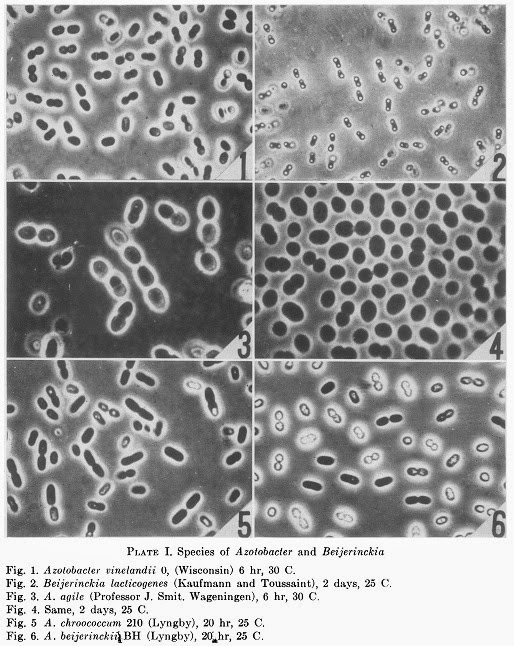
374 - The Azotobacteriaceae

This was a very interesting review of the Azotobacter family from more than fifty years ago. It was interesting to see observations in this paper that I had made myself in my own research.

It discusses the taxonomy of Azotobacter somewhat: the genus includes A. chroococcum, A. beijerinckii, and A. vinelandii of course, and A. agile (which I'm not sure is considered a real separate species now); other alleged species (A. indicum for example) seemed like they should be separated into another genus, Beijerinckia. A. chroococcum was the first, discovered by Martius Beijerinck in 1901.

Characteristic features of Azotobacter are their large size, short thick rod-shaped cells (often found in pairs), nitrogen fixation (despite being obligate aerobes), and poor growth on digestions of meat extracts and such, like LB (something I've noticed myself). The cells change shape depending on their conditions though, which can be confusing. Worse, they can be difficult to isolate from contaminating strains. They also form resistant, dormant cysts in some conditions, though I don't think I've observed this personally. They also can form storage granules of different kinds which are observable under a microscope.

They're pretty versatile in their ability to use different carbon compounds. They can use alcohols (ethanol, propanol, butanol, etc), organic acids (acetate, citrate, butyrate, etc), and saccharides (glucose, fructose, galactose, sucrose, etc.). This depends on the species and strain somewhat; some seem to be able to use lactose, others not. Some can use starch and some other polysaccharides. Some can even use cyclic compounds (benzoic acid, phenol, salicylic acid) which are generally toxic. There are some things they can't use, such as xylose, methanol, and formic acid. Their respiration rate can be very high, the highest observed in nature (at that time, at least).

Their versatility regarding nitrogen compounds seems to be lower though. They can fix nitrogen, of course, and use basic inorganic forms (ammonia, nitrate) and some common organic forms (urea, glutamate, asparagine), but otherwise are limited. So they don't grow well on complex forms such as protein digestions (peptone, tryptone).

Otherwise, as represented in Burk medium, they need phosphorus, sulfur, potassium, calcium, magnesium, iron (amount depending on whether they were fixing nitrogen), and of course molybdenum or vanadium helped when fixing nitrogen too. Other trace elements or vitamins seem unnecessary, at least in many conditions.

The review suggests that azotobacters can produce compounds that stimulate or inhibit plant roots; I wonder if that is true.

The organisms are obligate aerobes, of course, capable of tolerating very high levels of oxygen, especially when not fixing nitrogen. They're mesophiles, preferring around 30ºC. Preferred pH depends on the strain, but around 6-8 is typical.

Some have actually reported that the weather can affect their growth, especially high-pressure areas, but this hasn't been confirmed.

Many have noticed that azotobacters seem to mutate fairly frequently; this is probably due to transposons and natural competence.

How much nitrogen do azotobacters actually fix in soils? It's hard to tell, of course, because it depends on many things and it's hard to measure the contribution of a single genus in such a complex environment, so it couldn't be said.
Jensen, 1954
Reference:
Jensen, H. L. The Azotobacteriaceae. Bacteriol. Rev. 18, 195–214 (1954).

Thursday, March 5, 2015

024 - Essential metals for nitrogen fixation in a free-living N2-fixing bacterium: chelation, homeostasis and high use efficiency

The molybdenum (Mo) nitrogenase in Azotobacter is preferred, of course, but molybdenum is not always easy to find, especially in nature. Vanadium and iron are more common and available, so the V and Fe nitrogenases probably see regular use.

What They Wanted to Know
J.P. Bellenger and colleagues had already showed how bacteria capture and take up the metals they need with metallophores and transporters, but they wanted to figure out how much of each metal the organisms actually need.

What They Did
They studied A. vinelandii strain CA as a wild-type, and several mutants with various nitrogenases deleted: CA1.70 only has the Mo nitrogenase, CA11.70 only the V, and RP1.11 only the Fe. They also tested A. chroococcum.

They grew these with all the nutrients they needed except nitrogen and with varied concentrations of Mo, V, or Fe, measuring growth rate (by optical density), metallophore production, nitrogen fixation (by acetylene reduction and 15N uptake), intracellular metal/phosphorus, short-term metal uptake (with metal heavy/radioactive isotopes), nitrogenase gene expression (by RT-qPCR of nifD and vnfD), and actual nitrogenase protein levels (by Western blot on NifH).

What They Observed
Growth Rates
Not surprisingly, growth rates for each mutant were lower when given sub-optimal amounts of the metals they needed to fix nitrogen (Fe and sometimes Mo or V). But instead of an exponential growth phase in the curve like one expects, they saw initial fast growth, then a second phase of slower growth before stationary phase. Growth rates were also proportional to intracellular metal levels and nitrogen fixation.

For optimal growth, the Mo-only mutant needed 10-7 to 10-6 M Mo initially. The same was true of V and Fe. Levels higher than that seemed somewhat toxic, but extra Fe helped reduce that effect.

Growth rates of the V-only mutant maxed about 15% less than Mo-only (0.23 vs. 0.27 h-1). Fe-only only got up to 0.12.

Metallophores and Metal Uptake
A. vinelandii produces azotochelin and protochelin to bind useful metals and make them easier to obtain. The authors observed that at the highest Mo/V concentration, these metallophores were much more concentrated (possibly to reduce the metal toxicity). These are produced mostly during early exponential phase (which makes sense).

Though actually, measuring V uptake rates with V either free or bound to metallophores, they found that bound V uptake is slower than uptake of free V. This could be intentional (in a non-anthropomorphic sense); that is, differentially regulated. The maximum rate is always found in intermediate concentrations though. Rates for bound V are very slow at high V levels.

It seemed like intracellular levels of each metal didn't have much effect on levels of other metals; they were mainly regulated based on concentrations in the environment. A. vinelandii keeps taking up Mo as long as it is available (A. chroococcum stops at a much lower value though). This matches with other research on A. vinelandii (014).

With V, A. vinelandii levels increase up to a plateau in intermediate concentrations, but at higher concentrations the levels increase beyond the plateau. Similar with Fe, except Fe-only mutants might have a higher plateau than others. Which makes sense.

Metal Levels and Growth/Nitrogen Fixation
In wild-type A. vinelandii, when growing with V and limited amounts of Mo, the cells start by taking up Mo and growing constantly; when outside Mo runs out, they start taking up V. When that is depleted, the growth rate slows down.

Correspondingly, V-nitrogenase gene expression starts up when Mo runs out, though not all Mo-nitrogenase genes necessarily stop expression at that point.

And finally, overall nitrogenase protein levels stay fairly constant until both Mo and V run out, and then they rise a lot.

What This Means
The two phases can be explained this way: after all the necessary metals have been taken up, no more functional nitrogenase can be made, but what's already there can still fix nitrogen, so the cells can still produce biomass but not at maximum capacity. It's like if you have a big factory that can hold 50 assembly lines but you only have enough equipment for 20; you still produce, but not at your maximum.

The rise in nitrogenase levels after Mo and V run out could indicate that the cells produce extra iron-only nitrogenase when necessary because it will take extra to fix as much nitrogen as they were fixing before, since it's less efficient. That's an interesting, clever regulatory effect, though it isn't entirely clear that's what's happening.

At lower metal concentrations, metallophores seem important in part because they allow the cells to capture metals and make them more available, but also because they make metal uptake easier to regulate so they don't become toxic. This isn't as easy at high levels, as shown by lower growth rates.

The molybdenum and vanadium toxicity could be due to inhibition of iron uptake, causing limitation; the observation that more iron helps alleviate toxicity supports this hypothesis. On the other hand, they didn't really see a drop in iron levels in lower-iron conditions.

They saw Mo storage, but strangely not Fe storage, despite A. vinelandii seeming to have iron-storing mechanisms. It could just be the growth conditions (exponential, nitrogen-fixing).

Overall, it's a lot of data about a pretty complex system. I liked this quote from the conclusions:
"Azotobacter vinelandii thus seems to be well adapted for diazotrophic growth in a soil environment where low availability, large spatiotemporal heterogeneity and strong competition may contribute to metal limitation."

Reference:
Bellenger, J.-P., Wichard, T., Xu, Y. & Kraepiel, A. M. L. Essential metals for nitrogen fixation in a free-living N2-fixing bacterium: chelation, homeostasis and high use efficiency. Environ. Microbiol. 13, 1395–1411 (2011).

Wednesday, January 7, 2015

021 - Nitrogen fixation system of tungsten-resistant mutants of Azotobacter vinelandii

People had known at this point that tungsten was poisonous to nitrogenase in Azotobacter vinelandii. It seemed to replace molybdenum in the primary nitrogenase, rendering it non-functional for nitrogen fixation. But then Paul Bishop and colleagues discovered some strains that could grow in the presence of tungsten, using alternative nitrogenases (001). So Riddle and colleagues wanted to characterize such strains and their weird nitrogenases.

What They Did
The scientists first isolated some tungsten-tolerant mutants of their own. This is pretty simple; just grow cells (in this case, A. vinelandii ATCC 12837) in the presence of tungsten, and some tolerant mutants are likely to grow. They chose one and called it WD2 (for Tungsten-Derived 2). For some reason they grew their bacteria at 35ºC, which seems odd because usually Azotobacter is grown at 30ºC, but whatever.

Then they confirmed WD2's ability to grow and fix nitrogen in the presence of tungsten, compared to the parent, did acetylene reduction assays to measure nitrogenase activity, and ran 2-D gels to compare proteomics of the cells in different conditions. Finally they used electron spin resonance (ESR) and other tests to see the chemical characteristics of the cells' enzymes.

What They Observed
They compared the growth of the wild-type and WD2 in broth with or without tungsten. WD2's growth in tungsten was in between the growth of the wild-type in tungsten-free broth and the wild-type in broth with tungsten. Wild-type with tungsten didn't grow hardly at all, as expected. So tungsten inhibits WD2's growth a little bit, compared to the wild-type. To be fair, the amount of tungsten they used was 1000 times more than the minimum needed to inhibit nitrogen fixation in the wild-type.

Then they grew WD2 with various combinations of Mo and W. The growth curves were all pretty similar, not clearly significantly different, but the one with Mo and no W grew best and the one with W and no Mo was worst. Others were in between as expected (more Mo = better, more W = worse), so it seems like a good trend.

They measured acetylene reduction (as a proxy for nitrogen in nitrogenase activity assays) with the wild-type and WD2 (with tungsten), with various concentrations of acetylene in the atmosphere. In each case, activity (as measured by ethylene produced) was highest early in the exponential growth phase. It was not clear (to my eyes) that different amounts of acetylene or the different strains had significant effects on activity. It seemed like perhaps the higher concentrations permitted more activity later in the growth phase. WD2 in W broth showed only 17% the activity of the wild-type in regular broth.

2-D gels showed different profiles for WD2 in regular Burk broth vs. broth with tungsten, though it's always tough to interpret gel images on their own (as two of the same rarely look alike). It did seem like WD2 and the wild-type with ammonium showed similar profiles, and WD2 with tungsten or even with Mo was different, indicating different proteins for tungsten-tolerant nitrogen fixation. ESR spectra of the different proteins were different too.

With heat-extracted proteins from Mo-grown wild-type or W-grown WD2 cells, the wild-type had about 1 nmol Mo per mg protein, whereas WD2 had negligible, but had 18 nmol W. Acetylene reduction activity was much different too: wild-type had more than 10x the activity of WD2, at least in terms of ethylene produced. Spectra were very different too, especially in the band associated with the Mo-iron cofactor.

What This Means
Overall, WD2's results seem to agree with those of others (001), that mutants of wild-type A. vinelandii can fix nitrogen and grow in the presence of tungsten. And the 2-D gels apparently look similar between these two groups of researchers.

Some of the results (growth curves with different Mo:W ratios) seem to indicate that WD2 was using Mo even when tungsten was present. Others (2-D gels) seemed to indicate otherwise.

Based on the acetylene reduction assay, cells might have lower affinity for acetylene later in their growth phase.

Not much new, but it corroborates some data.

Reference:
1. Riddle, G. D., Simonson, J. G., Hales, B. J. & Braymer, H. D. Nitrogen fixation system of tungsten-resistant mutants of Azotobacter vinelandii. J. Bacteriol. 152, 72–80 (1982).

Wednesday, November 5, 2014

013 - Molybdenum-independent nitrogenases of Azotobacter vinelandii: a functional species of alternative nitrogenase-3 isolated from a molybdenum-tolerant strain contains an iron-molybdenum cofactor

What They Wanted to Know
Pau et al. knew that Azotobacter vinelandii had three versions of nitrogenase, including one with no heterometal (Mo or V), only iron. All of these had similar requirements for energy and conditions. They're all similar in structure too, except that the alternatives both have an extra subunit.

So Pau and colleagues wanted to purify the iron-only dinitrogenase from A. vinelandii and analyze its structure and such.

What They Did
They used a strain of A. vinelandii with the genes for Mo and V nitrogenases deleted, so the only one it could produce was the iron-only one. Since this strain couldn't fix nitrogen in the presence of Mo (it represses the alternatives), they selected for a mutant that didn't have this limitation: RP306. They grew large amounts of this strain (in a 400-L fermenter) and purified the nitrogenase from it. Then they analyzed the enzymatic activity and chemical structure of protein and metallic cofactor.

What They Saw
The parent of strain RP306 couldn't grow by fixing nitrogen when molybdenum (Mo) was higher than 5nM in the medium, but RP306 actually grew better as Mo increased, up to 20nM.

Since the V nitrogenase has an extra subunit (δ) encoded by the vnfG gene, and the Fe nitrogenase has a homologous gene, anfG, Pau et al. thought that it might encode a δ subunit also. So they analyzed the subunits of the dinitrogenase with SDS-PAGE, and did indeed see a third small subunit as expected, whose amino acid sequence corresponds to the sequence of the anfG gene.

In terms of metal content, the dinitrogenase seemed to have about 24 atoms of iron and 18 of sulfur, which corresponded well to previous work. Not surprisingly, it had negligible V, but surprisingly it had 1 atom of Mo. So they analyzed it with electron paramagnetic resonance or EPR spectroscopy, which gives different curves depending on the chemical composition, and it seemed like the iron-only nitrogenase actually had a Mo-containing cofactor! Though it seemed like only one of the two cofactors in the dinitrogenase contained Mo. They were able to extract this cofactor, observed that it had a Mo-to-Fe ratio of 1:4.3, and could insert into a cofactor-less Mo nitrogenase from Klebsiella pneumoniae and make it active.

This Fe dinitrogenase with a Mo cofactor could reduce acetylene, but only to ethylene, not to ethane like regular V and Fe nitrogenases could produce. This activity, or any other, was only present when the enzyme was paired with the iron-only version of dinitrogenase reductase, not with the other versions.

With other substrates (N2) or no substrate (just argon), this Fe nitrogenase didn't perform as well as the Mo nitrogenase. With argon, it produced 350 nmol hydrogen per minute per mg of enzyme, compared to 2220 from the Mo version; with nitrogen, it produced about 100 times less ammonia than the Mo version, but twice as much hydrogen as ammonia. This is about 4 times as much as expected from the Mo version, which produces one hydrogen per nitrogen fixed. So about 57% or 4/7ths of its electron flux goes to hydrogen, compared to 25% of the Mo nitrogenase's. They also saw some ethane produced from acetylene somehow, especially when the ratio of dinitrogenase reductase to dinitrogenase was higher; at least half the electron flux went to ethane.

What This Means
Apparently the allegedly iron-only nitrogenase can incorporate Mo-containing cofactor, at least partially, and this affects its activity. I wouldn't expect this to happen much in nature, since in the presence of Mo the Fe nitrogenase wouldn't be produced, so it's not clear what this really means in terms of enzyme activity. It seems important to exclude Mo from the medium when studying the real activity of the Fe nitrogenase though.

From other results, it seems like the cofactors, despite their differences in metal content, can substitute for each other in the holoenzymes, though the resulting activity changes (not surprisingly). The cells rely on regulation of genes that produce the proteins and cofactors to keep things running the way they should be, rather than specificity of cofactor for protein. But it's probably usually not disastrous if there are a few mix-ups. The activity is best with the right match, but it still works somewhat with some mismatches.

Citation: Pau, R. N., Eldridge, M. E., Lowe, D. J., Mitchenall, L. A. & Eady, R. R. Molybdenum-independent nitrogenases of Azotobacter vinelandii: a functional species of alternative nitrogenase-3 isolated from a molybdenum-tolerant strain contains an iron-molybdenum cofactor. Biochem. J. 293, 101–107 (1993).

Wednesday, October 30, 2013

025 - Siderophores Produced by Nitrogen-Fixing Azotobacter vinelandii OP in Iron-Limited Continuous Culture

One thing that's noteworthy about A. vinelandii is that when growing on agar plates or broth tubes of the medium commonly used for it (Burk's), after a certain time it produces this neon green pigment that diffuses through the medium. It's neon green under white light, but under ultraviolet light it fluoresces light blue!

This colorful feature is due to a molecule called a siderophore, which the bacteria secrete to scavenge (i.e. chelate) insoluble oxidized iron in the medium and bring it into the cell. Iron is an important element for A. vinelandii, especially for fixing nitrogen; all of its nitrogenases require it.

In the present study, the researchers wanted to find out how A. vinelandii responds to insufficient iron in its environment, and the function of proteins and compounds it produces. They used continuous culture to do this, analyzing steady states at different concentrations of iron.

The scientists grew A. vinelandii strain OP (aka CA) not with Burk's but with a medium called B6, which also works I guess. Obviously this didn't always include the same amount of iron that it normally contained. They actually cleaned their medium vessels and reactor with EDTA (a chelator that binds tightly to metals) to get rid of all traces of iron.

So they grew OP at four different concentrations of iron, and at steady state for each concentration, measured the concentration of cells (dry weight), quantities of different potential chemical siderophores (extraction and separation by electrophoresis), and quantity of yellow-green fluorescent protein (fluorescence measurement). They also measured the total amount of chelated (bound) metals from all the siderophores.

What they saw was not surprising: at higher levels of iron, there was a higher concentration of cells in the culture and a lower amount of chelation going on. This makes sense because the more iron there is, the less need there is for the bacteria to produce special chelators to scavenge it. The numbers they got were very consistent, differing only about 5% even between different chemostat runs.

Regarding the levels of specific siderophores, one was clearly the predominant one compared to the others. This one went down dramatically as iron increased, dropping all the way to zero when iron was sufficient; the others dropped also but still had low levels even in iron-sufficient conditions.

A few other things to note is that, according to the authors, the lack of fixed nitrogen in the medium prevented contamination of the chemostat, and since the reactor was made of Teflon, no bacterial growth built up on the walls (which presumably would happen on a different material).

So this study shows pretty well which siderophore is important for iron scavenging in A. vinelandii, and that iron deficiency (in nitrogen-fixing conditions at least) impairs its growth.

Citation: Fekete, F. A., Spence, J. T. & Emery, T. Siderophores Produced by Nitrogen-Fixing Azotobacter vinelandii OP in Iron-Limited Continuous Culture. Appl. Environ. Microbiol. 46, 1297–1300 (1983).

Tuesday, October 22, 2013

023 - Genome Sequence of Azotobacter vinelandii, an Obligate Aerobe Specialized To Support Diverse Anaerobic Metabolic Processes

One good way to learn a lot about a bacterial species, or at least to get a lot of hints about what it might do or be capable of doing, is to sequence its genome. So that's what a bunch of people decided to do with Azotobacter vinelandii. It makes sense, since this organism is one of the better-studied ones and has interesting capabilities, such as nitrogen fixation.

The strain they chose was called DJ, a variant of the wild-type strain CA. DJ is supposed to be easier to manipulate genetically than its parent. So they sequenced its entire genome, but focused mainly on the surprising amount of oxygen-sensitive enzymes they found in an obligately aerobic organism.

The method of sequencing, for those who care, was plain shotgun Sanger dye-terminator sequencing after generating a clone library. (Apparently, for some reason, Monsanto did a lot of the work.) I guess this was before the next-generation sequencing technologies were available or affordable. And teams of undergrads did much of the work labeling genes and such.

Overall, the genome is pretty similar to that of pseudomonads, especially Pseudomonas stutzeri (another nitrogen-fixing soil microbe). Some of their genes have been rearranged compared to each other, though, and A. vinelandii has almost 1,000 more genes.

In terms of energy-generating systems, A. vinelandii's genome has all the genes needed for aerobic metabolism but seems to lack any complete system for anaerobic respiration or fermentation. It is well-equipped for aerobic respiration though, which it seems to use to consume large amounts of oxygen that would otherwise damage its nitrogenase and other enzymes. The other mechanism it has to protect its nitrogenase is called the FeSII or Shethna protein, which can temporarily deactivate the nitrogenase when oxygen is too high, protecting it from damage.

The sequence showed the precise location of each set of nitrogenase genes relative to each other. They're somewhat spread out. It also located the mod genes for molybdenum (Mo) transport and the hox genes of the uptake hydrogenase (which are pretty close together). Though it turns out there is a second set of genes similar to the original mod operon elsewhere in the genome, that may be a second Mo transport system. Possibly even a third set right next to the first, but it's not certain what it does.

Somewhat interesting is a set of genes that are similar to something called carbon monoxide dehydrogenase (CODH) that is present in some anaerobic organisms. This can convert CO to CO2 and H2, effectively using it as an energy source instead of something toxic. But it's not certain whether this is functional in A. vinelandii at all. It may be related to some genes that seem to be related to soluble hydrogenases in other organisms, but their function isn't clear either.

A. vinelandii, some strains of it at least, is well-known for producing certain polymers: polyhydroxybutyrate (PHB), which can be used to make a kind of bioplastic; and alginate, and kind of mucusy stuff that has various uses too. The strains that make alginate are rather slimy and hard to work with, and supposedly this provides a further barrier against oxygen poisoning, but strains CA and DJ don't make it, and this sequence revealed why: a transposon inserted itself in the middle of a regulatory gene, inactivating it. That's all it takes.
The genes for PHB synthesis seem to be intact though.

Knowing the sequence of an organism is very helpful; if you want to check for new capabilities, you can just check the genome. So this is a good study.

Citation: Setubal, J. C. et al. Genome Sequence of Azotobacter vinelandii, an Obligate Aerobe Specialized To Support Diverse Anaerobic Metabolic Processes. J. Bacteriol. 191, 4534–4545 (2009).

Tuesday, October 15, 2013

020 - Comparative characterization of H2 production by the conventional Mo nitrogenase and the alternative "iron-only" nitrogenase of Rhodobacter capsulatus hup- mutants

As I've mentioned before, hydrogen gas is a byproduct of nitrogen fixation (which makes sense; nitrogenase adds protons and electrons to N2 to form NH3, and in the process some protons and electrons stick to each other, forming H2. And the different kinds of nitrogenase have different efficiencies—that is, different proportions of protons and electrons that come off as hydrogen instead of actually useful stuff. The molybdenum-containing nitrogenase is most efficient, with one H2 per N2 fixed, and the others have higher ratios.

So this study intended to compare different nitrogenases to find out how much hydrogen they produced. It was done with Rhodobacter capsulatus, not Azotobacter, but the enzymes are similar. R. capsulatus is a type of phototrophic bacterium that possesses the primary Mo nitrogenase and also the iron-only alternative, as well as an uptake hydrogenase.

In order to get around the confounding effects of an uptake hydrogenase, which would significantly reduce the amount of measurable hydrogen given off by all nitrogenases, the scientists used a hydrogenase-negative strain they had generated using a transposon (jumping gene). Besides this strain and its parent, they had a strain with the Mo nitrogenase and Mo transport genes deleted (so it could use only the iron nitrogenase), and a hydrogenase-negative mutant of this strain.

The strains were each grown in broth and then exposed to an atmosphere of argon or nitrogen, sometimes mixed with acetylene or oxygen. The purpose of argon is that, when the nitrogenase enzyme lacks any other substrate (nitrogen, acetylene, etc), it will still work but just devote all its protons and electrons to producing hydrogen gas, producing a lot more than in any other condition. Adding acetylene measured the enzyme activity converting acetylene to ethylene (and a little ethane too, in the case of the iron nitrogenase), and adding oxygen measured its effect on the enzymes. Then after some time for the reaction to occur, concentrations of ethylene, ethane, and hydrogen in the headspace were measured.

In an argon atmosphere with nothing else, the hydrogenase-negative Mo nitrogenase strain produced the most hydrogen. In the parent strain that was hydrogenase-positive, the hydrogenase consumed about 1/4 the hydrogen produced. The hydrogenase-negative strain using the iron nitrogenase produced about 1/2 the hydrogen of the top producer, and when present, hydrogenase consumed about 1/2 its hydrogen, resulting in 1/4 the amount of the top producer. So like this:

Under argon:
  • nif+ hup-: 100%
  • nif+ hup+: 75%
  • nif- hup-: 50%
  • nif- hup+: 25%
This may seem odd because the iron nitrogenase is supposed to produce more hydrogen (relative to other substrates), but that is not the only difference between the enzymes; the Mo nitrogenase's rate of production (productivity) is also higher, such that it produces more of any product in a given time. Since these reactions were measured after 1 hour, the Mo nitrogenase was able to produce more hydrogen in that time than the alternative, though they might have produced the same amount (or the iron version more) if allowed to consume all their substrate.

The story of hydrogen production is somewhat different in a nitrogen gas atmosphere:
  • nif+ hup-: 62%
  • nif+ hup+: 5%
  • nif- hup-: 100%
  • nif- hup+: 3%
Not surprisingly, when nitrogen is present for the enzymes to fix, the alternative nitrogenase produces a lot more hydrogen than the Mo nitrogenase. However, even in the hydrogenase-negative iron nitrogenase strain's case, the hydrogen produced is a bit more than 1/4 of that produced by the top producer under argon. When hydrogenase is present, it is able to consume most of the hydrogen. Similar results are obtained when acetylene is added to an argon atmosphere.

When acetylene was added, the hydrocarbon results were as expected also. Presence or absence of hydrogenase didn't make much difference regarding ethylene and ethane produced. Mo nitrogenase produced much more ethylene than iron nitrogenase, and hardly any ethane; while the iron nitrogenase produced about 17 times more ethane than the Mo nitrogenase, and 11 times less ethylene. Total products for Mo nitrogenase were also about 11 times more than for iron nitrogenase. More efficient, I say.

In terms of protons and electrons, these results suggest that 80% of Mo nitrogenase's electrons go toward nitrogen fixation (that is, 1 hydrogen for every nitrogen fixed, as I said), but only 45% of the alternative's electrons (so, it makes 3-4 hydrogens for each nitrogen).

Oxygen had different effects on the different enzymes also. In the hydrogenase-negative strains, higher levels of oxygen inhibited each, but the alternative nitrogenase's activity dropped to below 40% with very small increases in oxygen levels, whereas the decrease in Mo nitrogenase activity was almost linear with increasing O2, retaining as much activity as the alternative at more than five times the level of oxygen. So the iron nitrogenase seems to be about 4 times more sensitive to oxygen. Understandably alternative.

So, at least in this species, the iron nitrogenase is 3-4 times less efficient in terms of electrons going to hydrogen, about 11 times slower, and 4 times more sensitive to oxygen than the Mo nitrogenase.

Citation: Krahn, E., Schneider, K. & Müller, A. Comparative characterization of H2 production by the conventional Mo nitrogenase and the alternative ‘iron-only’ nitrogenase of Rhodobacter capsulatus hup- mutants. Appl. Microbiol. Biotechnol. 46, 285–290 (1996).

Thursday, October 10, 2013

017 - Mo-independent nitrogenase 3 is advantageous for diazotrophic growth of Azotobacter vinelandii on solid medium containing molybdenum

Everyone now knows that Azotobacter vinelandii has three nitrogenases, and that the Mo-containing one is the best. The iron-only nitrogenase is the least efficient but requires the fewest different metals (only iron, obviously, compared to iron plus another for the other two). But does A. vinelandii ever encounter situations in nature where it can't find molybdenum? It seems likely.

In this study, the scientists tested the difference in nitrogen fixation between cells growing on agar plates and cells growing in liquid broth. This is important because in liquid, nutrients are constantly being mixed and cells can all experience the same concentration of them, pretty much; whereas on agar, nutrients don't move around much (they're trapped in the gel) so the concentration around the bacteria decreases as cells use them up.

They tried growing two strains, wild-type CA and strain CA70 which lacks the genes for the iron-only nitrogenase, to see if one or the other grew more quickly on each type of medium. It turned out that, with the same total concentration of Mo in each, on agar CA outgrew CA70 more and more over time, while in liquid the numbers of cells of each strain remained about the same. And when they tested the strains on agar with different concentrations of Mo, CA outgrew CA70 more and more the lower the concentration of Mo was.

To confirm this, they used a strain (CA73) that had a fusion between anfH (one of the iron nitrogenase genes) and lacZ (makes an enzyme that can break down a compound into color, used to determine amount of a gene produced). They tested this on agar or in liquid with different concentrations of Mo, and found that expression of anfH was much higher on agar than in liquid for mid-range concentrations of Mo (on the low end, A. vinelandii expressed anfH in both conditions, while on the high end, it didn't need to express anfH in either).

Finally, they used a 2-D gel to confirm the presence of iron nitrogenase subunits.

So it seems that, when A. vinelandii is growing on agar, it can sometimes deplete the Mo present in the agar to the point that it needs to switch over to use the iron nitrogenase. In the soil, where A. vinelandii is found naturally, it is probably a common occurrence to encounter areas of low Mo and have to switch.

Citation: Maynard, R. H., Premakumar, R. & Bishop, P. E. Mo-independent nitrogenase 3 is advantageous for diazotrophic growth of Azotobacter vinelandii on solid medium containing molybdenum. J. Bacteriol. 176, 5583–5586 (1994).

Wednesday, October 9, 2013

015 - Characterization of genes involved in molybdenum transport in Azotobacter vinelandii

It is known that molybdenum (Mo) represses A. vinelandii's alternative nitrogenases, at least in the wild-type. What is not exactly known is the mechanism of this repression. Concentrations of Mo as low as 10 μM repress the alternatives, but some strains (such as CA6) produce the alternatives even with high concentrations of Mo. The question is, is this because Mo is not being transported into the cell, or because the protein that represses the alternatives is not functioning properly somehow?

So in the current study, they took a strain of A. vinelandii that can't make the primary nitrogenase but still represses the alternatives when Mo is present, and created mutants using a transposon, Tn5, then grew it on medium with Mo but without nitrogen, so that only those that had a mutation in a relevant gene could grow. And they found two Tn5-induced mutants, and also some that had mutated spontaneously to be able to grow in such conditions.

They named the two transposon mutants FL2 and FL4, focusing on them because the transposon insertion allowed them to locate and study the genes of interest. The mutants could grow pretty much just as fast with Mo present as the parent strain could grow with Mo absent (though these rates were all somewhat slow because they all needed to use the alternative nitrogenases, which are less efficient). Actually FL4 grew a bit faster than the parent.

They isolated and sequenced the section of the genome that the transposons had inserted themselves into, and it turned out that it was the mod operon that I've discussed before (012). FL2 had an insertion in modE, the regulatory gene, and FL4 had an insertion near the end of modB. So it seems like these genes are important for Mo-induced repression of alternative nitrogenases.

Citation: Luque, F., Mitchenall, L. A., Chapman, M., Christine, R. & Pau, R. N. Characterization of genes involved in molybdenum transport in Azotobacter vinelandii. Mol. Microbiol. 7, 447–459 (1993).

Monday, October 7, 2013

014 - Molybdenum accumulation and storage in Klebsiella pneumoniae and Azotobacter vinelandii

Since the primary nitrogenase of Azotobacter vinelandii (and other nitrogen-fixing organisms) is so dependent on molybdenum (Mo), such that they turn off expression of the nitrogenase in the absence of Mo, I thought it worthwhile to read about A. vinelandii's system for storing Mo. Klebsiella pneumoniae, another well-studied nitrogen-fixing soil organism (given its intimidating name because it is an opportunistic pathogen, I think), is used as a comparison.

Previous research had shown that A. vinelandii takes up and stores Mo continuously when it is present, whether or not the bacteria need to fix nitrogen. This is a different strategy from other diazotrophs (nitrogen-fixing organisms). In this study, bacteria were starved of Mo but given fixed nitrogen, and then put into media with varying amounts of Mo with or without fixed nitrogen. When fixed nitrogen was absent, nitrogenase activity maxed out at low concentrations of Mo, but the more Mo present, the more accumulated in the cells, much more than needed to make nitrogenase. When fixed nitrogen was present, the cells showed the same pattern of increasing Mo accumulation, though the levels seemed lower.

In contrast, K. pneumoniae seemed not to accumulate any Mo when fixed nitrogen was available, and while it did store Mo when fixing nitrogen, it was more than 10x less than the levels in A. vinelandii in any condition.

The researchers also measured accumulation of Mo over time. A. vinelandii took up 100% of the Mo provided within 1 hour (it was only a low concentration though), but K. pneumoniae didn't even start uptake until 2 hours in, and then took 2 hours to reach only 25% accumulation. Clearly the two organisms have different strategies; Klebsiella's uptake pattern correlated with its nitrogen-fixation pattern.

They tested the effect of oxygen on Mo uptake; oxygen is toxic to nitrogenase, such that K. pneumoniae doesn't fix nitrogen in its presence, and A. vinelandii takes steps to protect its nitrogenase. But A. vinelandii is an obligate aerobe, so it must still fix nitrogen and accumulate Mo in the presence of oxygen. Klebsiella, on the other hand, shuts off its nitrogenase and Mo uptake both when oxygen is present.

Chloramphenicol, an antibiotic that inhibits protein synthesis in bacteria, inhibited K. pneumoniae's Mo uptake too, but surprisingly not A. vinelandii's; the latter actually had more Mo per cell with chloramphenicol than without, because it was unable to multiply, so there was the same amount of Mo divided among fewer cells.

So there must be some protein in A. vinelandii that is able to store lots of molybdenum. Indeed, when transferred to Mo-free medium after accumulating Mo, the bacteria could fix nitrogen at the same rate as when growing in Mo-containing medium, at least for a while. Trying to purify the Mo-containing proteins from each organism, the scientists found that pretty much all the Mo in Klebsiella was contained in the nitrogenase, whereas (depending on the amount available) that only accounted for a fraction of Mo in Azotobacter. There is another protein that is able to store large amounts of the metal, about 14-15 atoms per molecule of storage protein.

As a bonus, they tested A. vinelandii's ability to store tungsten, and found that it was accumulated in the same way as Mo. It's a sneaky element, apparently.

Citation: Pienkos, P. T. & Brill, W. J. Molybdenum accumulation and storage in Klebsiella pneumoniae and Azotobacter vinelandii. J. Bacteriol. 145, 743–751 (1981).

Wednesday, October 2, 2013

012 - Mutational analysis of genes of the mod locus involved in molybdenum transport, homeostasis, and processing in Azotobacter vinelandii

So Azotobacter vinelandii CA6 has impaired molybdenum (Mo) uptake (003). This paper studies the Mo transport system of A. vinelandii, encoded by the mod genes, modEABC. It seems like ModA is a protein that binds Mo outside the cell, ModB brings them inside across the membrane, and ModC powers this process. ModE's role is unknown at this point.

The scientists generated a number of mutant strains of A. vinelandii, knocking out a given gene while also fusing it with lacZ to quantify its expression. They also discovered another mod gene, modG, adjacent to the others but in the opposite strand direction. It looks similar to half of modE, so the protein may have a similar function.

Another enzyme in A. vinelandii that requires Mo is nitrate reductase; the authors measured activity of this enzyme as a proxy for Mo transport activity. The wild-type's activity rises quickly as concentration of Mo in the environment increases, levels off, then rises quickly again at higher concentrations (supporting the idea of two different Mo transport systems). With mutants of modA, modB, and modC, the pattern was always the same: no activity until the concentration reached a certain point (the same point when the wild-type's activity started rising quickly the second time).

Other results were more puzzling: when modE was knocked out in a way that didn't inhibit expression of the other mod genes, it seemed to have good transport activity at lower Mo concentrations but not at higher; and the opposite when its knockout inhibited the other genes.
Strain CA11.6, which genetically combined the lack of Mo nitrogenase in CA11 (002) with the tungsten-tolerant phenotype of CA6 (003), showed good Mo uptake at low concentrations but not at higher. When the modB gene was specifically knocked out of CA11.6, there was hardly any uptake activity at any concentration. Considering my own research, it's difficult to say what is going on genetically in these cases.

When modG was targeted for knockout, it looked pretty much the same as wild-type activity, except when both modG and modE were deleted, in which case it showed activity at much lower concentrations even than wild-type. Explain that, science!

They also directly measured uptake of a radioactive isotope of molybdenum (99Mo) in the wild-type and modA or modB mutants. The rate of transport in the wild-type and modB mutant were pretty much constant, though the latter was slower than the former. In the modA mutant though, there was very little transport. They tried adding nonradioactive compounds (Mo, vanadium, sulfate, or tungsten) to compete with transport of radioactive Mo, and found that only Mo and tungsten inhibited radioactive Mo transport by competition. Evidence that the mod genes transport tungsten in addition to Mo.

Lastly, the scientists tested the nitrogen-fixing abilities of mod mutants. With Mo present, nitrogen-fixing growth of modE and G mutants was similar to wild-type. When it was absent, modG knockout grew more slowly and modE more quickly. A double mutant didn't grow hardly at all in either condition, in normal aerobic conditions, but with lower levels of oxygen it grew as well as the wild-type (both very slowly). It could also grow using vanadium (V) and the V-containing alternative nitrogenase.

The conclusions, I suppose, are that modABC are all important for Mo transport, especially at low concentrations. modE's role is not exactly clear, but it may regulate which Mo transporter system is working at a given time (possibly by repressing one and activating the other at low concentrations, and vice versa at high). modG's role is even less clear.

Citation: Mouncey, N. J., Mitchenall, L. A. & Pau, R. N. Mutational analysis of genes of the mod locus involved in molybdenum transport, homeostasis, and processing in Azotobacter vinelandii. J. Bacteriol. 177, 5294–5302 (1995).

Tuesday, October 1, 2013

003 - Phenotypic characterization of a tungsten-tolerant mutant of Azotobacter vinelandii

One tungsten-tolerant strain from 001 in particular caught the attention of the researchers. Azotobacter vinelandii strain CA6 just happened to mutate spontaneously to be able to fix nitrogen in the presence of tungsten (W).

Later research showed that A. vinelandii possesses three nitrogenase system, actually: the primary, molybdenum-containing one, and two alternatives: one with vanadium instead of molybdenum, and a third with iron. The third is least efficient, but iron is most likely to be available, so it is the most versatile.

But CA6 was still interesting, because somehow it was able to overcome the repressive effect that molybdenum (Mo) and W have on the alternative nitrogenases. So in order to study it, among other things, the scientists made a number of recombinant strains of A. vinelandii, to test the functions of different nitrogenase genes.

They tried growing wild-type strain CA and mutant strain CA6 with different concentrations of W. All tested concentrations of W inhibited CA, and above 1 μM (0.184mg W per liter) all concentrations inhibited it the same amount. With CA6, however, no amount of W seemed to affect its growth. However, when Mo was present (and no W), CA grew about twice as fast as CA6.

To figure out why, they deleted the genes for the alternative nitrogenases to create strain CA6.1.71 (sounds like software versions, heh). Obviously this couldn't fix nitrogen or grow without Mo present for its primary nitrogenase. But when Mo was present, it could grow just as fast as the wild-type, showing that the difference in growth rate is probably because CA6 wastes its energy producing less efficient nitrogenases instead of focusing on the efficient primary one.

They also made some genetic fusions of nitrogenase genes with a gene called lacZ, which codes for an enzyme that breaks the bond between the two sugar molecules of lactose, resulting in one molecule of glucose and one galactose. The purpose of this is that this enzyme also breaks the bond in a molecule called o-nitrophenyl-β-galactoside (ONPG), which releases a molecule of galactose but also o-nitrophenyl, which is a bright yellow color. So when you add ONPG to liquid containing the enzyme, you can tell how much enzyme is present by how yellow the liquid becomes. And by fusing lacZ to other genes, you can get an idea of how much those other genes are expressed in the cell.

So this way, they found that, in the wild-type strain CA, Mo-nitrogenase genes are expressed when Mo or W are present (not surprisingly), and alternative nitrogenase genes are only expressed when Mo or W is absent. In CA6, the iron-nitrogenase is produced with or without Mo or W; only vanadium represses it. And the vanadium nitrogenase in both is expressed only when vanadium is present. They confirmed these results with 2-D gels (described in 001).
(Side note: vnfH, vanadium dinitrogenase reductase, is expressed in CA whenever Mo or W is absent, whether or not V is present; in CA6, it is always expressed regardless of the metals in question.)

One possible reason for the difference between CA and CA6 is the latter's ability to take Mo into its cells; if its uptake of Mo is impaired, that could result in the observed phenotype. So the scientists tested that. They found that, not only was CA6's Mo uptake slower than CA's, but it ceased to take up more above a certain concentration, whereas for CA, the more that was available, the more CA took up. It seemed like there were two separate Mo-uptake systems, one that worked better in low concentrations and one in higher, and CA6 lacked the latter. However, there was still enough Mo present in CA6 that it should have repressed the alternative nitrogenases, so this explanation didn't quite work; there must be something else. These observations just add to the mystery of A. vinelandii CA6.

Citation: Premakumar, R., Jacobitz, S., Ricke, S. C. & Bishop, P. E. Phenotypic characterization of a tungsten-tolerant mutant of Azotobacter vinelandii. J. Bacteriol. 178, 691–696 (1996).

Monday, September 30, 2013

002 - Nitrogen fixation in molybdenum-deficient continuous culture by a strain of Azotobacter vinelandii carrying a deletion of the structural genes for nitrogenase (nifHDK)

Previously, another study (001) suggested the presence of an alternative nitrogenase system in Azotobacter vinelandii, but it was not conclusive. Another, later study confirmed this hypothesis by creating a strain completely lacking the genes encoding the primary, molybdenum-containing nitrogenase (nifHDK genes), so there's no way that strain could be using the primary nitrogenase. But this strain could still fix nitrogen and grow when molybdenum (Mo) was not present in its environment, so clearly it had to have some kind of alternative enzyme.

So in this study, the scientists wanted to figure out if this alternative enzyme had the same characteristics as the Mo-containing one, and if not, how they differed. And one of the best ways to determine the characteristics of metabolic pathways, such as nitrogen fixation, is to use continuous culture!

Continuous culture is a technique for maintaining cells in a constant state so they keep growing indefinitely. At its most basic, what it requires is a container in which the cells grow, with fresh culture medium (liquid containing all the nutrients the cells need) flowing into the container at a constant rate, while liquid and cells inside the container are constantly being removed at the same rate to keep the volume inside the container constant. If done right, the culture of cells will eventually reach a point when their population density, consumption of nutrients, growth rate, and all other metabolic characteristics all remain constant over time. This is called "steady state." By measuring the characteristics of the cells' metabolism at steady state in one condition (for example, with a high concentration of sugar), and then changing the condition (reducing the concentration of sugar) and allowing the cells to reach a new steady state, measuring the new characteristics, and comparing the two, it is possible to determine how the cells' metabolism works.

In this study, the scientists used continuous culture to grow A. vinelandii strain CA11, the one lacking the genes nifHDK for the Mo nitrogenase. They grew it in Mo-free medium, and used several techniques to confirm that it was indeed still fixing nitrogen (for example, depriving it of N2 gas for a time and observing its lack of growth; or more directly measuring the incorporation of a heavier isotope of nitrogen from 15Ngas).

Then they measured CA11's steady-state characteristics at a number of different dilution rates. Dilution rate is a measure of how quickly new medium is flowing into the culture and old culture volume is being removed, so basically the rate the cells are being diluted. As you might expect, the faster the dilution rate, the more quickly the cells have to grow to maintain their population density; otherwise they would be diluted more and more until none were left. Fortunately, higher dilution rate also means that fresh nutrients are being added more quickly, so growing faster is usually not a problem. But there is a point at which cells just can't grow any faster, called the maximum growth rate, so if the dilution rate is higher than this point, the cells can't keep up, and the population density decreases.

In this study, at different dilution rates, the authors measured the population density in a number of different ways: optical density (how much light passes through a volume of culture; the more densely-packed the cells, the less light passes through, so the higher the optical density); protein content (the amount of protein in a volume of culture; usually correlates with number of cells, but in some conditions cells will have more protein per cell than in other conditions); dry weight (the weight of a volume of culture after all the water is removed; usually correlates well with number of cells, but sometimes fewer larger cells can weigh as much as more smaller cells); nitrogen content (correlates well with protein content, since protein contains nitrogen); and number of colony-forming units (by spreading a known volume of cells onto a nutrient agar plate and counting the number of colonies that grow on the plate, you can get an idea of how many living cells were present in a given volume of culture). They found that with all these measures, there were fewer cells at higher dilution rates, but not much else was noteworthy about the experiment.

In a second experiment, they measured specific activities of nitrogen fixation at the steady states of different dilution rates. Normally, in the wild-type strain, the Mo nitrogenase takes one molecule of N2, converts it to two molecules of NH3, and also gives off one molecule of H2 as a byproduct. There's another enzyme called the uptake hydrogenase that takes the H2 produced by nitrogenase and oxidizes it for energy, similar to how cells oxidize sugar for energy. This recovers some energy the nitrogenase uses, which would otherwise be wasted. Nitrogenase requires a lot of energy, so it's worthwhile.

So the scientists measured the amount of hydrogen produced by CA11 to see if its alternative nitrogenase produced more or less hydrogen than the Mo-containing version. (They could do this because there was a chemical in the medium that happened to inhibit the uptake hydrogenase, so the hydrogen was released into the headspace of the culture vessel.)

They also measured the nitrogen-fixing activity of the nitrogenase more directly, both by measuring amounts of nitrogen and another way called the acetylene reduction assay. Nitrogenase is not a very picky enzyme; its main substrate is two nitrogens connected by a triple bond, but it will also transform most other molecules that consist of two atoms connected by a triple bond, including carbon monoxide and acetylene (C2H2, aka ethyne). So in the acetylene reduction assay, acetylene is added to a container with the enzyme, the enzyme (if present and active) converts it into ethylene (C2H4, aka ethene), which can be quantified to measure the enzyme's activity.

They found that as dilution rate increased, nitrogenase activity tended to increase also, producing more of all products (hydrogen, fixed nitrogen, and ethylene). They knew the hydrogen was produced by the nitrogenase because when they added ammonium (which represses nitrogenase activity; the cells aren't going to waste energy fixing nitrogen if there is already fixed nitrogen available), the hydrogen production ceased. They also found that, at mid-range dilution rates, the alternative nitrogenase produced about three H2 molecules for each ammonia (this ratio decreased at higher and lower dilution rates), which compared to the Mo-containing nitrogenase (1 hydrogen for each ammonia) is less efficient.

The scientists tried adding Mo to see what would happen. They found that, for the wild-type strain that still possessed the Mo-containing nitrogenase, adding Mo made it grow a lot more, but it actually inhibited the growth of CA11.

So it seems that the alternative nitrogenase is less efficient than the Mo-containing one, so the bacteria prefer to use the latter.

Citation: Bishop, P. E., Hawkins, M. E. & Eady, R. R. Nitrogen fixation in molybdenum-deficient continuous culture by a strain of Azotobacter vinelandii carrying a deletion of the structural genes for nitrogenase (nifHDK). Biochem J 238, 437–442 (1986).

Thursday, September 26, 2013

001 - Evidence for an alternative nitrogen fixation system in Azotobacter vinelandii

Azotobacter vinelandii is a well-studied microbe, discovered in 1903. It is most well-known for its nitrogen-fixing abilities (thus its name, "azoto" = nitrogen), the ability to convert nitrogen gas (N2) into "fixed" nitrogen forms, such as ammonia (NH3) and then into useful stuff like protein or nucleic acids. The enzyme that performs this reaction (called "nitrogenase") is almost always sensitive to/inactivated by oxygen, but A. vinelandii has ways of protecting its nitrogenase such that it can fix nitrogen even when oxygen is present; it is an obligate aerobe (i.e. it requires oxygen to grow). So that's the introduction.

In this particular study, the hypothesis was that the well-studied nitrogenase at the time, which contained a molybdenum (Mo) cofactor, was not the only nitrogenase that A. vinelandii possessed. That meant that when Mo was scarce or the enzyme was otherwise inactivated, the bacteria in some circumstances could still fix nitrogen (and, because fixed nitrogen is required for growth, could continue to proliferate) using its alternative enzyme.

In order to test this hypothesis, the researchers had a number of mutant strains of A. vinelandii (the wild-type strain being named CA), some of which couldn't fix nitrogen under some conditions, and others that had other phenotypes. These mutants were called CA1, CA2, etc.

The behavior the scientists were looking for in particular was tolerance to tungsten (W). Tungsten is similar to molybdenum in its atomic structure, just a bit bigger, so it sorta imitates Mo enough that when it's present in large enough concentrations, A. vinelandii incorporates W into its nitrogenase instead of Mo, but this form of the enzyme is unable to fix nitrogen. So the wild-type strain, CA, is unable to fix nitrogen or grow when too much W is present. However, some of the mutant strains could grow.

Another bit of evidence was the observation that all of the strains, even CA, could grow and fix nitrogen when neither tungsten nor molybdenum was present. The scientists used a technique called 2-D (two-dimensional) gels to observe changes in concentrations of all proteins in the cells individually. This process involves separating the proteins based on their polarity first in one direction, then separating them perpendicular to that direction based on their size, so this should allow them to see whether a protein is present in one condition but not in another. Indeed, they observed some proteins that were present only when the cells were fixing nitrogen in the presence of tungsten or absence of molybdenum! These seemed to be the components of the alternative nitrogenase.

So the model the authors propose for regulation of this alternative nitrogenase in the wild-type is, when tungsten or Mo is present, it's turned off (probably because it is less efficient than the Mo-containing nitrogenase, so preference is given to the latter when Mo is present), but when those metals are absent, it's turned on. The mutants can fix nitrogen in the presence of tungsten because somehow the repression of the alternative nitrogenase is not active in them.

So that's interesting. What was not known was the nature of this alternative enzyme, what metal it might contain instead of Mo, how the regulatory mechanisms functioned exactly, or whether the alternative system was completely independent genetically or just a modification of the Mo-containing one. But at least they had good evidence that the alternative exists.

Citation: Bishop, P. E., Jarlenski, D. M. & Hetherington, D. R. Evidence for an alternative nitrogen fixation system in Azotobacter vinelandii. Proc. Natl. Acad. Sci. 77, 7342–7346 (1980).