Showing posts with label A. chroococcum. Show all posts

Monday, July 20, 2015

457 - Hydrogenase and Nitrogen Fixation by Azotobacter

This study looked at hydrogenase in different Azotobacter species (A. vinelandii, A. chroococcum, A. agile whatever that is).

What They Saw
They looked at different kinds and amounts of fixed nitrogen and their effect and different gases in the atmosphere. Many experiments used ammonium phosphate or other forms of ammonium, and they thought maybe the drop in pH seen as ammonium was consumed led to decreased hydrogenase activity, but actually even when they used forms that didn't allow a pH drop, they still saw the same decrease, suggesting that it's the fixed nitrogen itself that leads to decreased activity. Which makes sense.

They found, consistent across species, that ammonium led to the biggest activity decrease, about 60-80%; nitrate as little as 20%; and glutamate hardly at all. I think these cultures were not adapted to these compounds though.

So they tried adapted cultures too. They found that the more fixed nitrogen they added, the less hydrogenase activity they saw. Adaptation didn't matter with ammonium, but cultures adapted to nitrate had more of a decrease in activity. Apparently they didn't test glutamate.

Then they compared cells with various nitrogen sources grown in air or in a hydrogen-oxygen mixture. They didn't test cells without a nitrogen source in this gas mixture though, maybe because they couldn't grow. Anyway, the hydrogenase was always more active in air with no fixed nitrogen than with any kind of fixed nitrogen (as seen before), and with H2-O2 the activity seemed even lower, even than with the same fixed nitrogen source in air. Activity was almost zero in nitrate-adapted cells given nitrate. This seems odd; previous studies seemed to show that hydrogen stimulated hydrogenase activity.

What This Means
I'd say other studies showing stimulation by hydrogen were more convincing, but at least this one was consistent showing an adaptation effect and down-regulation in the presence of fixed nitrogen.

Reference:
Lee, S. B. & Wilson, P. W. Hydrogenase and Nitrogen Fixation by Azotobacter. J. Biol. Chem. 151, 377–385 (1943).

Friday, July 17, 2015

453 - Direct mass-spectrometric determination of the relationship between respiration, hydrogenase and nitrogenase activities in Azotobacter chroococcum

This study looked at hydrogen and its relationship to different enzymatic processes in Azotobacter chroococcum.

What They Saw
The organism was grown in continuous culture with limited oxygen, 5% glucose. Samples were removed and sparged with different mixtures of argon, oxygen, and deuterium. Gases are measured by mass spectrometer.

Their figure is pretty confusing, poorly designed, and poorly described, but as far as I can tell, when they added either 80% argon with 20% oxygen or 70% argon, 20% oxygen, and 10% deuterium, the oxygen goes down to near zero within about 5 minutes either way, at which point hydrogen production starts increasing and deuterium uptake slows down or stops. So it seems like oxygen is required for hydrogenase to work.

They tried again with the addition of some carbon monoxide and acetylene to inhibit hydrogenase. This didn't really change the oxygen consumption, but deuterium consumption was a lot lower. Hydrogen evolution was the same.

What This Means
The deuterium consumption is by hydrogenase, of course, and it seems like oxygen is a necessary electron acceptor for it to function (in the absence of something else). But it seems like the increase in hydrogen evolution is not because hydrogenase stopped working, but rather because nitrogenase started, as oxygen stopped interfering. This is something we've seen before.

Oxygen is important for many things: it provides energy by accepting electrons, powering the nitrogenase and allowing more hydrogen production. It accepts electrons from hydrogenase, enabling hydrogen oxidation. It inhibits nitrogenase, reducing hydrogen production. Pretty confusing.

Reference:

Thursday, July 16, 2015

448 - Hydrogen-deuterium exchange reactions catalysed by nitrogenase

Previous reports suggested that nitrogenase could convert dideuterium (D2) to hydrogen-deuterium (HD) by swapping one hydrogen from water with one deuterium atom. This only happened in the presence of nitrogen. This was tested in various organisms with D2 or D2O as a source of deuterium.

Azotobacter species didn't make HD unless ATP and electrons were present. They actually made less hydrogen and HD with nitrogen than with argon, contradicting earlier findings. 10% CO did inhibit HD formation but not hydrogen formation. Acetylene and methyl isocyanide inhibited HD completely. Cyanide partially or fully inhibited.

There was more exchange with D2O than with D2 for some reason, but this was inhibited more by nitrogen or cyanide.

This seems to have implications for nitrogenase's functions relating to hydrogen.

Reference:
Kelly, M. Hydrogen-deuterium exchange reactions catalysed by nitrogenase. Biochem J 109, 322–324 (1968).

365 - Mechanism of biological nitrogen fixation VII. Molecular H2 and the pN2 function of Azotobacter

They looked at the amount of nitrogen fixed with different concentrations in the atmosphere, in Azotobacter vinelandii and chroococcum cells. They were looking for KN2: the concentration of nitrogen at which the amount of nitrogen fixed is half the maximum.

With inert gases (argon, helium) or with a partial vacuum, the concentration of nitrogen had to get down below 0.15 atm before the fixation decreased much. It gets to 50% around 0.01 atm. But when there was hydrogen, the rate decreased more quickly; the more, the faster. So hydrogen seems to inhibit the nitrogenase, but only at very high concentrations (over 20% of the atmosphere). This inhibition is competitive and reversible.

Reference:
Wyss, O., Lind, C. J., Wilson, J. B. & Wilson, P. W. Mechanism of biological nitrogen fixation VII. Molecular H2 and the pN2 function of Azotobacter. Biochem J 35, 845–854 (1941).

Wednesday, July 15, 2015

362 - Mutants of Azotobacter chroococcum Defective in Hydrogenase Activity

This study isolated some hydrogenase-negative mutants of Azotobacter chroococcum by chemical mutagenesis and looked at how they behaved.

What They Saw
Almost all of the 16 mutants had almost no hydrogenase activity, as expected. Some had a little, <2% of wild-type. Some more had a little hydrogen-producing activity in the right conditions, usually less than 7% of the wild-type, but one had 40% of wild-type. That one also seemed to have a relatively active soluble hydrogenase (possibly the uptake hydrogenase in soluble form). All of them seemed able to take up nickel.

The one weirdest mutant, MCD-124, showed max activity at a different pH (5.5 instead of 8) and was weird in other ways.

Also, the authors were surprised by the frequency with which they could get hydrogenase mutants. They wondered whether the relevant genes were just more susceptible, or if the growth medium was more favorable to mutants somehow, or if there were just that many necessary genes. But judging from the genome sequence, this isn't quite a sufficient explanation.

Overall, it's hard to know exactly what's going on in this study.

Reference:
Yates, M. G. & Robson, R. L. Mutants of Azotobacter chroococcum Defective in Hydrogenase Activity. J Gen Microbiol 131, 1459–1466 (1985).

Tuesday, July 7, 2015

307 - The Relationship Between Hydrogenase and Nitrogenase in Azotobacter chroococcum: Effect of Nitrogen Sources on Hydrogenase Activity

This study looked at the influence of different sources of nitrogen on the activity of nitrogenase and hydrogenase in Azotobacter chroococcum.

What They Saw
They grew cells in batch or continuous culture with sodium nitrate, ammonium acetate or chloride, or dinitrogen gas. Cultures were either carbon- or sulfate-limited. Dissolved oxygen was kept above zero. Nitrogenase activity was measured by acetylene reduction and hydrogenase by methylene blue (or by adding H-T with radioactive tritium and measuring radioactivity of resulting water when oxygen was the electron acceptor).

There was about twice as much hydrogenase activity when cells were fixing nitrogen in batch than when they had either ammonium or nitrate. They cite other results in A. chroococcum and A. vinelandii that showed higher activity with nitrate than ammonium though, but still less than when fixing nitrogen. This might be because cells have to adapt to use nitrate, and they'll be fixing nitrogen before that happens. But care is necessary because activity changes over the course of a batch culture, increasing throughout exponential phase even when standardized by protein concentration.

In continuous cultures, they started growing with ammonium, then switched to nitrogen-free, watched what happened with hydrogenase and nitrogenase, and then pulsed a limited amount of ammonium. As expected, nitrogenase activity started up and rose to a plateau, then immediately stopped when ammonium was added, and restarted when it was removed. Hydrogenase activity showed a similar pattern, though more delayed, and it never went all the way to zero.

In sulfate-limited culture, hydrogenase activity was lower even when fixing nitrogen, about the same as with ammonium in carbon limitation, and when going from fixing to non-fixing (with ammonium), the activity declined a bit but then went back up to about the same level. Results were similar going from non-fixing to fixing. So with sulfate limitation, nitrogen source doesn't matter much.

Also with nitrogen-fixing cells in sulfate limitation, when they increased the dilution rate, hydrogenase activity decreased but nitrogenase increased. The decrease wasn't linear, though; it leveled off.

They also tested whether adding hydrogen to the atmosphere of an ammonium-grown culture would influence hydrogenase activity, and it did! Hydrogenase activity doubled. This was not the case with sulfate limitation though, only carbon limitation. They didn't test nitrogen-fixing cells.

What This Means
The continuous culture experiments helped overcome the constantly changing activity in batch cultures.

That hydrogenase activity lags behind nitrogenase activity increase when ammonium runs out could be explained by the last observation: maybe nitrogenase starts producing hydrogen (as it does) and this stimulates hydrogenase activity.

They reasoned from the data that excess carbon might inhibit hydrogenase activity somehow (like catabolite repression). I'm not sure that makes sense, but it seems possible, and does fit with the data from batch cultures, sulfate limitations, and increasing dilution rates. Interesting.

Reference:
Partridge, C. D. P., Walker, C. C., Yates, M. G. & Postgate, J. R. The Relationship Between Hydrogenase and Nitrogenase in Azotobacter chroococcum: Effect of Nitrogen Sources on Hydrogenase Activity. J Gen Microbiol 119, 313–319 (1980).

297 - The identification, characterization, sequencing and mutagenesis of the genes (hupSL) encoding the small and large subunits of the H2-uptake hydrogenase of Azotobacter chroococcum

And finally, seeming to complete our journey back in time through the discovery of hydrogenase genetics in Azotobacter chroococcum, this study looks at the structural genes, hupSL.

What They Saw
The sequences were similar to A. vinelandii's hoxKG structural genes. They tried knocking each out, then measuring hydrogen oxidation (with methylene blue) and hydrogen production (with methyl viologen). As expected, hydrogen oxidation in mutants was no higher than negative controls. Surprisingly, they did see hydrogen production in the some of the different mutants with a strong electron donor, but it was less than in the wild-type. Only the mutant with an insertion very close to the start of the hupS gene had no hydrogen production.

What This Means
It seems like a fragment of HupS is sufficient to produce hydrogen with a strong electron donor, but not as much as with both HupS and HupL completely intact.

Reference:

Monday, July 6, 2015

296 - The Azotobacter chroococcum hydrogenase gene cluster: sequences and genetic analysis of four accessory genes, hup A, hupB, hupY and hupC

So at this point, hupSL (hydrogenase structural genes) and hupDE (accessory genes at the end of the operon) had already been identified. This study found a few more upstream of hupDE.

What They Saw
They sequenced the DNA upstream of hupDE and found four open reading frames, which they called hupABYC. The AB and C were similar to E. coli genes, but the Y wasn't, so they called it Y (for Ynknown, I guess). These were all homologous to A. vinelandii genes though, and in the same order.

Then they tried knocking out each of these. Each knockout was unable to oxidize hydrogen, even in the presence of methylene blue as an electron acceptor.

They also made a fusion of HupL (the structural subunit) and beta-galactosidase, then knocked out hupY or hupB to see if this changed the expression of hupL. Beta-galactosidase activity rose a little bit, like 25% in each, but it didn't seem either was an important regulator.

Reference:

295 - Sequences, organization and analysis of the hupZMNOQRTV genes from the Azotobacter chroococcum hydrogenase gene cluster

This study focuses on the hydrogenase genes in Azotobacter chroococcum. They had already found hupSL encoding the structural genes (equivalent to A. vinelandii's hoxKG I guess), and then the accessory genes hupABYCDE further downstream (homologous to A. vinelandii's hypABFCDE). Now, in between, are the hupZMNOQRTV genes, completing the 16-gene operon.

What They Saw
This set of genes seems to be homologous to A. vinelandii's hoxZMLOQRTV string, making the whole operon very similar in both organisms.

As in previous studies, HupZ (and its analog, HoxZ) seems to be an electron carrier in the membrane, possibly a cytochrome. When they knocked it out, they observed similar results to 070: hydrogenase could oxidize hydrogen with methylene blue as an electron acceptor, but not with oxygen, so HupZ seems to be part of the transport chain to oxygen.

Based on comparison with homologs in other organisms, HupM may help the hydrogenase attach to the membrane, or with processing the subunits. It's unclear. The other genes may be involved in processing or metal stuff. HupR may be another electron-carrying protein. Further study is required.

Reference:
Du, L., Tibelius, K. H., Souza, E. M., Garg, R. P. & Yates, M. G. Sequences, organization and analysis of the hupZMNOQRTV genes from the Azotobacter chroococcum hydrogenase gene cluster. Journal of Molecular Biology 243, 549–557 (1994).

Tuesday, June 30, 2015

159 - Effect of chelating agents on hydrogenase in Azotobacter chroococcum: Evidence that nickel is required for hydrogenase synthesis

This study used chelating (metal-binding) compounds to study the cofactor of hydrogenase in Azotobacter chroococcum.

What They Saw
All the chelators they added (NTA, EDTA, etc.) decreased the hydrogenase activity in batch cultures, though to different extents. NTA was much stronger than EDTA. The effect was not inhibition of already-formed enzyme (since adding chelators to resting cells or extracts didn't affect activity), so it must be from preventing formation of additional enzyme.

They tried adding trace metal salts along with the chelators to see if pure excess of whatever was missing could restore activity. Copper, zinc, and manganese didn't really do anything. Cobalt helped if it was added in fairly large amounts, but the most helpful was nickel. Adding extra iron boosted this effect even more.

Monitoring nickel uptake by adding radioactive nickel, they saw that cyanide completely wiped out uptake (possibly by binding the nickel), but juglone and 2,4-dinitrophenol enhanced it (despite inhibiting respiration). Sodium azide didn't really affect either. The chelators they tested earlier generally seemed to inhibit nickel uptake too, generally in the same proportions as they had inhibited hydrogenase activity.

What This Means
Chelators seem to inhibit hydrogenase, but rather than acting on the enzyme directly, it seems to be by inhibiting its synthesis, and even this mechanism seems to be by inhibiting nickel uptake in most cases, rather than something more direct. Nickel is important for synthesizing the enzyme; it's a part of its essential cofactor. It seems like cobalt might be able to substitute for nickel somewhat though. I wonder if palladium would work too, since it has similar orbital arrangements. But apparently cobalt doesn't help in the absence of chelators or contaminating trace metals, so maybe it only helped here because it distracted the chelators away from nickel (so to speak).

Reference:

Thursday, May 28, 2015

225 - O2-repression of nitrogenase synthesis in Azotobacter chroococcum

Klebsiella pneumoniae only fixes nitrogen when oxygen levels are very low (or absent), so oxygen represses nitrogenase synthesis. This study looks at whether the same is true in Azotobacter chroococcum; it seems unlikely, since this organism is known for its very aerobic nitrogen fixation; however, it is possible to stress this organism with oxygen such that it may shut down nitrogenase, at least temporarily.

What Robson Saw
He grew A. chroococcum in chemostats with Burk medium with mannitol, with or without ammonium for nitrogen, and stressed them with oxygen either by moving ammonium-grown cells to ammonium-free medium or by suddenly increasing aeration in nitrogen-fixing cells. He looked at levels of nitrogenase proteins (by labeling with radioactive sulfur isotopes) and nitrogenase activity.

At initial low oxygen levels, activity increased and radioisotype-labeled protein levels were relatively high (indicating high levels of nitrogenase protein synthesis). Upon oxygen shock, activity went to zero and protein synthesis levels dropped a lot. When the stress was relieved, both measures increased again.

With ammonium removed and then re-added, things were similar: nitrogenase activity went up and synthesis gradually increased to a plateau, but decreased when more ammonium was added. It did take a relatively longer time for nitrogenase activity to pick up after ammonium was removed, about 80 minutes.

Along with nitrogenase, flavodoxin and the small protein that protects nitrogenase from oxygen by temporarily inactivating it both showed up in radiolabeling. The former matched nitrogenase synthesis patterns, but the latter was fairly constant.

What This Means
It seems that oxygen stress can repress synthesis of nitrogenase even in Azotobacter, though radiolabeling might not be the best method for studying this question. This adds another layer to Azotobacter's protection of its enzymes from oxygen.

Reference:
Robson, R. L. O2-repression of nitrogenase synthesis in Azotobacter chroococcum. FEMS Microbiology Letters 5, 259–262 (1979).

Tuesday, May 26, 2015

213 - Characterization of an oxygen-stable nitrogenase complex isolated from Azotobacter chroococcum

When respiratory protection fails in Azotobacter, it can temporarily inactivate its nitrogenase to protect it, by association with another protein, called FeSII or Shethna. This study purifies this whole complex (nitrogenase and FeSII) and investigates its characteristics in A. chroococcum.

What They Saw
The more pure the nitrogenase, the less protection from oxygen inactivation they observed. But while crude extract had the most protection, more pure forms were pretty similar until the protective FeSII protein was absent, in which case the nitrogenase was rapidly inactivated. Magnesium ions (or possibly other divalent ions) were also necessary for this stabilization.

This protective protein was 14 kDa, orange in color, and had 2 Fe and 2 S atoms, so a 2Fe-2S center (thus the name). This version seems smaller than the A. vinelandii version though, which is 23 kDa. In stable complexes, the three components (dinitrogenase, dinitrogenase reductase, and FeSII) were present in about 1:1:1 ratios.

What This Means
This FeSII (with Mg ions) appears to be sufficient to protect the nitrogenase complex from oxygen, stabilizing it even outside of the cellular environment. This stability is perhaps not complete though, since crude extracts did show more activity after exposure to oxygen.

Reference:

Friday, May 22, 2015

198 - Oxidation of nitrogenase iron protein by dioxygen without inactivation could contribute to high respiration rates of Azotobacter species and facilitate nitrogen fixation in other aerobic environments

This study looks at oxygen interactions with dinitrogenase reductase (DNR) in Azotobacter chroococcum (and Klebsiella pneumoniae) to see if it's possible that the enzyme can be oxidized without being totally inactivated.

When the DNR was present in high enough levels relative to the amount of oxygen (4-fold molar excess), it was protected from inactivation by oxygen: it seemed to reduce superoxides to peroxide (and then water if catalase doesn't get to it first) before the reactive oxygen species could harm it. Superoxide seems to be the harmful form of oxygen for DNR. They suggest this helps with high respiration rates (i.e. consumption of oxygen). They calculated that if 10% of the cell's protein were DNR, it could account for pretty much all of the oxygen consumption. This is unlikely, but it could still be a significant part of respiratory protection. They call this "autoprotection."

Reference:

Wednesday, May 20, 2015

099 - Oxygen and Hydrogen in Biological Nitrogen Fixation

Oxygen is pretty toxic to nitrogen fixation enzymes, so organisms or the people studying them need to take steps to protect them. They lose more than half their activity within minutes exposed to air. The dinitrogenase reductase is more sensitive than the dinitrogenase itself, at least the Mo version. Some can retain some activity even up to an hour in air. But the FeMo-cofactor, when extracted, is even more sensitive than the dinitrogenase reductase. Overall, it seems that the metal-sulfur centers are the most sensitive parts.

And yet, there are nitrogen-fixing species that are obligate aerobes, or even oxygenic. How do they do it?

Azotobacter has been shown to increase its respiration while its growth efficiency decreases as oxygen increases, seeming to waste the oxygen: this has been called "respiratory protection." The mechanism for this is not simple though; it involves carefully regulated shifts in respiratory components throughout the whole catabolic system.

Azotobacter also has the ability to reversibly inactivate its nitrogenase if respiratory protection is not possible (such as in carbon-limited conditions, or upon a sudden increase in oxygen). This seems to depend on FeSII protein (aka Shethna), though it is suggested that there may be other mechanisms.

When oxygen is too high and cells' supply of fixed nitrogen runs out, production of nitrogenase may be regulated (no sense making an enzyme when it can't function). This regulation may be done by the products of nifAL genes.

Azotobacter also produces gummy alginate which might have a role in protection from oxygen, but non-gummy strains (such as CA) have been isolated that don't seem especially oxygen-sensitive. I wonder if they have higher rates of respiration though, or if they might be more sensitive in carbon-limited conditions.

Nitrogenase also produces hydrogen gas, whether or not it's reducing anything else. This reaction seems separate from the nitrogen fixation reaction, since some things can inhibit the latter without inhibiting the former. Acetylene seems to inhibit hydrogen production though. Nitrogen can't compete with hydrogen for electrons completely, even with pure pressurized nitrogen; the enzyme always produces at least 1 mol hydrogen for each mol nitrogen gas fixed.

Of course, this hydrogen usually doesn't just escape; Azotobacter and other diazotrophs recapture it with their uptake hydrogenase. The exact purpose this serves is not clear though.

Reference:
Robson, R. L. & Postgate, J. R. Oxygen and Hydrogen in Biological Nitrogen Fixation. Ann Rev Microbiol 34, 183–207 (1980).

Monday, May 18, 2015

374 - The Azotobacteriaceae

This was a very interesting review of the Azotobacter family from more than fifty years ago. It was interesting to see observations in this paper that I had made myself in my own research.

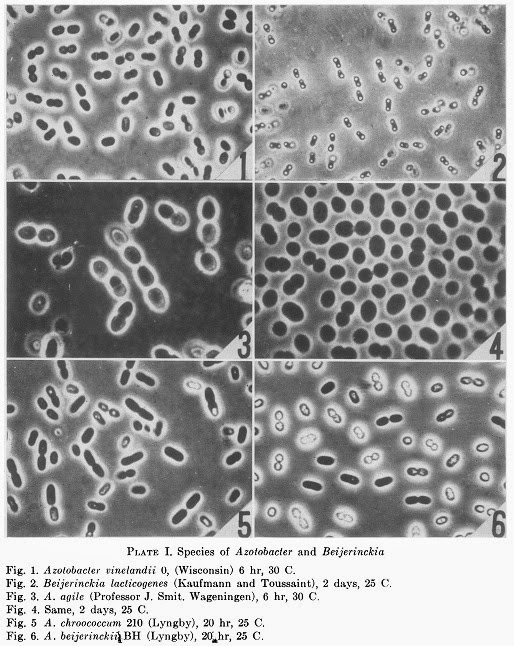
It discusses the taxonomy of Azotobacter somewhat: the genus includes A. chroococcum, A. beijerinckii, and A. vinelandii of course, and A. agile (which I'm not sure is considered a real separate species now); other alleged species (A. indicum for example) seemed like they should be separated into another genus, Beijerinckia. A. chroococcum was the first, discovered by Martius Beijerinck in 1901.

Characteristic features of Azotobacter are their large size, short thick rod-shaped cells (often found in pairs), nitrogen fixation (despite being obligate aerobes), and poor growth on digestions of meat extracts and such, like LB (something I've noticed myself). The cells change shape depending on their conditions though, which can be confusing. Worse, they can be difficult to isolate from contaminating strains. They also form resistant, dormant cysts in some conditions, though I don't think I've observed this personally. They also can form storage granules of different kinds which are observable under a microscope.

They're pretty versatile in their ability to use different carbon compounds. They can use alcohols (ethanol, propanol, butanol, etc), organic acids (acetate, citrate, butyrate, etc), and saccharides (glucose, fructose, galactose, sucrose, etc.). This depends on the species and strain somewhat; some seem to be able to use lactose, others not. Some can use starch and some other polysaccharides. Some can even use cyclic compounds (benzoic acid, phenol, salicylic acid) which are generally toxic. There are some things they can't use, such as xylose, methanol, and formic acid. Their respiration rate can be very high, the highest observed in nature (at that time, at least).

Their versatility regarding nitrogen compounds seems to be lower though. They can fix nitrogen, of course, and use basic inorganic forms (ammonia, nitrate) and some common organic forms (urea, glutamate, asparagine), but otherwise are limited. So they don't grow well on complex forms such as protein digestions (peptone, tryptone).

Otherwise, as represented in Burk medium, they need phosphorus, sulfur, potassium, calcium, magnesium, iron (amount depending on whether they were fixing nitrogen), and of course molybdenum or vanadium helped when fixing nitrogen too. Other trace elements or vitamins seem unnecessary, at least in many conditions.

The review suggests that azotobacters can produce compounds that stimulate or inhibit plant roots; I wonder if that is true.

The organisms are obligate aerobes, of course, capable of tolerating very high levels of oxygen, especially when not fixing nitrogen. They're mesophiles, preferring around 30ºC. Preferred pH depends on the strain, but around 6-8 is typical.

Some have actually reported that the weather can affect their growth, especially high-pressure areas, but this hasn't been confirmed.

Many have noticed that azotobacters seem to mutate fairly frequently; this is probably due to transposons and natural competence.

How much nitrogen do azotobacters actually fix in soils? It's hard to tell, of course, because it depends on many things and it's hard to measure the contribution of a single genus in such a complex environment, so it couldn't be said.
Jensen, 1954
Reference:
Jensen, H. L. The Azotobacteriaceae. Bacteriol. Rev. 18, 195–214 (1954).

Monday, May 11, 2015

165 - The Behaviour of Azotobacter chroococcum in Oxygen- and Phosphate-limited Chemostat Culture

This study looked at Azotobacter chroococcum behavior when limited in oxygen or phosphate.

What They Saw
They grew A. chroococcum in chemostats, similar to previous studies (163). In their allegedly oxygen-limited culture, biomass levels fell as dilution rate increased, while carbon dioxide production fell and then rose again for some reason; they claim it's just random, and that CO2 was actually fairly constant (or blame it on consistency of electricity in Britain). They also observed that as dilution rate decreased, the amount of PHB in the cells rose. They could tell the cells were oxygen-limited because when more oxygen was added, it disappeared pretty quickly.

When cells were phosphate-limited, extra oxygen was pretty toxic; the cells couldn't handle it. Plating cells out after this challenge revealed that there was very little viability, if any. In contrast, cells that had been oxygen-limited didn't seem to mind extra oxygen much, especially when they were grown on medium with fixed nitrogen.

What This Means
It fits pretty well with previous results. PHB seems to be an electron sink, useful when cells don't have enough oxygen to receive all their electrons.

The fact that oxygen didn't reduce cells' viability when plated on medium with fixed nitrogen suggests that the cells' problem with extra oxygen is lack of ability to fix nitrogen immediately, rather than loss of viability. Then the cells ramp up respiration to consume the extra oxygen—respiratory protection.

Reference:
Lees, H. & Postgate, J. R. The Behaviour of Azotobacter chroococcum in Oxygen- and Phosphate-limited Chemostat Culture. J Gen Microbiol 75, 161–166 (1973).

Tuesday, April 28, 2015

113 - The hydrogen cycle in nitrogen-fixing Azotobacter chroococcum

Azotobacter chroococcum makes hydrogen when fixing nitrogen, but its uptake hydrogenase reoxidizes hydrogen. It wasn't clear what the purpose of this reoxidation is, or in what conditions it's useful, or how much hydrogen is produced in different conditions, so this study aimed to find out.

What They Saw
When they had bacteria in carbon-free broth, with hydrogen present in the atmosphere, the bacteria were able to reduce acetylene with nitrogenase using only energy from the hydrogen. No such activity was observed without hydrogen present. Even when mannitol was added up to 2 g/L, adding hydrogen still increased the acetylene reduction activity, though the proportion of activity attributable to hydrogen decreased as mannitol increased, though surprisingly it leveled off above zero even when mannitol wasn't the limiting nutrient anymore; it's possible that electron transfer from hydrogen works differently.

They also tried increasing oxygen levels with a little mannitol; when hydrogen was absent, oxygen became inhibitory about twice as fast as when hydrogen was present, so hydrogenase seems to help protect the nitrogenase. The effect went down to around zero as mannitol increased though.

They looked at hydrogen production when fixing nitrogen with various limitations (carbon, nitrogen, oxygen) in continuous culture; unlike in batch culture, cells seemed to evolve significant hydrogen. They compared hydrogen produced in air to that produced when replacing air with argon to get the proportion of nitrogenase activity going to hydrogen (presumably in air, the remainder goes to actually fixing nitrogen), and found that under oxygen or nitrogen limitation (whatever that means here), the proportion was 40-50% going to hydrogen. In carbon limitation, it was lower, around 13%, but they said that hydrogenase activity was higher in this case (for some reason) so it doesn't represent the true proportion (since not all hydrogen is observed).

What This Means
Since hydrogen could protect nitrogenase from oxygen, it seems like its electrons go to oxygen through the respiratory chain rather than to power nitrogenase activity.

It is somewhat puzzling that the hydrogenase would work so well when acetylene is present, since acetylene has been shown to inhibit the hydrogenase (112). They observed that in this study too. So it's possible that the hydrogenase might be even more useful when acetylene is not present. But 40% acetylene is required to completely inactivate hydrogenase, whereas they only used 8% in the activity assays.

40-50% electron flux going to hydrogen is higher than estimated by others, at least for the molybdenum nitrogenase, but it's unclear the effect of the limitations imposed.

Here's the model they propose:
Walker and Yates, 1978
Reference:
Walker, C. C. & Yates, M. G. The hydrogen cycle in nitrogen-fixing Azotobacter chroococcum. Biochimie 60, 225–231 (1978).

Monday, April 27, 2015

108 - The Beneficial Effect of Hydrogenase in Azotobacter chroococcum Under Nitrogen-Fixing, Carbon-Limiting Conditions in Continuous and Batch Cultures

Since hydrogen is an energy-rich gas, and nitrogenase produces hydrogen, one would expect that diazotrophs that can re-oxidize the hydrogen they produce (using uptake hydrogenases) would have a competitive advantage over those that lack an uptake hydrogenase. However, results of previous studies of this question, in this and other organisms, have been mixed (019,065).

This study is another comparison of Azotobacter chroococcum strains, one with and three without an uptake hydrogenase, in a variety of conditions.

What They Saw
As the dilution rate increased in carbon-limited nitrogen-fixing conditions, the wild-type strain's growth yield remained relatively constant, while the three mutants' yields were noticeably lower at most rates. There was no noticeable difference when fixed nitrogen was provided. When oxygen or sulfate were limiting, there didn't seem to be much difference between strains.

When the strains were mixed together in equal densities in continuous culture, the mutants seem to overtake the wild-type a couple times at lower dilution rates, but the wild-type always took over at higher rates. With ammonium added, there was no consistent pattern.

What This Means
The mutants in this study were obtained by random mutagenesis, so the lack of hydrogenase wasn't necessarily the only difference from wild-type. Still, the three strains seemed to give some fairly consistent results.

The advantage seen in the wild-type occurred in low-density populations or high dilution rates, so it seems like the hydrogenase helps recover energy (or protect nitrogenase from oxygen) rather than preventing inhibition by hydrogen itself.


Reference:
Aguilar, O. M., Yates, M. G. & Postgate, J. R. The Beneficial Effect of Hydrogenase in Azotobacter chroococcum Under Nitrogen-Fixing, Carbon-Limiting Conditions in Continuous and Batch Cultures. J. Gen. Microbiol. 131, 3141–3145 (1985).

Wednesday, April 22, 2015

163 - Effect of Oxygen on Growth of Azotobacter chroococcum in Batch and Continuous Cultures

This is another chemostat study of Azotobacter chroococcum and the effects of oxygen on various physiological parameters.

They grew the bacteria on mannitol B medium (apparently Burk medium but with mannitol in place of sucrose) or B6 (B, modified for chemostats by adding some trace elements and nitrilotriacetic acid (to keep everything in solution). They measured oxygen with an electrode and regulated the gases flowing through.

A nutrient was considered limiting if decreasing its feed decreased bacterial growth proportionally, except for nitrogen gas, whose limitation was diagnosed by exclusion (i.e. no other nutrient addition could increase growth).

They measured dry weights and mannitol consumed.

What They Saw
In initial batch cultures, inoculated A. chroococcum grew only those with low aeration (or low oxygen exposure) when fixing nitrogen, but given ammonium it could grow in up to 40% oxygen with high aeration.

Then they tried continuous culture with different oxygen levels, between about 1% and 60% of the gas flow (with the rest nitrogen), at D = 0.2 h-1. They saw the highest yield of biomass remain fairly constant between 10 to almost 60% oxygen. Nitrogenase efficiency (fixed N per substrate consumption) was highest at lowest oxygen, dropped some up to 20%, and then dropped very low at 30% or higher.
Dalton and Postgate 1968, fig 1
Respiratory activity plateaued between 20 and 50%.

Then they tried limiting the carbon at 20% oxygen. This led to inhibitory oxygen levels quickly when oxygen was increased (by raising agitation from 680 to 1100rpm or raising oxygen from 20 to 50%). So carbon limitation led to oxygen hypersensitivity, when fixing nitrogen. The same was true of phosphate limitation.

What This Means
It supports the idea of respiratory protection (respiring carbon quickly and inefficiently to reduce oxygen to protect oxygen-sensitive nitrogenase); when carbon is unavailable, the cells are more sensitive to oxygen when fixing nitrogen. Also the efficiency increases as oxygen levels decrease.

Reference:
Dalton, H. & Postgate, J. R. Effect of Oxygen on Growth of Azotobacter chroococcum in Batch and Continuous Cultures. J. Gen. Microbiol. 54, 463–473 (1968).

Tuesday, April 21, 2015

114 - The growth of nitrogen-fixing Azotobacter chroococcum in continuous culture under intense aeration

This study attempted to precisely define the transition from oxygen limitation to oxygen sufficiency in Azotobacter chroococcum.

They grew the bacteria in a chemostat with agitation up to 1750 rpm and different dilution rates of 0.1-0.3 h-1 in a liquid volume of 200 mL, measuring dissolved oxygen with a probe, in mannitol-containing B6 medium.

At such high feeding rates, the culture could be adapted to any level of oxygen (up to the 1750-rpm agitation limit with 20% oxygen in the flow), so that the probe was reading 0% (since it was all consumed). They tried increasing the proportion of oxygen in the flow up to 50%, but this was too much; the cells couldn't tolerate it.

What They Saw
As oxygen increased above atmospheric levels (20%) the carbon dioxide produced increased also, at all dilution rates, up to the 50% oxygen mark, when some of the cultures couldn't take it anymore. This was still true when proportional to biomass.

Biomass didn't change much with higher oxygen at lower dilution rates, though at higher rates the higher oxygen levels resulted in greater biomass. The composition of biomass didn't change much with dilution rate or oxygen level; at a low dilution rate and 20% oxygen, PHB production was about 19% of the biomass, but no more than 6% in any other condition. RNA also decreased from around 20% to closer to 10%. "Polysaccharide" was 3-4% in lower D values but 7-12% in higher, and protein increased from around 60-70 to 70-80%.

Carbon inputs and outputs were pretty balanced over different D and oxygen values; when outputs were noticeably less than inputs, there was a noticeable drop in pH (seeming to indicate incomplete oxidation of substrate).

For some reason, cells didn't do as well at lower D values; there was a loss of viability.

What This Means
The authors thought that measuring dissolved oxygen or oxygen transfer directly was not adequate to determine how much oxygen was actually getting to cells, because neither measure matched well with the amount of carbon dioxide being produced (which should correlate well with oxygen consumption). Only CO2 production, O2 consumption, or growth are reliable to measure oxygen transfer.

Still, it's hard to know exactly what "oxygen limitation" means; does it start when increasing the oxygen leads to an increase in biomass? Or when cells start producing PHB (which apparently is a much lower level)? The authors suggest the former as the better definition; this seems odd though, because they observed that biomass increased as oxygen increased up to the point when oxygen became intolerable and the cells washed out.

And yet, the cultures did seem to be oxygen-limited at 20% oxygen. The maintenance coefficient calculated from CO2 production at 20% oxygen corresponded to that which others calculated in A. vinelandii in oxygen-limited cultures (0.0055 mmol O2/mg dry weight per hour), and the respiratory index (mmol CO2 produced per mg cell growth) approached the value indicative of oxygen limitation. Above this value, excess carbon dioxide is produced, indicating respiratory protection in the cells (oxidizing the substrate to use up all the oxygen).

Reference:
Hine, P. W. & Lees, H. The growth of nitrogen-fixing Azotobacter chroococcum in continuous culture under intense aeration. Can. J. Microbiol. 22, 611–618 (1976).