Showing posts with label A. beijerinckii. Show all posts

Monday, May 18, 2015

374 - The Azotobacteriaceae

This was a very interesting review of the Azotobacter family from more than fifty years ago. It was interesting to see observations in this paper that I had made myself in my own research.

It discusses the taxonomy of Azotobacter somewhat: the genus includes A. chroococcum, A. beijerinckii, and A. vinelandii of course, and A. agile (which I'm not sure is considered a real separate species now); other alleged species (A. indicum for example) seemed like they should be separated into another genus, Beijerinckia. A. chroococcum was the first, discovered by Martius Beijerinck in 1901.

Characteristic features of Azotobacter are their large size, short thick rod-shaped cells (often found in pairs), nitrogen fixation (despite being obligate aerobes), and poor growth on digestions of meat extracts and such, like LB (something I've noticed myself). The cells change shape depending on their conditions though, which can be confusing. Worse, they can be difficult to isolate from contaminating strains. They also form resistant, dormant cysts in some conditions, though I don't think I've observed this personally. They also can form storage granules of different kinds which are observable under a microscope.

They're pretty versatile in their ability to use different carbon compounds. They can use alcohols (ethanol, propanol, butanol, etc), organic acids (acetate, citrate, butyrate, etc), and saccharides (glucose, fructose, galactose, sucrose, etc.). This depends on the species and strain somewhat; some seem to be able to use lactose, others not. Some can use starch and some other polysaccharides. Some can even use cyclic compounds (benzoic acid, phenol, salicylic acid) which are generally toxic. There are some things they can't use, such as xylose, methanol, and formic acid. Their respiration rate can be very high, the highest observed in nature (at that time, at least).

Their versatility regarding nitrogen compounds seems to be lower though. They can fix nitrogen, of course, and use basic inorganic forms (ammonia, nitrate) and some common organic forms (urea, glutamate, asparagine), but otherwise are limited. So they don't grow well on complex forms such as protein digestions (peptone, tryptone).

Otherwise, as represented in Burk medium, they need phosphorus, sulfur, potassium, calcium, magnesium, iron (amount depending on whether they were fixing nitrogen), and of course molybdenum or vanadium helped when fixing nitrogen too. Other trace elements or vitamins seem unnecessary, at least in many conditions.

The review suggests that azotobacters can produce compounds that stimulate or inhibit plant roots; I wonder if that is true.

The organisms are obligate aerobes, of course, capable of tolerating very high levels of oxygen, especially when not fixing nitrogen. They're mesophiles, preferring around 30ºC. Preferred pH depends on the strain, but around 6-8 is typical.

Some have actually reported that the weather can affect their growth, especially high-pressure areas, but this hasn't been confirmed.

Many have noticed that azotobacters seem to mutate fairly frequently; this is probably due to transposons and natural competence.

How much nitrogen do azotobacters actually fix in soils? It's hard to tell, of course, because it depends on many things and it's hard to measure the contribution of a single genus in such a complex environment, so it couldn't be said.
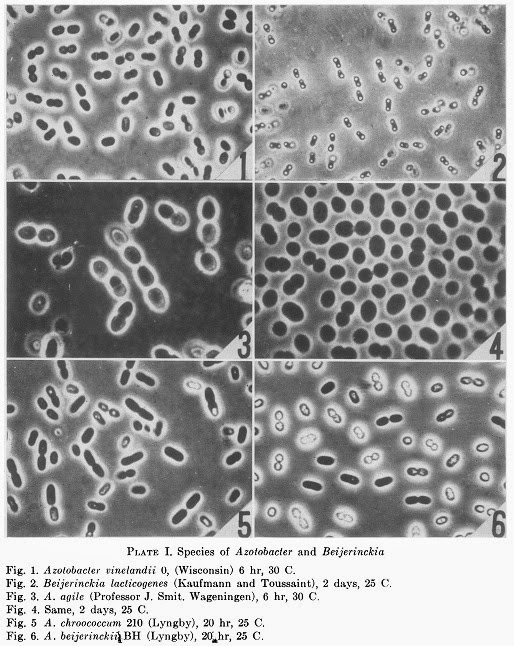
Jensen, 1954
Reference:
Jensen, H. L. The Azotobacteriaceae. Bacteriol. Rev. 18, 195–214 (1954).

Wednesday, May 13, 2015

156 - Poly-β-hydroxybutyrate biosynthesis and the regulation of glucose metabolism in Azotobacter beijerinckii

This study was intended to study carbon metabolism in Azotobacter and the formation of PHB.

What They Saw
The enzymes they studied (glucose 6-phosphate dehydrogenase, 6-phosphogluconate dehydrogenase, glyceraldehyde 3-phosphate dehydrogenase, 6-phosphogluconate dehydratase, 3-deoxy-2-oxo-6-phosphogluconate aldolase, citrate synthase, and isocitrate dehydrogenase) all seemed to be inhibited by NADH and/or NADPH.

What This Means
PHB synthesis consumes reduced nucleotides such as NADH, which could reduce their inhibitory effects when oxygen is limited.

Reference:

Tuesday, May 12, 2015

175 - Regulation of the Tricarboxylic Acid Cycle and Poly-β-hydroxybutyrate Metabolism in Azotobacter beijerinckii Grown under Nitrogen or Oxygen Limitation

When Azotobacter grows in oxygen-limited conditions, one expects that reducing equivalents such as NADH and NADPH would accumulate (since the electrons have no good acceptor). This could inhibit the TCA cycle. This study looked at different catabolic enzymes and their behavior under different nutrient limitations.

What They Saw
They grew A. beijerinckii in a chemostat with oxygen or (alleged) nitrogen limitations. As seen before, low oxygen induced PHB formation to store the carbon and as an electron sink. Adding extra oxygen caused a drop in PHB and dry weight, and then removing it reversed the effect. Enzymes for PHB synthesis showed a similar pattern.

NADH oxidase and enzymes involved in the TCA cycle of carbon catabolism (2-oxoglutarate dehydrogenase and isocitrate dehydrogenase) tended to increase activity as oxygen increased, and vice versa. NADH oxidase (part of the electron transport chain), though, fell after the initial increase and then rose again at the second increase. This enzyme seems like an important part of the genus's respiratory protection.

Some other TCA enzymes, citrate synthase and pyruvate dehydrogenase, didn't change much with oxygen changes.

They saw again that the lower the oxygen, the higher the growth yield (amount of biomass produced per unit sucrose), though probably some of this was due to PHB formation increasing the dry weight. The amount of sucrose consumed increased as oxygen increased, indicating less efficient growth.

With NADH/NAD+, when oxygen limitation was first imposed, the ratio rose greatly but then went down again quickly, and remained mostly steady with some fluctuations.

What This Means
The recovery of NADH/NAD+ ratio is likely due to the formation of PHB acting as an electron sink.

Azotobacter is kind of an interesting mix of aerobic and facultative organisms; they need oxygen, but not too much, and excess is harmful, so their respiratory systems are tightly regulated to deal with multiple different levels. The ability to fix nitrogen puts them in kind of a different category.

Reference:
Jackson, F. A. & Dawes, E. A. Regulation of the Tricarboxylic Acid Cycle and Poly-β-hydroxybutyrate Metabolism in Azotobacter beijerinckii Grown under Nitrogen or Oxygen Limitation. J. Gen. Microbiol. 97, 303–312 (1976).

Thursday, April 30, 2015

153 - The role of oxygen limitation in the formation of poly-β-hydroxybutyrate during batch and continuous culture of Azotobacter beijerinckii

This is a study on what factors initiate production of large amounts of PHB in Azotobacter beijerinckii.

What They Saw
In batch with 5 g/L glucose, bacteria started producing PHB near the end of the exponential phase. They stopped when they had consumed all the glucose, and then consumed the PHB, but this didn't help them increase in density, possibly because the PHB itself had been a proportion of the bacterial density; it seemed to permit the increase in actual biomass.

When glucose was 20 g/L, the cells continued producing PHB and the bacterial dry weight kept increasing long after exponential phase ended; the polymer got up to 74% of the dry weight.

Using an oxygen electrode, they observed that PHB production didn't start until dissolved oxygen reached 0%, at which point exponential phase was over. So they thought it might be oxygen limitation that induced the production, unlike in other organisms where nitrogen limitation is the inducer. But to be sure that it was really oxygen and not nitrogen, they turned to chemostats.

They found that nitrogen limitation didn't induce PHB formation at any dilution rate, though growth yield increased as D increased. In contrast, in oxygen-limited conditions, the PHB content (as a proportion of dry weight) and yield seemed to decreased as D increased, starting around 45% and going down to 20%, while growth yield seemed to peak at mid-range and then fall. Glucose limitation didn't induce PHB either, though some was produced at lower dilution rates.

The sudden imposition of oxygen limitation on nitrogen-limited cultures immediately induced PHB formation, and content increased over at least 10 hours. Dry weight and OD initially went up but then back down below what it had been, possibly reflecting more efficient growth until oxygen was completely depleted. They don't show it, but claim that PHB went back down from 45% to 20% after 32 hours.

What This Means
The authors speculate that the limitation of low oxygen comes in at the level of the TCA cycle; acetyl-CoA stops being oxidized as much as before, so it starts going toward PHB synthesis.

So limited oxygen might be the best condition for these microbes: they have some but not too much, their growth is more efficient, and they produce a nice storage polymer to save food for harder times.

Reference:
Senior, P. J., Beech, G. A., Ritchie, G. A. F. & Dawes, E. A. The role of oxygen limitation in the formation of poly-β-hydroxybutyrate during batch and continuous culture of Azotobacter beijerinckii. Biochem. J. 128, 1193–1201 (1972).

Wednesday, April 29, 2015

141 - Effect of Oxygen and Nitrogen Limitation on Poly-β-Hydroxybutyrate Biosynthesis in Ammonium-Grown Azotobacter beijerinckii

Azotobacter produces PHB polymer under nutrient limitations (other than carbon); the authors wanted to see whether nitrogen-fixing conditions were required for this process. This may affect the influence of oxygen on the organism, since it doesn't require respiratory protection.

What They Saw
The capsuleless strain of A. beijerinckii they used in this study accumulated up to 70% of its dry weight as PHB in batch culture, like its parent, whether or not it was fixing nitrogen. It started accumulating right when the culture became oxygen-limited.

So they grew A. beijerinckii in low-oxygen continuous culture with ammonium. Oxygen was about 1.75%, flowing at 0.4 liters per minute. As the dilution rate increased, dry weight and PHB proportions decreased, and the cells consumed less of the available carbon and nitrogen. PHB only got up to 50% though.

When they reduced the ammonium and kept oxygen constant at about 5% saturation, they saw constant PHB at 1% of dry weight and all the ammonium was consumed (so, ammonium-limiting growth), but total dry weight and carbon consumption showed the same pattern as before.

They tried even lower levels of oxygen to see if they could get PHB up to 70% of dry weight in continuous like in batch cultures, and succeeded, when oxygen was only 0.275% of the inflow, and dilution rates were fairly high (0.18 h-1). Actually at very low oxygen, higher dilution rate meant higher PHB content, then the trend reversed at a bit higher oxygen, and then returned at an even higher level. The reversal took place when the total biomass had peaked in the highest dilution rate:
Ward et al. 1977
What This Means
As in a previous study (114), the question came up of what oxygen limitation actually means: is it the point at which oxygen is the only nutrient holding cells back from growth, or is it the point at which they change their metabolism to start producing PHB? It is poorly defined.

The biggest difference seen between nitrogen-fixing and nitrogen-assimilating conditions is the high-low-high pattern seen with ammonium, compared to a steady decrease seen when fixing nitrogen. So it seems like the main difference may only be that nitrogen fixation requires so much more energy.

Reference:

Friday, April 24, 2015

136 - Effect of Oxygen Concentration and Growth Rate on Glucose Metabolism, Poly-β-Hydroxybutyrate Biosynthesis and Respiration of Azotobacter beijerinckii

This is a study on Azotobacter beijerinckii and the effects of oxygen levels on its respiration, PHB production, and other parameters.

They varied the oxygen in the inflowing gas between 0 and atmospheric (20%), and also varied dilution rates (when not holding D at 0.1 h-1).

What They Saw
As oxygen decreased, the PHB content of cells increased up to about 50% of the dry weight near 0% oxygen. Activities of PHB-producing enzymes increased also, while glucose-6-phosphate dehydrogenase activity remained constant. Below about 5% oxygen, the culture seemed oxygen-limited (no dissolved oxygen was detectable). They also saw increased respiratory activity and carbon dioxide production as oxygen increased, and indication of respiratory protection of nitrogenase.

When they increased the dilution rates (from 0.1 up to 0.2), they saw an increase in the activity of each enzyme tested. PHB content decreased as D increased, which is inconsistent with the increase in PHB enzyme activities, but it's likely that enzymes breaking down PHB were more active too.

The Entner-Doudoroff pathways seems to be the main glucose metabolism pathway in A. beijerinckii.

Reference:
Carter, I. S. & Dawes, E. A. Effect of Oxygen Concentration and Growth Rate on Glucose Metabolism, Poly-β-Hydroxybutyrate Biosynthesis and Respiration of Azotobacter beijerinckii. J. Gen. Microbiol. 110, 393–400 (1979).