Showing posts with label oxygen. Show all posts

Thursday, September 3, 2015

062 - Characterization of the iron superoxide dismutase gene of Azotobacter vinelandii: sodB may be essential for viability

This study looked at superoxide dismutase in Azotobacter vinelandii, an Fe-SOD encoded by sodB, and its importance.

What They Saw
Running proteins on a gel testing for SOD activity, they saw two bands: one was Fe-SOD and the other CuZnSOD (which sits in the periplasm). They tried knocking out sodB from A. vinelandii by introducing a kanamycin resistance cassette, and isolated a kan-resistant strain, but it appeared to have two copies of sodB (only one of which was knocked out). They tried increasing the concentration of kanamycin (presumably to force the strain to have multiple copies of the resistance gene), and got one that grew slowly at 100x more kanamycin than I use, but they couldn't get rid of the SOD. Seems like it's essential.

This also supports the idea that A. vinelandii can have multiple copies of its chromosome, since they saw multiple PCR products from the same locus, with and without the resistance marker. The genome only has one copy of sodB, so there must be multiple genome copies.

Reference:
Qurollo, B. A., Bishop, P. E. & Hassan, H. M. Characterization of the iron superoxide dismutase gene of Azotobacter vinelandii: sodB may be essential for viability. Can. J. Microbiol. 47, 63–71 (2001).

Wednesday, August 19, 2015

571 - Oxygen effects on the nickel- and iron-containing hydrogenase from Azotobacter vinelandii

This study looks at how oxygen affects the uptake hydrogenase of Azotobacter vinelandii.

What They Saw
They grew A. vinelandii OP (aka CA) and purified its membrane-bound hydrogenase. When purified anaerobically, it was fully active with an electron acceptor other than oxygen (methylene blue or benzylviologen). Added oxygen appeared to inhibit this reduction of methylene blue, and this was noncompetitive inhibition (adding extra methylene blue didn't relieve it).

When oxygen was removed by adding an oxygen-binding protein (leghemoglobin), the inhibition was reversed and activity recovered.

They claim the membrane-associated hydrogenase in these experiments was incapable of reducing the oxygen; it's not clear if being more capable would change the results, but it seems likely.

There was also slower, irreversible inactivation, shown by adding oxygen to an assay and adding enough dithionite to consume all of it to remove any effect of reversible inhibition. Over time, the enzyme lost activity, whether aerobically or anaerobically purified. Purified enzyme lost more activity more quickly than membrane-bound. It seemed like activity was only lost when the enzymes were exposed when active, but simply activating them didn't reproduce the effect. It was a confusing assay.

They did find that adding hydrogen could provide protection from inactivation, up to almost 100% protection, but neither hydrogen nor oxygen was consumed during this process. Super weird.

Finally, carbon monoxide didn't help protect the enzyme from oxygen at all, nor did affect protection by hydrogen.

What This Means
It's interesting, but probably not that important physiologically. A. vinelandii is capable of withstanding high levels of oxygen, and such high levels are just as likely to inhibit the nitrogenase which produces the hydrogen as the hydrogenase which consumes it. It might be interesting to study whether oxygen inhibits the oxidation of added hydrogen though.

Reference:
Seefeldt, L. C. & Arp, D. J. Oxygen effects on the nickel- and iron-containing hydrogenase from Azotobacter vinelandii. Biochemistry 28, 1588–1596 (1989).

Monday, August 10, 2015

557 - Detection of the in vivo incorporation of a metal cluster into a protein - The FeMo cofactor is inserted into the FeFe protein of the alternative nitrogenase of Rhodobacter capsulatus

This is another study looking at central cofactors from some nitrogenase versions inserted into other apoproteins than usual, but this time in Rhodobacter capsulatus.

What They Saw
They looked at purified enzymes from wild-type R. capsulatus and a nifHDK deletion mutant. The latter should only produce the iron-only nitrogenase, if anything. They had to treat the medium to remove as much Mo as possible so as to be able to control the concentration; this reduced the Mo present from around 1 ppb to less than 0.05 ppb (the detection limit).

They found that adding 10μM Mo to cultures growing with no Mo (and thus producing the Fe nitrogenase) greatly increased the amount of ethane produced from acetylene reduction (up to 40% of the ethylene produced). Without Mo, ethane remained constant at about 2% of ethylene. The amount of ethane increased over 72 hours too, up to 68% of ethylene; however, total activity decreased greatly over that time, down to only about 5% of what it had been before adding Mo. The ethane production rate increased for 24 hours and then decreased more slowly than the ethylene rate. This may be due to repression of the Fe nitrogenase, but the authors claim it is not, because the rate decreases more quickly in late-log cultures with chloramphenicol + Mo than with just chloramphenicol (or neither, which was about the same as with chloramphenicol alone). This shows that no new nitrogenase protein is being made even when chloramphenicol is absent, but adding Mo speeds the loss of it.
They also found that the more Mo they added, the higher the proportion of ethane produced (and also the lower the total acetylene reduction activity).

They tested the sensitivity of the system to oxygen, both with and without Mo: in both cases, more oxygen meant less acetylene reduction, though the system with Mo seemed a bit more sensitive (dropping to almost 0% with 1% oxygen while that without Mo only fell to about 20%), but also they noticed that increased oxygen increased the proportion of ethane produced after Mo was added. So somehow oxygen enhanced the Mo effect.

Rhenium, tungsten, and vanadium did not cause anything similar to the Mo effect. The Mo effect was also absent in mutants unable to produce FeMo cofactor (nifE knockouts), so it seems like the cofactor is part of the system. nifQ knockouts seemed to show the effect only at high concentrations of Mo (0.1-1mM); this gene's product is involved in cofactor synthesis at a different step. Mo uptake wasn't an issue; all strains had the same intracellular concentrations.

Using EPR spectroscopy on purified enzyme, they claim to show that the spectrum for Fe nitrogenase with added Mo is similar to that of the Mo nitrogenase from the wild-type, so it seems like the FeMo cofactor is incorporated into the Fe nitrogenase. I would've liked to see their result for the Fe nitrogenase without added Mo as a control, but I'll have to take their word for it. Though they did do metal analysis that found ratios of Fe to Mo similar to that of the Mo nitrogenase.

The fact that chloramphenicol didn't prevent the Mo effect seemed to show that the proteins required to make FeMoco were present before Mo was added. This was confirmed with lacZ fusions to related genes to observe expression more directly.

What This Means
Is FeMoco actually replacing FeFeco in completed enzymes? Seems more likely that FeMoco is inserting into incomplete apoprotein, but it's hard to distinguish between these possibilities. Considering that the process seems to continue over several days, maybe the FeMoco is actually displacing FeFeco from completed proteins over time. This is supported by the observation of oxygen enhancement of the Mo effect; oxygen seems to make the enzyme more labile.

Reference:

Monday, July 20, 2015

454 - Activity of the H2-oxidizing hydrogenase in different N2-fixing bacteria

Despite some studies suggesting that hydrogen stimulates hydrogenase, other data suggested it does not. So the people who generated this data did this study on various species, including Azotobacter vinelandii CA, and claimed that low oxygen stimulated hydrogenase activity.

What They Saw
They grew A. vinelandii with ammonium chloride and measured hydrogenase activity with different electron acceptors (oxygen, methylene blue, etc). As A. vinelandii grew, it used up the dissolved oxygen, and hydrogenase activity went up but then back down after the oxygen was gone (when oxygen or iron cyanide were the electron acceptors, it went to zero; otherwise it didn't go all the way to zero). This was all in the presence of ammonium.

What This Means
Based on other studies, I wouldn't expect much activity from hydrogenase in general when growing with fixed nitrogen. I'm not sure how to interpret these results, especially with electron acceptors other than oxygen, but I guess it would make sense if hydrogenase were somewhat downregulated in low-oxygen conditions, even if other acceptors were present.

Reference:
Pinkwart, M., Bahl, H., Reimer, M., Wölfle, D. & Berndt, H. Activity of the H2-oxidizing hydrogenase in different N2-fixing bacteria. FEMS Microbiology Letters 6, 177–181 (1979).

Friday, July 17, 2015

453 - Direct mass-spectrometric determination of the relationship between respiration, hydrogenase and nitrogenase activities in Azotobacter chroococcum

This study looked at hydrogen and its relationship to different enzymatic processes in Azotobacter chroococcum.

What They Saw
The organism was grown in continuous culture with limited oxygen, 5% glucose. Samples were removed and sparged with different mixtures of argon, oxygen, and deuterium. Gases are measured by mass spectrometer.

Their figure is pretty confusing, poorly designed, and poorly described, but as far as I can tell, when they added either 80% argon with 20% oxygen or 70% argon, 20% oxygen, and 10% deuterium, the oxygen goes down to near zero within about 5 minutes either way, at which point hydrogen production starts increasing and deuterium uptake slows down or stops. So it seems like oxygen is required for hydrogenase to work.

They tried again with the addition of some carbon monoxide and acetylene to inhibit hydrogenase. This didn't really change the oxygen consumption, but deuterium consumption was a lot lower. Hydrogen evolution was the same.

What This Means
The deuterium consumption is by hydrogenase, of course, and it seems like oxygen is a necessary electron acceptor for it to function (in the absence of something else). But it seems like the increase in hydrogen evolution is not because hydrogenase stopped working, but rather because nitrogenase started, as oxygen stopped interfering. This is something we've seen before.

Oxygen is important for many things: it provides energy by accepting electrons, powering the nitrogenase and allowing more hydrogen production. It accepts electrons from hydrogenase, enabling hydrogen oxidation. It inhibits nitrogenase, reducing hydrogen production. Pretty confusing.

Reference:

Friday, June 26, 2015

070 - The hoxZ gene of the Azotobacter vinelandii hydrogenase operon is required for activation of hydrogenase

Here they wanted to look into the hoxZ gene more closely. Previous studies suggested that the product might be involved in electron transport for the hydrogenase.

What They Saw
They grew Azotobacter vinelandii DJ (an easy-to-transform strain) and knocked out hoxZ and hoxKG by transformation and screening for hydrogen production.

Comparing the hoxZ mutant to DJ (positive control) and the hoxKG mutant (negative control), they observed an intermediate rate of hydrogen oxidation, so there seemed to still be some activity. DJ consumed nearly all the hydrogen, and hoxKG consumed very little (the graph showed a decrease but it was apparently because gas leaked out of the vial, so it's a good thing they had good controls!).

Then they tried measuring short-term hydrogen oxidation with different electron acceptors: oxygen or methylene blue. DJ quickly oxidized all the hydrogen while reducing oxygen or methylene blue, as expected. Both mutants didn't show activity with either acceptor at first, despite the difference in the previous assay. But then they added sodium dithionite (a powerful reducer of oxygen) and more methylene blue, and the hoxZ mutant showed up to 80% of the activity of DJ. As far as I can tell, the hoxKG didn't show the same effect when they gave it the same treatment, but they don't say that explicitly. But it seems like the hydrogenase needs to be activated somehow, as by dithionite.

These results were confirmed by observing methylene blue color change too; DJ quickly started oxidizing hydrogen, but the hoxZ mutant did too after a longer lag period.

When they isolated membrane-bound hydrogenase from cells (still embedded in membranes), even DJ needed activation with dithionite. hoxKG mutants had no activity in any case, of course. But hoxZ mutant had more activity in the soluble supernatant portion than DJ did, at least when membranes were isolated aerobically; it seemed like lack of hoxZ led to more soluble enzyme. But it had low activity in general so this conclusion was uncertain. Though membrane-bound activity in general was higher when isolated anaerobically, and they didn't measure soluble activity in that case for some reason. So HoxZ may help stabilize hydrogenase in the presence of oxygen.

The increased presence of detached hydrogenase in the mutant was not confirmed by Western blot, so it seems like an artifact.

What This Means
HoxZ seems to have a role in shuttling electrons between hydrogenase and oxygen, though there may be other components involved in this path. It's possible that when HoxZ is missing, another acceptor can take the electrons, but isn't as good at it.

It also may be involved in activating the enzyme (which requires removing oxygen and providing reduction); somehow hydrogen is not enough for this. And it may help stabilize the hydrogenase to keep oxygen from inactivating it, maybe also using its role as electron transporter.

Reference:
Sayavedra-Soto, L. A. & Arp, D. J. The hoxZ gene of the Azotobacter vinelandii hydrogenase operon is required for activation of hydrogenase. J. Bacteriol. 174, 5295–5301 (1992).

Thursday, June 11, 2015

049 - Purification and properties of membrane-bound hydrogenase from Azotobacter vinelandii

Azotobacter has a hydrogenase. Some organisms have hydrogenases that produce hydrogen, or sometimes produce and sometimes break down (reversible). Azotobacter's had not been observed to break down hydrogen (so was considered unidirectional). This study purified the membrane-bound uptake hydrogenase from A. vinelandii and tested its properties.

What They Saw
They measured activity of purified enzyme with an electrode measuring hydrogen oxidation in the presence of methylene blue dye (an electron acceptor).

They measured stability of the enzyme in the presence of oxygen, and found that crude extracts were very stable (and could go for weeks without losing activity), but the more pure the preparation, the less oxygen-tolerant it was: the most pure lost half its activity in 20 minutes at 20% oxygen. This inactivation was irreversible.

With a very good electron donor (methyl viologen), the hydrogenase could produce hydrogen. The highest rate they saw was 3.4 μmol hydrogen per minute per mg protein, which peaked at a fairly low pH (around 4). The rate was almost 0 closer to neutral. Also, the presence of hydrogen in the environment inhibits its production by the enzyme.

Even when electron acceptors were not present, the enzyme could combine one deuterium from D2 with one hydrogen from water to make HD.

The enzyme seemed to be good at donating electrons to acceptors with positive mid-point potentials but not to negative ones, so it seems to have a higher potential than reversible hydrogenases.

Reference:
Kow, Y. W. & Burris, R. H. Purification and properties of membrane-bound hydrogenase from Azotobacter vinelandii. J Bacteriol 159, 564–569 (1984).

Thursday, May 28, 2015

225 - O2-repression of nitrogenase synthesis in Azotobacter chroococcum

Klebsiella pneumoniae only fixes nitrogen when oxygen levels are very low (or absent), so oxygen represses nitrogenase synthesis. This study looks at whether the same is true in Azotobacter chroococcum; it seems unlikely, since this organism is known for its very aerobic nitrogen fixation; however, it is possible to stress this organism with oxygen such that it may shut down nitrogenase, at least temporarily.

What Robson Saw
He grew A. chroococcum in chemostats with Burk medium with mannitol, with or without ammonium for nitrogen, and stressed them with oxygen either by moving ammonium-grown cells to ammonium-free medium or by suddenly increasing aeration in nitrogen-fixing cells. He looked at levels of nitrogenase proteins (by labeling with radioactive sulfur isotopes) and nitrogenase activity.

At initial low oxygen levels, activity increased and radioisotype-labeled protein levels were relatively high (indicating high levels of nitrogenase protein synthesis). Upon oxygen shock, activity went to zero and protein synthesis levels dropped a lot. When the stress was relieved, both measures increased again.

With ammonium removed and then re-added, things were similar: nitrogenase activity went up and synthesis gradually increased to a plateau, but decreased when more ammonium was added. It did take a relatively longer time for nitrogenase activity to pick up after ammonium was removed, about 80 minutes.

Along with nitrogenase, flavodoxin and the small protein that protects nitrogenase from oxygen by temporarily inactivating it both showed up in radiolabeling. The former matched nitrogenase synthesis patterns, but the latter was fairly constant.

What This Means
It seems that oxygen stress can repress synthesis of nitrogenase even in Azotobacter, though radiolabeling might not be the best method for studying this question. This adds another layer to Azotobacter's protection of its enzymes from oxygen.

Reference:
Robson, R. L. O2-repression of nitrogenase synthesis in Azotobacter chroococcum. FEMS Microbiology Letters 5, 259–262 (1979).

216 - Effect of Dissolved Oxygen on Growth Yield and Aldolase Activity in Chemostat Culture of Azotobacter vinelandii

This study looked at carbon- or oxygen-limited cultures of Azotobacter vinelandii and the effects on enzymes of the TCA cycle: aldolase, glyceraldehyde-3-phosphate dehydrogenase, isocitrate dehydrogenase, and isocitrate lyase.

What They Saw
They grew A. vinelandii in chemostats with Burk medium with glucose at different agitation speeds and different dilution rates.

At the second-lowest agitation, dissolved oxygen was low and a bit of glucose was residual in the outflow (about 0.44 g/L); this increased as D increased. Growth yield and carbon dioxide production didn't change much as D changed. Things were similar in the lowest agitation, except there was less biomass and presumably more residual sugar.

At the second-highest agitation, residual glucose was very low up to D = 0.2, then went up, so the culture seemed to switch from glucose-limited to oxygen-limited at that point. Biomass increased up to that point too, and then decreased. Growth yield and CO2 production changed inversely, with yield increasing up to a certain D before 0.2 and then leveling off. Once leveled off, values were similar to those from lower aerations.

So overall for all aerations, as dissolved oxygen increased, growth yield from glucose decreased; growth became less efficient. Carbon dioxide production increased though, indicating that the carbon was being consumed but going toward that gas, complete oxidation.

In terms of enzyme activities, of the four tested enzymes, only aldolase increased as oxygen increased. Below is their model of what effect this has:
Fig 4, Nagai et al. 1971
The rise in aldolase activity meant that carbon was cycling through the pentose cycle more instead of moving on to the TCA cycle (which could lead to greater ATP generation and anabolism), so that explains the increase in CO2 production and decreased growth yield.

Reference:
Nagai, S., Nishizawa, Y., Onodera, M. & Aiba, S. Effect of Dissolved Oxygen on Growth Yield and Aldolase Activity in Chemostat Culture of Azotobacter vinelandii. J Gen Microbiol 66, 197–203 (1971).

Wednesday, May 27, 2015

215 - Respiratory protection of nitrogenase in Azotobacter vinelandii

This study is pretty similar to 214, on how oxygen levels influence the respiratory chain of Azotobacter vinelandii.

What They Saw
They grew cells in batch at low aeration, and then increased the aeration to expose cells to excess oxygen.

The results were similar to 214: when aeration increased, cells stopped growing until respiration had ramped up and leveled off. Despite the large increase in respiration, cellular ATP levels dropped 40%. P/O ratios decreased as respiration increased to accommodate the increased oxygen, at least for NADH dehydrogenase.

They tried adding chloramphenicol again, since last time it didn't affect the growth lag, but this time observed that it lessened the increase in respiration about half, and prevented cytochrome a2 and other dehydrogenase increases.

What This Means
The M/N ratio, meaning maintenance M (moles ATP consumed per weight of cells over time) over phosphorylating efficiency N (P/O ratio x 2), explains doubling of respiratory activity upon increase in oxygen only if M increases or N decreases. It doesn't seem like M does increase, so N seems to be decreasing, because respiration uncouples from phosphorylation.

A. vinelandii seems to have different branches in its respiratory chain, which allows it to tolerate different and suddenly changing levels of oxygen.

Reference:
Jones, C. W., Brice, J. M., Wright, V. & Ackrell, B. A. C. Respiratory protection of nitrogenase in Azotobacter vinelandii. FEBS Letters 29, 77–81 (1973).

214 - The Respiratory System of Azotobacter vinelandii 2. Oxygen Effects

This study looks at how oxygen levels influence the respiratory chain in Azotobacter vinelandii.

What They Saw
They grew cells with high or low aeration (based on volume of culture in the same size flask), then isolated respiratory membranes and measured P/O ratios.

The cells grew and quickly used up all the dissolved oxygen. With high aeration, they grew much faster and leveled off once the oxygen was gone, and with low aeration the growth was slower (not even really logarithmic) but continued long after the oxygen was gone. Respiratory activities were 2-5x higher when cells were growing logarithmically with excess oxygen than when oxygen was limited.

If they suddenly increased the aeration when oxygen had run out, respiratory activity increased back up to high levels (1000 μl/h/mg dry weight). Cells didn't start growing again until it had leveled off. This lag was the same when chloramphenicol (which inhibits protein synthesis) was present, suggesting that it wasn't due to the synthesis of new enzymes for respiration.

When oxygen was being consumed, cytochrome and oxidase levels were pretty constant (except cyt o oxidase, which increased), but when oxygen ran out, levels of c4, c5, and b1 increased quickly and a2 more slowly. Cytochrome o oxidase and a2 oxidase also increased a lot, a1 less so. The increase of o was fastest and greatest.

P/O ratios were similar to those seen before at maximum, but they didn't reach this maximum until oxygen was mostly used up late in the logarithmic growth phase, at least for NADH dehydrogenase.

With low aeration, cytochrome levels were pretty constant (since oxygen ran out almost immediately), increasing just a little, except for cyt a2 oxidase which went up pretty constantly. P/O ratios were pretty level too, and fairly high, similar to when oxygen ran out in high aeration.

What This Means
This kind of pattern fits in well with those seen in other obligate aerobes. Cytochromes probably increase during oxygen limitation to try to compensate for the limitation. But the low P/O ratios at high oxygen makes sense in light of respiratory protection; respiration is uncoupled from energy generation.

Reference:
Ackrell, B. A. C. & Jones, C. W. The Respiratory System of Azotobacter vinelandii 2. Oxygen Effects. Eur. J. Biochem. 20, 29–35 (1971).

Tuesday, May 26, 2015

352 - The Respiratory System of Azotobacter vinelandii: 1. Properties of Phosphorylating Respiratory Membranes

Similar to 161, this study looks at elements of Azotobacter vinelandii's respiratory chain and P/O ratios thereof.

What They Saw
They isolated respiratory membranes (basically pieces of cell with the respiratory chain intact but not much else, I think) and looked at oxygen reduction with different electron donors.

They saw P/O levels up to 1.1 with NADH and about 0.7 with malate, higher than in 161.

Reference:
Ackrell, B. A. C. & Jones, C. W. The Respiratory System of Azotobacter vinelandii: 1. Properties of Phosphorylating Respiratory Membranes. Eur. J. Biochem. 20, 22–28 (1971).

213 - Characterization of an oxygen-stable nitrogenase complex isolated from Azotobacter chroococcum

When respiratory protection fails in Azotobacter, it can temporarily inactivate its nitrogenase to protect it, by association with another protein, called FeSII or Shethna. This study purifies this whole complex (nitrogenase and FeSII) and investigates its characteristics in A. chroococcum.

What They Saw
The more pure the nitrogenase, the less protection from oxygen inactivation they observed. But while crude extract had the most protection, more pure forms were pretty similar until the protective FeSII protein was absent, in which case the nitrogenase was rapidly inactivated. Magnesium ions (or possibly other divalent ions) were also necessary for this stabilization.

This protective protein was 14 kDa, orange in color, and had 2 Fe and 2 S atoms, so a 2Fe-2S center (thus the name). This version seems smaller than the A. vinelandii version though, which is 23 kDa. In stable complexes, the three components (dinitrogenase, dinitrogenase reductase, and FeSII) were present in about 1:1:1 ratios.

What This Means
This FeSII (with Mg ions) appears to be sufficient to protect the nitrogenase complex from oxygen, stabilizing it even outside of the cellular environment. This stability is perhaps not complete though, since crude extracts did show more activity after exposure to oxygen.

Reference:

Friday, May 22, 2015

198 - Oxidation of nitrogenase iron protein by dioxygen without inactivation could contribute to high respiration rates of Azotobacter species and facilitate nitrogen fixation in other aerobic environments

This study looks at oxygen interactions with dinitrogenase reductase (DNR) in Azotobacter chroococcum (and Klebsiella pneumoniae) to see if it's possible that the enzyme can be oxidized without being totally inactivated.

When the DNR was present in high enough levels relative to the amount of oxygen (4-fold molar excess), it was protected from inactivation by oxygen: it seemed to reduce superoxides to peroxide (and then water if catalase doesn't get to it first) before the reactive oxygen species could harm it. Superoxide seems to be the harmful form of oxygen for DNR. They suggest this helps with high respiration rates (i.e. consumption of oxygen). They calculated that if 10% of the cell's protein were DNR, it could account for pretty much all of the oxygen consumption. This is unlikely, but it could still be a significant part of respiratory protection. They call this "autoprotection."

Reference:

197 - Superoxide dismutase and catalase in Azotobacter vinelandii grown in continuous culture at different dissolved oxygen concentrations

Considering how oxygen-sensitive nitrogenase is, it might be expected that enzymes specifically involved in oxygen detoxification (such as catalase and superoxide dismutase (SOD)) might be involved in protecting such oxygen-sensitive enzymes, especially since ramping up respiration in response to increased oxygen might also ramp up the production of reactive oxygen species. This study investigates the activity of SOD and catalase in Azotobacter vinelandii at different oxygen levels.

What They Saw
They grew A. vinelandii OP (aka CA) in chemostats with different levels of oxygen, with 3 or 15 g/L sucrose. They extracted enzymes from samples and assayed them for SOD or catalase activity, and also by electrophoresis.

As oxygen saturation increased from 1% to 90%, SOD activity increased linearly (when standardized to total protein); the increase was slightly faster at lower oxygen when standardized by number of cells (probably because cell size increases as oxygen increases, 098). The sucrose concentration didn't affect things. When cells were given ammonia, SOD activity was about 2x lower.

Based on electrophoresis, they concluded that the SOD is iron-containing, rather than manganese. They tried adding manganese but still didn't see any Mn-SOD.

It didn't seem like catalase activity increased with increasing oxygen, standardized by protein. The increase standardized by cells was much more apparent.

What This Means
It seems like SOD at least might contribute to A. vinelandii's protection of its nitrogenase enzyme from oxygen.

Reference:

Thursday, May 21, 2015

195 - Levels and activities of nitrogenase proteins in Azotobacter vinelandii grown at different dissolved oxygen concentrations

Obviously oxygen levels have a big effect on nitrogen-fixing Azotobacter. This study looked into specific effects on levels of different proteins related to nitrogen fixation, at different oxygen levels.

What They Saw
They grew A. vinelandii OP (aka CA) in chemostats with 3 g/L sucrose at different oxygen levels (or dilution rates). They measured nitrogenase activity and purified nitrogenase components as well as flavodoxin and FeSII protein.

Unlike in previous studies (111, 165, 183), increasing the oxygen levels didn't seem to reduce nitrogenase activity (in steady state), at least not in the range they tried (except maybe a little at low levels). At all different levels, nitrogenase activity (i.e. acetylene reduction) correlated only with dilution rate.

With Western blots, they found that levels of different nitrogenase proteins (and others) didn't really vary much across different oxygen levels; they were always about 10% of total protein. And if the activity doesn't vary, this means the proportion of active enzyme is constant too. The enzyme activity does match previous numbers though (106).

Trying to grow cells in ammonia, the two components of nitrogenase disappeared, flavodoxin decreased, but FeSII remained constant.

They tried measuring nitrogenase levels at different dilution rates and oxygen levels. At the lowest D, nitrogenase increased as oxygen increased, but it remained pretty constant at higher rates (as shown before). In contrast to the earlier data though, levels didn't seem to increase consistently with increasing D; it could be that the same quantity of enzyme is less active at lower D, probably related to the flow of electrons to the enzymes.

Then they tried inhibiting protein synthesis with chloramphenicol, at either low or high oxygen. The culture started to wash out, of course. Levels of the four proteins didn't change much with oxygen or with time passed after addition of the antibiotic, but nitrogenase activity decreased greatly over time (while respiratory activity didn't change much). This wasn't due to damage to the nitrogenase components; nitrogenase extracts had just as much activity as cells grown without chloramphenicol. Somehow the activity is inhibited.

What This Means
As suggested before, it seems like the absolute presence/concentration of oxygen doesn't determine its toxicity so much as the ratio of oxygen to availability of energy and reducing equivalents. So if there's enough energy and electrons available to nitrogenase, it can keep going up to high levels of oxygen.

Reference:
Dingler, C., Kuhla, J., Wassink, H. & Oelze, J. Levels and activities of nitrogenase proteins in Azotobacter vinelandii grown at different dissolved oxygen concentrations. J Bacteriol 170, 2148–2152 (1988).

Wednesday, May 20, 2015

099 - Oxygen and Hydrogen in Biological Nitrogen Fixation

Oxygen is pretty toxic to nitrogen fixation enzymes, so organisms or the people studying them need to take steps to protect them. They lose more than half their activity within minutes exposed to air. The dinitrogenase reductase is more sensitive than the dinitrogenase itself, at least the Mo version. Some can retain some activity even up to an hour in air. But the FeMo-cofactor, when extracted, is even more sensitive than the dinitrogenase reductase. Overall, it seems that the metal-sulfur centers are the most sensitive parts.

And yet, there are nitrogen-fixing species that are obligate aerobes, or even oxygenic. How do they do it?

Azotobacter has been shown to increase its respiration while its growth efficiency decreases as oxygen increases, seeming to waste the oxygen: this has been called "respiratory protection." The mechanism for this is not simple though; it involves carefully regulated shifts in respiratory components throughout the whole catabolic system.

Azotobacter also has the ability to reversibly inactivate its nitrogenase if respiratory protection is not possible (such as in carbon-limited conditions, or upon a sudden increase in oxygen). This seems to depend on FeSII protein (aka Shethna), though it is suggested that there may be other mechanisms.

When oxygen is too high and cells' supply of fixed nitrogen runs out, production of nitrogenase may be regulated (no sense making an enzyme when it can't function). This regulation may be done by the products of nifAL genes.

Azotobacter also produces gummy alginate which might have a role in protection from oxygen, but non-gummy strains (such as CA) have been isolated that don't seem especially oxygen-sensitive. I wonder if they have higher rates of respiration though, or if they might be more sensitive in carbon-limited conditions.

Nitrogenase also produces hydrogen gas, whether or not it's reducing anything else. This reaction seems separate from the nitrogen fixation reaction, since some things can inhibit the latter without inhibiting the former. Acetylene seems to inhibit hydrogen production though. Nitrogen can't compete with hydrogen for electrons completely, even with pure pressurized nitrogen; the enzyme always produces at least 1 mol hydrogen for each mol nitrogen gas fixed.

Of course, this hydrogen usually doesn't just escape; Azotobacter and other diazotrophs recapture it with their uptake hydrogenase. The exact purpose this serves is not clear though.

Reference:
Robson, R. L. & Postgate, J. R. Oxygen and Hydrogen in Biological Nitrogen Fixation. Ann Rev Microbiol 34, 183–207 (1980).

Monday, May 18, 2015

374 - The Azotobacteriaceae

This was a very interesting review of the Azotobacter family from more than fifty years ago. It was interesting to see observations in this paper that I had made myself in my own research.

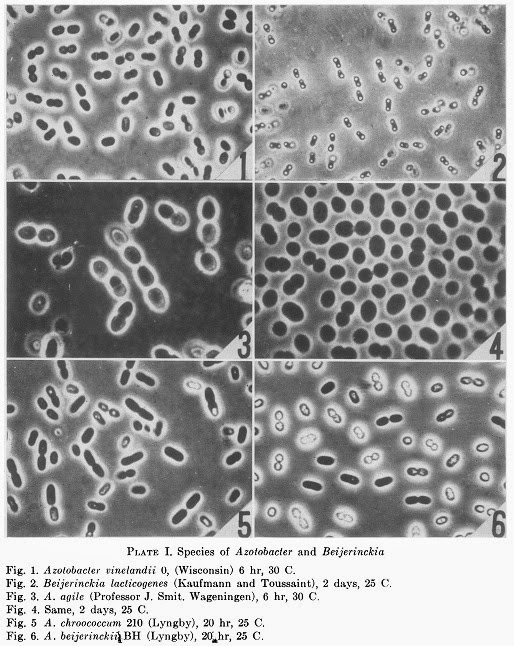
It discusses the taxonomy of Azotobacter somewhat: the genus includes A. chroococcum, A. beijerinckii, and A. vinelandii of course, and A. agile (which I'm not sure is considered a real separate species now); other alleged species (A. indicum for example) seemed like they should be separated into another genus, Beijerinckia. A. chroococcum was the first, discovered by Martius Beijerinck in 1901.

Characteristic features of Azotobacter are their large size, short thick rod-shaped cells (often found in pairs), nitrogen fixation (despite being obligate aerobes), and poor growth on digestions of meat extracts and such, like LB (something I've noticed myself). The cells change shape depending on their conditions though, which can be confusing. Worse, they can be difficult to isolate from contaminating strains. They also form resistant, dormant cysts in some conditions, though I don't think I've observed this personally. They also can form storage granules of different kinds which are observable under a microscope.

They're pretty versatile in their ability to use different carbon compounds. They can use alcohols (ethanol, propanol, butanol, etc), organic acids (acetate, citrate, butyrate, etc), and saccharides (glucose, fructose, galactose, sucrose, etc.). This depends on the species and strain somewhat; some seem to be able to use lactose, others not. Some can use starch and some other polysaccharides. Some can even use cyclic compounds (benzoic acid, phenol, salicylic acid) which are generally toxic. There are some things they can't use, such as xylose, methanol, and formic acid. Their respiration rate can be very high, the highest observed in nature (at that time, at least).

Their versatility regarding nitrogen compounds seems to be lower though. They can fix nitrogen, of course, and use basic inorganic forms (ammonia, nitrate) and some common organic forms (urea, glutamate, asparagine), but otherwise are limited. So they don't grow well on complex forms such as protein digestions (peptone, tryptone).

Otherwise, as represented in Burk medium, they need phosphorus, sulfur, potassium, calcium, magnesium, iron (amount depending on whether they were fixing nitrogen), and of course molybdenum or vanadium helped when fixing nitrogen too. Other trace elements or vitamins seem unnecessary, at least in many conditions.

The review suggests that azotobacters can produce compounds that stimulate or inhibit plant roots; I wonder if that is true.

The organisms are obligate aerobes, of course, capable of tolerating very high levels of oxygen, especially when not fixing nitrogen. They're mesophiles, preferring around 30ºC. Preferred pH depends on the strain, but around 6-8 is typical.

Some have actually reported that the weather can affect their growth, especially high-pressure areas, but this hasn't been confirmed.

Many have noticed that azotobacters seem to mutate fairly frequently; this is probably due to transposons and natural competence.

How much nitrogen do azotobacters actually fix in soils? It's hard to tell, of course, because it depends on many things and it's hard to measure the contribution of a single genus in such a complex environment, so it couldn't be said.
Jensen, 1954
Reference:
Jensen, H. L. The Azotobacteriaceae. Bacteriol. Rev. 18, 195–214 (1954).

Friday, May 15, 2015

183 - Studies on the mechanism of electron transport to nitrogenase in Azotobacter vinelandii

Later investigators criticized the previous study (182) as too simplistic, not explaining the total potential of the nitrogenase system. Azotobacter seems to make three flavodoxins, not just azotoflavin; flavodoxin II seems like the important one but it wasn't known how it got reduced; and ferredoxin might not be involved at all.

So this study grew A. vinelandii with and without ammonium, then observed the differences in its redox systems.

What They Saw
They grew cells in a chemostat with ammonium, and then removed samples and washed with nitrogen-free medium to remove the fixed nitrogen. They measured nitrogenase activity of these samples and labeled newly formed proteins with radioactive sulfur compounds.

They observed that nitrogenase activity correlated well with rate of respiration in different conditions, so they wondered if the two might be linked.

After they removed the fixed nitrogen from cells that had been growing with it, they observed nitrogenase activity within 20 minutes. Then the activity increased linearly over time for at least 40 minutes in this condition. On protein gels, they observed the nitrogenase proteins produced quickly, within 5 minutes, and flavodoxin II showed up some time later. There are some others of uncertain identity, and some interesting ones showing up only in the membrane protein fraction.

What This Means
The linear relationship between respiration and nitrogenase activity has a number of possible explanations. Extra respiration could mean higher membrane potential or ATP levels, so more energy for nitrogenase, or there could be more enzymes (or enzymes that are more active) to transport electrons to nitrogenase. The former seems unlikely, since Azotobacter uncouples respiration from energy generation at higher oxygen levels, so extra respiration doesn't necessarily mean more energy. And extra enzymes seems unlikely too, based on the protein results.

So it seems like increased nitrogenase activity might be due to increased transport of electrons to the enzyme, though it's not clear how that happens.

Reference:
Klugkist, J., Haaker, H. & Veeger, C. Studies on the mechanism of electron transport to nitrogenase in Azotobacter vinelandii. European Journal of Biochemistry 155, 41–46 (1986).

Wednesday, May 13, 2015

178 - Dependence of nitrogenase switch-off upon oxygen stress on the nitrogenase activity in Azotobacter vinelandii

This study looks at what it takes for oxygen stress to induce Azotobacter vinelandii to shut off its nitrogenase.

What They Saw
They grew A. vinelandii OP (aka CA) in chemostats, fixing nitrogen, with limited carbon (3 g/L of sucrose, acetate, or citrate). They stressed the culture with oxygen by increasing the aeration for 6-minute periods. They measured acetylene reduction, and nitrogen fixation directly (by fixed nitrogen increase). They also measured oxygen levels going in and coming out, to determine consumption.

As usual, with sucrose, they observed that respiration rates increased as oxygen levels rose. At a given oxygen level, respiration also increased as the dilution rate D increased. The amount of respiration increase wasn't the same at different dilution rates though, even with the same change in oxygen. The oxygen maintenance requirement increases as oxygen increases, but not linearly (the rate of increase goes down).

With acetate or citrate, the oxygen maintenance coefficient (and respiration at a given oxygen level) was much lower than with sucrose. Also as D increased, respiration with citrate increased linearly, but with acetate it leveled off at some point.

The rate of nitrogen fixation depended only on D, and increased linearly with D. The carbon source didn't affect it.

When they did the oxygen challenges, they found that up to D = 0.15 h-1, increasing the oxygen shut off nitrogenase completely. Above that D, the shut-off was less severe. With a less severe challenge, there was less shut-off at the same D too, as expected. Substrate didn't seems to matter.

They couldn't measure a change in respiration from oxygen stress directly, because it was too short, but they knew that cultures grown in acetate or citrate couldn't increase their respiration because they had already consumed all the substrate. There was still residual sucrose though, but the amount didn't seem to change with oxygen challenge, so they concluded that respiration didn't suddenly increase.

Finally they tried controlling nitrogenase activity by giving cells small amounts of ammonium, not enough to repress nitrogen fixation, just reduce it. So giving cells 1 mM ammonium when D = 0.16 resulted in the same nitrogenase activity as when D = 0.06 with no ammonium. And they found that an equivalent oxygen challenge led to the same amount of nitrogenase shut-off.

What This Means
So the rate of oxygen consumption doesn't affect how severe the nitrogenase shut-off is, only the rates of substrate feeding and nitrogenase activity, and more so the latter.

This is kinda weird, because if respiration is how the cells protect nitrogenase from oxygen by removing it (respiratory protection), then higher respiration should correlate with higher nitrogenase activity, but it doesn't seem to here. Also, oxygen level and oxygen consumption should correlate linearly, but they don't, especially considering different carbon substrates.

The authors propose that, instead of respiratory protection, the cells' redox state is what matters: nitrogenase requires a reduced state to function, and more oxygen leads to a more oxidized state. Reduction is made possible by the carbon substrate, which provides energy and electrons; at higher dilution rates, more reduction is possible, so the nitrogenase activity can be higher. That also explains why at higher D, the same oxygen challenge leads to less nitrogenase shut-off, because the change in the redox state is less severe. That way, the cells don't need to create an anaerobic environment in their cytoplasm, just maintain a low redox potential and good flow of electrons.

Respiratory protection as a concept is still useful, since it is still true that the cells' respiration increases as oxygen increases when fixing nitrogen, to allow nitrogenase to function; it's just the details that have been challenged here.

Reference: