Showing posts with label PHB. Show all posts

Monday, May 18, 2015

374 - The Azotobacteriaceae

This was a very interesting review of the Azotobacter family from more than fifty years ago. It was interesting to see observations in this paper that I had made myself in my own research.

It discusses the taxonomy of Azotobacter somewhat: the genus includes A. chroococcum, A. beijerinckii, and A. vinelandii of course, and A. agile (which I'm not sure is considered a real separate species now); other alleged species (A. indicum for example) seemed like they should be separated into another genus, Beijerinckia. A. chroococcum was the first, discovered by Martius Beijerinck in 1901.

Characteristic features of Azotobacter are their large size, short thick rod-shaped cells (often found in pairs), nitrogen fixation (despite being obligate aerobes), and poor growth on digestions of meat extracts and such, like LB (something I've noticed myself). The cells change shape depending on their conditions though, which can be confusing. Worse, they can be difficult to isolate from contaminating strains. They also form resistant, dormant cysts in some conditions, though I don't think I've observed this personally. They also can form storage granules of different kinds which are observable under a microscope.

They're pretty versatile in their ability to use different carbon compounds. They can use alcohols (ethanol, propanol, butanol, etc), organic acids (acetate, citrate, butyrate, etc), and saccharides (glucose, fructose, galactose, sucrose, etc.). This depends on the species and strain somewhat; some seem to be able to use lactose, others not. Some can use starch and some other polysaccharides. Some can even use cyclic compounds (benzoic acid, phenol, salicylic acid) which are generally toxic. There are some things they can't use, such as xylose, methanol, and formic acid. Their respiration rate can be very high, the highest observed in nature (at that time, at least).

Their versatility regarding nitrogen compounds seems to be lower though. They can fix nitrogen, of course, and use basic inorganic forms (ammonia, nitrate) and some common organic forms (urea, glutamate, asparagine), but otherwise are limited. So they don't grow well on complex forms such as protein digestions (peptone, tryptone).

Otherwise, as represented in Burk medium, they need phosphorus, sulfur, potassium, calcium, magnesium, iron (amount depending on whether they were fixing nitrogen), and of course molybdenum or vanadium helped when fixing nitrogen too. Other trace elements or vitamins seem unnecessary, at least in many conditions.

The review suggests that azotobacters can produce compounds that stimulate or inhibit plant roots; I wonder if that is true.

The organisms are obligate aerobes, of course, capable of tolerating very high levels of oxygen, especially when not fixing nitrogen. They're mesophiles, preferring around 30ºC. Preferred pH depends on the strain, but around 6-8 is typical.

Some have actually reported that the weather can affect their growth, especially high-pressure areas, but this hasn't been confirmed.

Many have noticed that azotobacters seem to mutate fairly frequently; this is probably due to transposons and natural competence.

How much nitrogen do azotobacters actually fix in soils? It's hard to tell, of course, because it depends on many things and it's hard to measure the contribution of a single genus in such a complex environment, so it couldn't be said.
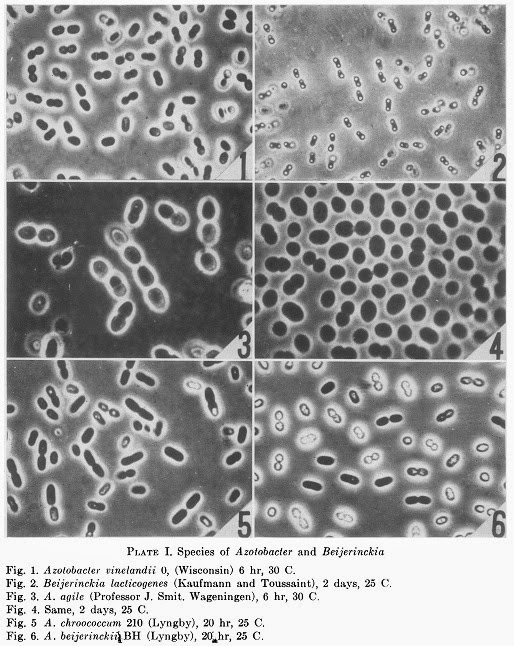
Jensen, 1954
Reference:
Jensen, H. L. The Azotobacteriaceae. Bacteriol. Rev. 18, 195–214 (1954).

Wednesday, May 13, 2015

156 - Poly-β-hydroxybutyrate biosynthesis and the regulation of glucose metabolism in Azotobacter beijerinckii

This study was intended to study carbon metabolism in Azotobacter and the formation of PHB.

What They Saw
The enzymes they studied (glucose 6-phosphate dehydrogenase, 6-phosphogluconate dehydrogenase, glyceraldehyde 3-phosphate dehydrogenase, 6-phosphogluconate dehydratase, 3-deoxy-2-oxo-6-phosphogluconate aldolase, citrate synthase, and isocitrate dehydrogenase) all seemed to be inhibited by NADH and/or NADPH.

What This Means
PHB synthesis consumes reduced nucleotides such as NADH, which could reduce their inhibitory effects when oxygen is limited.

Reference:

Tuesday, May 12, 2015

175 - Regulation of the Tricarboxylic Acid Cycle and Poly-β-hydroxybutyrate Metabolism in Azotobacter beijerinckii Grown under Nitrogen or Oxygen Limitation

When Azotobacter grows in oxygen-limited conditions, one expects that reducing equivalents such as NADH and NADPH would accumulate (since the electrons have no good acceptor). This could inhibit the TCA cycle. This study looked at different catabolic enzymes and their behavior under different nutrient limitations.

What They Saw
They grew A. beijerinckii in a chemostat with oxygen or (alleged) nitrogen limitations. As seen before, low oxygen induced PHB formation to store the carbon and as an electron sink. Adding extra oxygen caused a drop in PHB and dry weight, and then removing it reversed the effect. Enzymes for PHB synthesis showed a similar pattern.

NADH oxidase and enzymes involved in the TCA cycle of carbon catabolism (2-oxoglutarate dehydrogenase and isocitrate dehydrogenase) tended to increase activity as oxygen increased, and vice versa. NADH oxidase (part of the electron transport chain), though, fell after the initial increase and then rose again at the second increase. This enzyme seems like an important part of the genus's respiratory protection.

Some other TCA enzymes, citrate synthase and pyruvate dehydrogenase, didn't change much with oxygen changes.

They saw again that the lower the oxygen, the higher the growth yield (amount of biomass produced per unit sucrose), though probably some of this was due to PHB formation increasing the dry weight. The amount of sucrose consumed increased as oxygen increased, indicating less efficient growth.

With NADH/NAD+, when oxygen limitation was first imposed, the ratio rose greatly but then went down again quickly, and remained mostly steady with some fluctuations.

What This Means
The recovery of NADH/NAD+ ratio is likely due to the formation of PHB acting as an electron sink.

Azotobacter is kind of an interesting mix of aerobic and facultative organisms; they need oxygen, but not too much, and excess is harmful, so their respiratory systems are tightly regulated to deal with multiple different levels. The ability to fix nitrogen puts them in kind of a different category.

Reference:
Jackson, F. A. & Dawes, E. A. Regulation of the Tricarboxylic Acid Cycle and Poly-β-hydroxybutyrate Metabolism in Azotobacter beijerinckii Grown under Nitrogen or Oxygen Limitation. J. Gen. Microbiol. 97, 303–312 (1976).

Monday, May 11, 2015

165 - The Behaviour of Azotobacter chroococcum in Oxygen- and Phosphate-limited Chemostat Culture

This study looked at Azotobacter chroococcum behavior when limited in oxygen or phosphate.

What They Saw
They grew A. chroococcum in chemostats, similar to previous studies (163). In their allegedly oxygen-limited culture, biomass levels fell as dilution rate increased, while carbon dioxide production fell and then rose again for some reason; they claim it's just random, and that CO2 was actually fairly constant (or blame it on consistency of electricity in Britain). They also observed that as dilution rate decreased, the amount of PHB in the cells rose. They could tell the cells were oxygen-limited because when more oxygen was added, it disappeared pretty quickly.

When cells were phosphate-limited, extra oxygen was pretty toxic; the cells couldn't handle it. Plating cells out after this challenge revealed that there was very little viability, if any. In contrast, cells that had been oxygen-limited didn't seem to mind extra oxygen much, especially when they were grown on medium with fixed nitrogen.

What This Means
It fits pretty well with previous results. PHB seems to be an electron sink, useful when cells don't have enough oxygen to receive all their electrons.

The fact that oxygen didn't reduce cells' viability when plated on medium with fixed nitrogen suggests that the cells' problem with extra oxygen is lack of ability to fix nitrogen immediately, rather than loss of viability. Then the cells ramp up respiration to consume the extra oxygen—respiratory protection.

Reference:
Lees, H. & Postgate, J. R. The Behaviour of Azotobacter chroococcum in Oxygen- and Phosphate-limited Chemostat Culture. J Gen Microbiol 75, 161–166 (1973).

Thursday, April 30, 2015

153 - The role of oxygen limitation in the formation of poly-β-hydroxybutyrate during batch and continuous culture of Azotobacter beijerinckii

This is a study on what factors initiate production of large amounts of PHB in Azotobacter beijerinckii.

What They Saw
In batch with 5 g/L glucose, bacteria started producing PHB near the end of the exponential phase. They stopped when they had consumed all the glucose, and then consumed the PHB, but this didn't help them increase in density, possibly because the PHB itself had been a proportion of the bacterial density; it seemed to permit the increase in actual biomass.

When glucose was 20 g/L, the cells continued producing PHB and the bacterial dry weight kept increasing long after exponential phase ended; the polymer got up to 74% of the dry weight.

Using an oxygen electrode, they observed that PHB production didn't start until dissolved oxygen reached 0%, at which point exponential phase was over. So they thought it might be oxygen limitation that induced the production, unlike in other organisms where nitrogen limitation is the inducer. But to be sure that it was really oxygen and not nitrogen, they turned to chemostats.

They found that nitrogen limitation didn't induce PHB formation at any dilution rate, though growth yield increased as D increased. In contrast, in oxygen-limited conditions, the PHB content (as a proportion of dry weight) and yield seemed to decreased as D increased, starting around 45% and going down to 20%, while growth yield seemed to peak at mid-range and then fall. Glucose limitation didn't induce PHB either, though some was produced at lower dilution rates.

The sudden imposition of oxygen limitation on nitrogen-limited cultures immediately induced PHB formation, and content increased over at least 10 hours. Dry weight and OD initially went up but then back down below what it had been, possibly reflecting more efficient growth until oxygen was completely depleted. They don't show it, but claim that PHB went back down from 45% to 20% after 32 hours.

What This Means
The authors speculate that the limitation of low oxygen comes in at the level of the TCA cycle; acetyl-CoA stops being oxidized as much as before, so it starts going toward PHB synthesis.

So limited oxygen might be the best condition for these microbes: they have some but not too much, their growth is more efficient, and they produce a nice storage polymer to save food for harder times.

Reference:
Senior, P. J., Beech, G. A., Ritchie, G. A. F. & Dawes, E. A. The role of oxygen limitation in the formation of poly-β-hydroxybutyrate during batch and continuous culture of Azotobacter beijerinckii. Biochem. J. 128, 1193–1201 (1972).

Wednesday, April 29, 2015

141 - Effect of Oxygen and Nitrogen Limitation on Poly-β-Hydroxybutyrate Biosynthesis in Ammonium-Grown Azotobacter beijerinckii

Azotobacter produces PHB polymer under nutrient limitations (other than carbon); the authors wanted to see whether nitrogen-fixing conditions were required for this process. This may affect the influence of oxygen on the organism, since it doesn't require respiratory protection.

What They Saw
The capsuleless strain of A. beijerinckii they used in this study accumulated up to 70% of its dry weight as PHB in batch culture, like its parent, whether or not it was fixing nitrogen. It started accumulating right when the culture became oxygen-limited.

So they grew A. beijerinckii in low-oxygen continuous culture with ammonium. Oxygen was about 1.75%, flowing at 0.4 liters per minute. As the dilution rate increased, dry weight and PHB proportions decreased, and the cells consumed less of the available carbon and nitrogen. PHB only got up to 50% though.

When they reduced the ammonium and kept oxygen constant at about 5% saturation, they saw constant PHB at 1% of dry weight and all the ammonium was consumed (so, ammonium-limiting growth), but total dry weight and carbon consumption showed the same pattern as before.

They tried even lower levels of oxygen to see if they could get PHB up to 70% of dry weight in continuous like in batch cultures, and succeeded, when oxygen was only 0.275% of the inflow, and dilution rates were fairly high (0.18 h-1). Actually at very low oxygen, higher dilution rate meant higher PHB content, then the trend reversed at a bit higher oxygen, and then returned at an even higher level. The reversal took place when the total biomass had peaked in the highest dilution rate:
Ward et al. 1977
What This Means
As in a previous study (114), the question came up of what oxygen limitation actually means: is it the point at which oxygen is the only nutrient holding cells back from growth, or is it the point at which they change their metabolism to start producing PHB? It is poorly defined.

The biggest difference seen between nitrogen-fixing and nitrogen-assimilating conditions is the high-low-high pattern seen with ammonium, compared to a steady decrease seen when fixing nitrogen. So it seems like the main difference may only be that nitrogen fixation requires so much more energy.

Reference:

Friday, April 24, 2015

136 - Effect of Oxygen Concentration and Growth Rate on Glucose Metabolism, Poly-β-Hydroxybutyrate Biosynthesis and Respiration of Azotobacter beijerinckii

This is a study on Azotobacter beijerinckii and the effects of oxygen levels on its respiration, PHB production, and other parameters.

They varied the oxygen in the inflowing gas between 0 and atmospheric (20%), and also varied dilution rates (when not holding D at 0.1 h-1).

What They Saw
As oxygen decreased, the PHB content of cells increased up to about 50% of the dry weight near 0% oxygen. Activities of PHB-producing enzymes increased also, while glucose-6-phosphate dehydrogenase activity remained constant. Below about 5% oxygen, the culture seemed oxygen-limited (no dissolved oxygen was detectable). They also saw increased respiratory activity and carbon dioxide production as oxygen increased, and indication of respiratory protection of nitrogenase.

When they increased the dilution rates (from 0.1 up to 0.2), they saw an increase in the activity of each enzyme tested. PHB content decreased as D increased, which is inconsistent with the increase in PHB enzyme activities, but it's likely that enzymes breaking down PHB were more active too.

The Entner-Doudoroff pathways seems to be the main glucose metabolism pathway in A. beijerinckii.

Reference:
Carter, I. S. & Dawes, E. A. Effect of Oxygen Concentration and Growth Rate on Glucose Metabolism, Poly-β-Hydroxybutyrate Biosynthesis and Respiration of Azotobacter beijerinckii. J. Gen. Microbiol. 110, 393–400 (1979).

Tuesday, April 21, 2015

114 - The growth of nitrogen-fixing Azotobacter chroococcum in continuous culture under intense aeration

This study attempted to precisely define the transition from oxygen limitation to oxygen sufficiency in Azotobacter chroococcum.

They grew the bacteria in a chemostat with agitation up to 1750 rpm and different dilution rates of 0.1-0.3 h-1 in a liquid volume of 200 mL, measuring dissolved oxygen with a probe, in mannitol-containing B6 medium.

At such high feeding rates, the culture could be adapted to any level of oxygen (up to the 1750-rpm agitation limit with 20% oxygen in the flow), so that the probe was reading 0% (since it was all consumed). They tried increasing the proportion of oxygen in the flow up to 50%, but this was too much; the cells couldn't tolerate it.

What They Saw
As oxygen increased above atmospheric levels (20%) the carbon dioxide produced increased also, at all dilution rates, up to the 50% oxygen mark, when some of the cultures couldn't take it anymore. This was still true when proportional to biomass.

Biomass didn't change much with higher oxygen at lower dilution rates, though at higher rates the higher oxygen levels resulted in greater biomass. The composition of biomass didn't change much with dilution rate or oxygen level; at a low dilution rate and 20% oxygen, PHB production was about 19% of the biomass, but no more than 6% in any other condition. RNA also decreased from around 20% to closer to 10%. "Polysaccharide" was 3-4% in lower D values but 7-12% in higher, and protein increased from around 60-70 to 70-80%.

Carbon inputs and outputs were pretty balanced over different D and oxygen values; when outputs were noticeably less than inputs, there was a noticeable drop in pH (seeming to indicate incomplete oxidation of substrate).

For some reason, cells didn't do as well at lower D values; there was a loss of viability.

What This Means
The authors thought that measuring dissolved oxygen or oxygen transfer directly was not adequate to determine how much oxygen was actually getting to cells, because neither measure matched well with the amount of carbon dioxide being produced (which should correlate well with oxygen consumption). Only CO2 production, O2 consumption, or growth are reliable to measure oxygen transfer.

Still, it's hard to know exactly what "oxygen limitation" means; does it start when increasing the oxygen leads to an increase in biomass? Or when cells start producing PHB (which apparently is a much lower level)? The authors suggest the former as the better definition; this seems odd though, because they observed that biomass increased as oxygen increased up to the point when oxygen became intolerable and the cells washed out.

And yet, the cultures did seem to be oxygen-limited at 20% oxygen. The maintenance coefficient calculated from CO2 production at 20% oxygen corresponded to that which others calculated in A. vinelandii in oxygen-limited cultures (0.0055 mmol O2/mg dry weight per hour), and the respiratory index (mmol CO2 produced per mg cell growth) approached the value indicative of oxygen limitation. Above this value, excess carbon dioxide is produced, indicating respiratory protection in the cells (oxidizing the substrate to use up all the oxygen).

Reference:
Hine, P. W. & Lees, H. The growth of nitrogen-fixing Azotobacter chroococcum in continuous culture under intense aeration. Can. J. Microbiol. 22, 611–618 (1976).

Friday, December 12, 2014

203 - Encystment and alkylresorcinol production by Azotobacter vinelandii strains impaired in poly-β-hydroxybutyrate synthesis

As mentioned before, Azotobacter species can make some useful polymers, such as poly-β-hydroxybutyrate (PHB), a kind of bioplastic. A. vinelandii also makes some other potentially useful polymers: alginate, a kind of slimy polysaccharide; and compounds called alkylresorcinols. 

This last is involved in encystment, when the cells change into a more resistant, dormant state, called a cyst. Alginate is involved in that too, actually, but alkylresorcinols are lipids that replace phospholipids in the membrane. And PHB accumulates in granules in the cyst, possibly as food storage for when the cyst germinates.

What They Wanted to Know
Considering that PHB seems important for the encystment process, or at least shows up in cysts, Segura and colleagues wondered if mutating the phb genes in A. vinelandii might affect the cells' encystment.

What They Did
The scientists sequenced the region of genome containing the phb operon, and compared the open reading frames they found to known sequences. Of the genes they found, they made strains of A. vinelandii with two different genes knocked out, phbC (which makes PHB synthase) and phbB (acetoacetyl-CoA reductase), by inserting stuff into the genes; and characterized these mutants, testing their PHB production, aklylresorcinol production, and encystment. Measuring the PHB followed the usual methods, with boiling chloroform and concentrated sulfuric acid; sounds like tons of fun.

What They Observed
In the sequence they got, there were six open reading frames (ORFs). By comparing the sequences to other known PHB-related genes (such as from 174), they identified the ORFs from A. vinelandii as the PHB-producing operon phbBAC, along with the regulator-producing gene phbR. Another of the six was like phbP from Ralstonia eutropha, making a granule-associated protein, and next to that an ORF similar to phbF in R. eutropha, seemingly a putative regulator for PhbP.

Then they knocked out phbB and phbC, though not in the same strain. Neither of these mutants produced detectable levels of PHB. The phbB knockout had over 90% reduction in acetoacetyl-CoA reductase activity (makes sense) and also much less activity from PhbA or PhbC; it seemed like the mutation had polar effects on the operon. The phbC mutant only had much reduction in PHB synthase, about 95%, which makes sense, though the other enzymes were affected a little too (~40%), maybe because of unstable mRNA.

Then they induced encystment, apparently with n-butanol. Neither mutant seemed impaired; phbB knockout actually seemed to encyst more. And with a different induction method, they saw the same results, even in regular Burk medium. Obviously they didn't contain PHB granules, but this didn't seem to be a problem: their viability was the same or even higher than wild-type cysts.

Regarding alkylresorcinol production, A. vinelandii produces them when PHB or n-butanol replace glucose as a carbon source. But the authors tested the mutant strains first in regular Burk, since they apparently could form cysts in that; turns out they also were able to produce alkylresorcinols, unlike the wild-type, especially the phbB knockout, which also had greater alginate production (possibly contributing to its higher viability).

Under an electron microscope, the mutants' cysts didn't have PHB granules (of course), and in the phbB knockout strain, the exine of the cysts seemed thicker than other strains', probably due to extra alginate and alkylresorcinols.

What This Means
The phb operon is the one involved in PHB production in A. vinelandii too. Knocking out phbC seems to produce a cleaner phenotype, with less effect on the cells other than lack of PHB production. But it seems like lack of PHB channels more carbon through the lipid metabolism pathway. It doesn't seem to affect encystment much, at least not negatively, but this may only be because of the unnatural lab environment in which the cells are growing.

All this extra production of alkylresorcinol and alginate may be due to accumulation of acetyl-CoA that would normally go toward PHB. The mutant lacking PHB synthase may accumulate hydroxybutyrate instead; it's not clear what effects that might have.

Reference: Segura, D., Cruz, T. & Espín, G. Encystment and alkylresorcinol production by Azotobacter vinelandii strains impaired in poly-β-hydroxybutyrate synthesis. Arch Microbiol 179, 437–443 (2003).

Thursday, November 13, 2014

174 - Poly(3-Hydroxybutyrate) Synthesis Genes in Azotobacter sp. Strain FA8

Azotobacter is a genus that makes polyhydroxyalkanoates, especially polyhydroxybutyrate (PHB). This is a carbon-storage polymer, so the cells can store extra carbon in their environment they can't use right away, and it forms intracellular granules that can be consumed later. Also it's basically a kind of plastic, but biodegradable, so it's of some economic and biotech interest.

What They Wanted to Know
Pettinari and colleagues had a species of Azotobacter called FA8 that makes PHB, but at the time they didn't know what genes were involved in the PHB synthesis process in Azotobacter, so they wanted to figure that out. The genes are more well-studied in other species, but might not all be the same.

What They Did
They cut up genome DNA with a restriction enzyme and put it into an Escherichia coli library, then screened the strains they got for one gene in particular: phbC, which encodes PHB synthase, the final enzyme in the PHB production pathway (at least in other species). This screening was done using a PHB synthase-deficient strain of another well-known PHB-producing species, Ralstonia eutropha. If they put a plasmid into this R. eutropha and suddenly it can produce PHB again, it must have the phbC gene.

When they found an transformant of R. eutropha that produced polymer, they extracted it from the cells to analyze the monomeric units: lyophilize the cells, extract the polymer with hot chloroform, precipitate with ethanol, then analyze methyl ester derivatives with a gas chromatograph.

Then they sequenced the gene they had found, responsible for this PHB synthesis, and compared it with other known synthases, from Pseudomonas, Ralstonia, and Burkholderia species; they also looked upstream and downstream from this gene for other relevant genes, and cloned and sequenced those that they found, comparing them to other species as before.

So then to make sure the phbC gene they found actually deserved its name (and was doing what they expected), they knocked it out in Azotobacter FA8 by inserting an antibiotic resistance marker in the middle of it. First they amplified a 578-bp section of gene, inserted that product into the pGEM-T Easy vector. Then they cut this piece open with PstI, inserted a kanamycin cassette from pUC4K, and transferred this whole construct into pAT18, which can replicate in E. coli but not Azotobacter. Finally they used conjugation to transfer the plasmid from E. coli to Azotobacter, where the latter recombined with it to transfer the kan cassette into its genome, thus becoming able to resist the kanamycin used to select for transconjugants. They confirmed the PHB-lacking phenotype using the GC method described above. To make extra-sure, they made another construct in pRK404 with an intact phbC gene, transferred that to Azotobacter, and observed that it restored the PHB-producing phenotype.

Finally they wanted to see if Azotobacter FA8 could make more kinds of polymers than just PHB. There are different kinds of PHA synthases that can incorporate different monomers with different carbon-chain lengths; some prefer short chains, some longer. So they grew the bacteria on media with different carbon sources, specifically glucose and/or octanoate or hexanoate. They also tried putting genes from Pseudomonas aeruginosa in the phbC-knockout strain, which they thought might help metabolize the longer chains better. And they tried putting Azotobacter genes in R. eutropha to see what polymers they could get from there.

What They Observed
Analyzing the polymer that R. eutropha produced with the Azotobacter gene, they found it was a homopolymer composed entirely of 3-hydroxybutyrate, so, basic PHB. The gene was closely related to PHB synthase genes from other related species, as mentioned, so they named it phbC in Azotobacter. Knocking the gene out and then restoring it by complementation confirmed that it was correctly named.

There was nothing interesting downstream of phbC, but upstream they found a couple other genes that were also very similar to PHB-related genes: phbA, that encodes β-ketoacyl-CoA thiolase, and phbB, which makes acetoacetyl-CoA reductase. Together these form the phb operon, apparently in Azotobacter as well as other species. They also found some consensus regions for σ70-dependent promoters upstream of phbB.
In their experiments with polymer production, Azotobacter could only grow when glucose was present, regardless of other genes or carbon sources. And when it produced polymer at all, which was only when it had its own phbC gene, it produced only PHB. There were similar results in R. eutropha possessing Azotobacter's phbC.

What This Means
Pettinari and colleagues seem to have identified the PHA synthase-encoding gene in Azotobacter FA8 and identified the product as a short-chain specific synthase, that doesn't do much longer than four carbons per monomer. So that's good to know.

Apparently around the time this paper was in publication, someone else published A. vinelandii phbB and phbC gene sequences; comparing them to the ones in this paper, they're over 90% similar, which makes sense. So it should be possible to use knowledge of one when studying the other.

Citation: Pettinari, M. J. et al. Poly(3-Hydroxybutyrate) Synthesis Genes in Azotobacter sp. Strain FA8. Appl. Environ. Microbiol. 67, 5331–5334 (2001).

Tuesday, October 22, 2013

023 - Genome Sequence of Azotobacter vinelandii, an Obligate Aerobe Specialized To Support Diverse Anaerobic Metabolic Processes

One good way to learn a lot about a bacterial species, or at least to get a lot of hints about what it might do or be capable of doing, is to sequence its genome. So that's what a bunch of people decided to do with Azotobacter vinelandii. It makes sense, since this organism is one of the better-studied ones and has interesting capabilities, such as nitrogen fixation.

The strain they chose was called DJ, a variant of the wild-type strain CA. DJ is supposed to be easier to manipulate genetically than its parent. So they sequenced its entire genome, but focused mainly on the surprising amount of oxygen-sensitive enzymes they found in an obligately aerobic organism.

The method of sequencing, for those who care, was plain shotgun Sanger dye-terminator sequencing after generating a clone library. (Apparently, for some reason, Monsanto did a lot of the work.) I guess this was before the next-generation sequencing technologies were available or affordable. And teams of undergrads did much of the work labeling genes and such.

Overall, the genome is pretty similar to that of pseudomonads, especially Pseudomonas stutzeri (another nitrogen-fixing soil microbe). Some of their genes have been rearranged compared to each other, though, and A. vinelandii has almost 1,000 more genes.

In terms of energy-generating systems, A. vinelandii's genome has all the genes needed for aerobic metabolism but seems to lack any complete system for anaerobic respiration or fermentation. It is well-equipped for aerobic respiration though, which it seems to use to consume large amounts of oxygen that would otherwise damage its nitrogenase and other enzymes. The other mechanism it has to protect its nitrogenase is called the FeSII or Shethna protein, which can temporarily deactivate the nitrogenase when oxygen is too high, protecting it from damage.

The sequence showed the precise location of each set of nitrogenase genes relative to each other. They're somewhat spread out. It also located the mod genes for molybdenum (Mo) transport and the hox genes of the uptake hydrogenase (which are pretty close together). Though it turns out there is a second set of genes similar to the original mod operon elsewhere in the genome, that may be a second Mo transport system. Possibly even a third set right next to the first, but it's not certain what it does.

Somewhat interesting is a set of genes that are similar to something called carbon monoxide dehydrogenase (CODH) that is present in some anaerobic organisms. This can convert CO to CO2 and H2, effectively using it as an energy source instead of something toxic. But it's not certain whether this is functional in A. vinelandii at all. It may be related to some genes that seem to be related to soluble hydrogenases in other organisms, but their function isn't clear either.

A. vinelandii, some strains of it at least, is well-known for producing certain polymers: polyhydroxybutyrate (PHB), which can be used to make a kind of bioplastic; and alginate, and kind of mucusy stuff that has various uses too. The strains that make alginate are rather slimy and hard to work with, and supposedly this provides a further barrier against oxygen poisoning, but strains CA and DJ don't make it, and this sequence revealed why: a transposon inserted itself in the middle of a regulatory gene, inactivating it. That's all it takes.
The genes for PHB synthesis seem to be intact though.

Knowing the sequence of an organism is very helpful; if you want to check for new capabilities, you can just check the genome. So this is a good study.

Citation: Setubal, J. C. et al. Genome Sequence of Azotobacter vinelandii, an Obligate Aerobe Specialized To Support Diverse Anaerobic Metabolic Processes. J. Bacteriol. 191, 4534–4545 (2009).