Showing posts with label nitrogen. Show all posts

Thursday, May 5, 2016

217 - Short-Term Effect of Ammonium Chloride on Nitrogen Fixation by Azotobacter vinelandii and by Bacteroids of Rhizobium leguminosarum

The question here is how fixed nitrogen regulates nitrogenase in Azotobacter vinelandii. Adding ammonium above a certain concentration immediately shuts off nitrogen fixation, but the organism doesn't have the DRAT/DRAG enzyme system for ADP-ribosylation of the nitrogenase for posttranscriptional regulation that other organisms have.

This shut-off in A. vinelandii is not due solely to repression of nitrogenase synthesis, since that would not show an effect so quickly. To test alternative mechanisms, this paper took cells grown without fixed nitrogen, suspended them in buffer with a carbon source (sucrose or succinate) and oxygen, and measured acetylene reduction before and after adding ammonium. They also measured nucleotide phosphate levels and respiration.

As expected, adding ammonium greatly lowered nitrogen fixation. The ratio of ATP to ADP seemed mostly to increase though, so lack of ATP didn't seem to cause the inhibition. So what's left? Maybe lack of reducing equivalents used to reduce nitrogen.

Then they did a very confusing and poorly explained experiment (Fig 2) showing uptake of ammonium, which doesn't seem very surprising or informative. However, apparently adding a compound that dissipates membrane potential (valinomycin) caused the opposite effect (loss of ammonium), and another (nigericin) does the opposite (enhancing uptake), so that's somewhat interesting.

They measured proton motive force by a gradient of lipophilic cations, such as tetraphenylphosphonium, across the membrane. They also used a weak acid, 5,5-dimethyloxazolidine-2,4-dione to measure the pH gradient. The sum of these measurements was the proton motive force, in mV.

What they saw was that increasing amounts of ammonium chloride decreased the total proton motive force, but not the pH gradient part or the internal pH of the cells. So the electrical gradient was decreased. This could be because taking up a lot of ammonium, a cation, affects the charge of the membrane. I wonder if they could've tested this further using a different cation though.

Anyway, that's pretty interesting. Nitrogen fixation requires a fairly delicate redox balance, but this can be beneficial for the cells if they use imbalance to regulate their metabolism.

Reference:
Laane, C., Krone, W., Konings, W., Haaker, H. & Veeger, C. Short-Term Effect of Ammonium Chloride on Nitrogen Fixation by Azotobacter vinelandii and by Bacteroids of Rhizobium leguminosarum. Eur J Biochem 103, 39–46 (1980).

Thursday, September 3, 2015

062 - Characterization of the iron superoxide dismutase gene of Azotobacter vinelandii: sodB may be essential for viability

This study looked at superoxide dismutase in Azotobacter vinelandii, an Fe-SOD encoded by sodB, and its importance.

What They Saw
Running proteins on a gel testing for SOD activity, they saw two bands: one was Fe-SOD and the other CuZnSOD (which sits in the periplasm). They tried knocking out sodB from A. vinelandii by introducing a kanamycin resistance cassette, and isolated a kan-resistant strain, but it appeared to have two copies of sodB (only one of which was knocked out). They tried increasing the concentration of kanamycin (presumably to force the strain to have multiple copies of the resistance gene), and got one that grew slowly at 100x more kanamycin than I use, but they couldn't get rid of the SOD. Seems like it's essential.

This also supports the idea that A. vinelandii can have multiple copies of its chromosome, since they saw multiple PCR products from the same locus, with and without the resistance marker. The genome only has one copy of sodB, so there must be multiple genome copies.

Reference:
Qurollo, B. A., Bishop, P. E. & Hassan, H. M. Characterization of the iron superoxide dismutase gene of Azotobacter vinelandii: sodB may be essential for viability. Can. J. Microbiol. 47, 63–71 (2001).

Monday, July 20, 2015

457 - Hydrogenase and Nitrogen Fixation by Azotobacter

This study looked at hydrogenase in different Azotobacter species (A. vinelandii, A. chroococcum, A. agile whatever that is).

What They Saw
They looked at different kinds and amounts of fixed nitrogen and their effect and different gases in the atmosphere. Many experiments used ammonium phosphate or other forms of ammonium, and they thought maybe the drop in pH seen as ammonium was consumed led to decreased hydrogenase activity, but actually even when they used forms that didn't allow a pH drop, they still saw the same decrease, suggesting that it's the fixed nitrogen itself that leads to decreased activity. Which makes sense.

They found, consistent across species, that ammonium led to the biggest activity decrease, about 60-80%; nitrate as little as 20%; and glutamate hardly at all. I think these cultures were not adapted to these compounds though.

So they tried adapted cultures too. They found that the more fixed nitrogen they added, the less hydrogenase activity they saw. Adaptation didn't matter with ammonium, but cultures adapted to nitrate had more of a decrease in activity. Apparently they didn't test glutamate.

Then they compared cells with various nitrogen sources grown in air or in a hydrogen-oxygen mixture. They didn't test cells without a nitrogen source in this gas mixture though, maybe because they couldn't grow. Anyway, the hydrogenase was always more active in air with no fixed nitrogen than with any kind of fixed nitrogen (as seen before), and with H2-O2 the activity seemed even lower, even than with the same fixed nitrogen source in air. Activity was almost zero in nitrate-adapted cells given nitrate. This seems odd; previous studies seemed to show that hydrogen stimulated hydrogenase activity.

What This Means
I'd say other studies showing stimulation by hydrogen were more convincing, but at least this one was consistent showing an adaptation effect and down-regulation in the presence of fixed nitrogen.

Reference:
Lee, S. B. & Wilson, P. W. Hydrogenase and Nitrogen Fixation by Azotobacter. J. Biol. Chem. 151, 377–385 (1943).

Wednesday, July 8, 2015

308 - Hydrogen-mediated enhancement of hydrogenase expression in Azotobacter vinelandii

This study looked at whether added hydrogen could stimulate hydrogenase activity in Azotobacter vinelandii.

What They Saw
They grew cells with or without ammonium, then added argon or hydrogen to their headspace, and measured whole-cell or purified hydrogenase activity. Oxygen or methylene blue were electron acceptors.

With ammonium, there was a little activity, but adding hydrogen gas increased it about 2.5 to 5 times. As a control, injecting the same amount of argon didn't change anything. In nitrogen-fixing cells, adding hydrogen didn't affect activity.

As with others, activity increased over time in the culture, even corrected by biomass; the hypothesis was that excess carbon inhibits it somehow.

If they added an mRNA or protein synthesis inhibitor (rifampin or chloramphenicol) before adding the hydrogen, activity didn't increase with either case, so it seemed like the regulation was transcriptional.

Also, since the effect was the same with methylene blue (which doesn't require electron transport chain components to act as electron acceptor), it seemed that the regulation was at the hydrogenase directly rather than a related component.

Comparing a couple of Mo nitrogenase-deficient strains (CA11 and CA30) to their parent, they saw that hydrogen didn't affect hydrogenase activity in CA much (in nitrogen-fixing conditions), but it did increase the activity a lot in the mutants. The hydrogenase protein abundance increased too. But in conditions with ammonium, CA and CA11 behaved pretty similar.

Reference:
Prosser, J., Graham, L. & Maier, R. J. Hydrogen-mediated enhancement of hydrogenase expression in Azotobacter vinelandii. J. Bacteriol. 170, 1990–1993 (1988).

Tuesday, July 7, 2015

307 - The Relationship Between Hydrogenase and Nitrogenase in Azotobacter chroococcum: Effect of Nitrogen Sources on Hydrogenase Activity

This study looked at the influence of different sources of nitrogen on the activity of nitrogenase and hydrogenase in Azotobacter chroococcum.

What They Saw
They grew cells in batch or continuous culture with sodium nitrate, ammonium acetate or chloride, or dinitrogen gas. Cultures were either carbon- or sulfate-limited. Dissolved oxygen was kept above zero. Nitrogenase activity was measured by acetylene reduction and hydrogenase by methylene blue (or by adding H-T with radioactive tritium and measuring radioactivity of resulting water when oxygen was the electron acceptor).

There was about twice as much hydrogenase activity when cells were fixing nitrogen in batch than when they had either ammonium or nitrate. They cite other results in A. chroococcum and A. vinelandii that showed higher activity with nitrate than ammonium though, but still less than when fixing nitrogen. This might be because cells have to adapt to use nitrate, and they'll be fixing nitrogen before that happens. But care is necessary because activity changes over the course of a batch culture, increasing throughout exponential phase even when standardized by protein concentration.

In continuous cultures, they started growing with ammonium, then switched to nitrogen-free, watched what happened with hydrogenase and nitrogenase, and then pulsed a limited amount of ammonium. As expected, nitrogenase activity started up and rose to a plateau, then immediately stopped when ammonium was added, and restarted when it was removed. Hydrogenase activity showed a similar pattern, though more delayed, and it never went all the way to zero.

In sulfate-limited culture, hydrogenase activity was lower even when fixing nitrogen, about the same as with ammonium in carbon limitation, and when going from fixing to non-fixing (with ammonium), the activity declined a bit but then went back up to about the same level. Results were similar going from non-fixing to fixing. So with sulfate limitation, nitrogen source doesn't matter much.

Also with nitrogen-fixing cells in sulfate limitation, when they increased the dilution rate, hydrogenase activity decreased but nitrogenase increased. The decrease wasn't linear, though; it leveled off.

They also tested whether adding hydrogen to the atmosphere of an ammonium-grown culture would influence hydrogenase activity, and it did! Hydrogenase activity doubled. This was not the case with sulfate limitation though, only carbon limitation. They didn't test nitrogen-fixing cells.

What This Means
The continuous culture experiments helped overcome the constantly changing activity in batch cultures.

That hydrogenase activity lags behind nitrogenase activity increase when ammonium runs out could be explained by the last observation: maybe nitrogenase starts producing hydrogen (as it does) and this stimulates hydrogenase activity.

They reasoned from the data that excess carbon might inhibit hydrogenase activity somehow (like catabolite repression). I'm not sure that makes sense, but it seems possible, and does fit with the data from batch cultures, sulfate limitations, and increasing dilution rates. Interesting.

Reference:
Partridge, C. D. P., Walker, C. C., Yates, M. G. & Postgate, J. R. The Relationship Between Hydrogenase and Nitrogenase in Azotobacter chroococcum: Effect of Nitrogen Sources on Hydrogenase Activity. J Gen Microbiol 119, 313–319 (1980).

Friday, May 22, 2015

197 - Superoxide dismutase and catalase in Azotobacter vinelandii grown in continuous culture at different dissolved oxygen concentrations

Considering how oxygen-sensitive nitrogenase is, it might be expected that enzymes specifically involved in oxygen detoxification (such as catalase and superoxide dismutase (SOD)) might be involved in protecting such oxygen-sensitive enzymes, especially since ramping up respiration in response to increased oxygen might also ramp up the production of reactive oxygen species. This study investigates the activity of SOD and catalase in Azotobacter vinelandii at different oxygen levels.

What They Saw
They grew A. vinelandii OP (aka CA) in chemostats with different levels of oxygen, with 3 or 15 g/L sucrose. They extracted enzymes from samples and assayed them for SOD or catalase activity, and also by electrophoresis.

As oxygen saturation increased from 1% to 90%, SOD activity increased linearly (when standardized to total protein); the increase was slightly faster at lower oxygen when standardized by number of cells (probably because cell size increases as oxygen increases, 098). The sucrose concentration didn't affect things. When cells were given ammonia, SOD activity was about 2x lower.

Based on electrophoresis, they concluded that the SOD is iron-containing, rather than manganese. They tried adding manganese but still didn't see any Mn-SOD.

It didn't seem like catalase activity increased with increasing oxygen, standardized by protein. The increase standardized by cells was much more apparent.

What This Means
It seems like SOD at least might contribute to A. vinelandii's protection of its nitrogenase enzyme from oxygen.

Reference:

Monday, May 18, 2015

374 - The Azotobacteriaceae

This was a very interesting review of the Azotobacter family from more than fifty years ago. It was interesting to see observations in this paper that I had made myself in my own research.

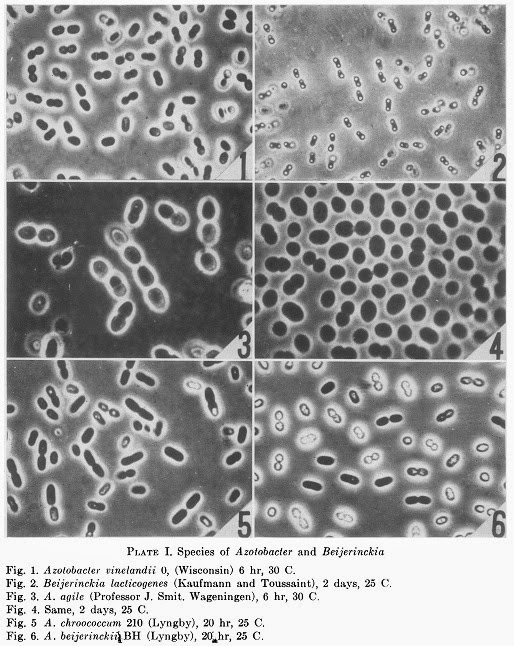
It discusses the taxonomy of Azotobacter somewhat: the genus includes A. chroococcum, A. beijerinckii, and A. vinelandii of course, and A. agile (which I'm not sure is considered a real separate species now); other alleged species (A. indicum for example) seemed like they should be separated into another genus, Beijerinckia. A. chroococcum was the first, discovered by Martius Beijerinck in 1901.

Characteristic features of Azotobacter are their large size, short thick rod-shaped cells (often found in pairs), nitrogen fixation (despite being obligate aerobes), and poor growth on digestions of meat extracts and such, like LB (something I've noticed myself). The cells change shape depending on their conditions though, which can be confusing. Worse, they can be difficult to isolate from contaminating strains. They also form resistant, dormant cysts in some conditions, though I don't think I've observed this personally. They also can form storage granules of different kinds which are observable under a microscope.

They're pretty versatile in their ability to use different carbon compounds. They can use alcohols (ethanol, propanol, butanol, etc), organic acids (acetate, citrate, butyrate, etc), and saccharides (glucose, fructose, galactose, sucrose, etc.). This depends on the species and strain somewhat; some seem to be able to use lactose, others not. Some can use starch and some other polysaccharides. Some can even use cyclic compounds (benzoic acid, phenol, salicylic acid) which are generally toxic. There are some things they can't use, such as xylose, methanol, and formic acid. Their respiration rate can be very high, the highest observed in nature (at that time, at least).

Their versatility regarding nitrogen compounds seems to be lower though. They can fix nitrogen, of course, and use basic inorganic forms (ammonia, nitrate) and some common organic forms (urea, glutamate, asparagine), but otherwise are limited. So they don't grow well on complex forms such as protein digestions (peptone, tryptone).

Otherwise, as represented in Burk medium, they need phosphorus, sulfur, potassium, calcium, magnesium, iron (amount depending on whether they were fixing nitrogen), and of course molybdenum or vanadium helped when fixing nitrogen too. Other trace elements or vitamins seem unnecessary, at least in many conditions.

The review suggests that azotobacters can produce compounds that stimulate or inhibit plant roots; I wonder if that is true.

The organisms are obligate aerobes, of course, capable of tolerating very high levels of oxygen, especially when not fixing nitrogen. They're mesophiles, preferring around 30ºC. Preferred pH depends on the strain, but around 6-8 is typical.

Some have actually reported that the weather can affect their growth, especially high-pressure areas, but this hasn't been confirmed.

Many have noticed that azotobacters seem to mutate fairly frequently; this is probably due to transposons and natural competence.

How much nitrogen do azotobacters actually fix in soils? It's hard to tell, of course, because it depends on many things and it's hard to measure the contribution of a single genus in such a complex environment, so it couldn't be said.
Jensen, 1954
Reference:
Jensen, H. L. The Azotobacteriaceae. Bacteriol. Rev. 18, 195–214 (1954).

Tuesday, May 12, 2015

175 - Regulation of the Tricarboxylic Acid Cycle and Poly-β-hydroxybutyrate Metabolism in Azotobacter beijerinckii Grown under Nitrogen or Oxygen Limitation

When Azotobacter grows in oxygen-limited conditions, one expects that reducing equivalents such as NADH and NADPH would accumulate (since the electrons have no good acceptor). This could inhibit the TCA cycle. This study looked at different catabolic enzymes and their behavior under different nutrient limitations.

What They Saw
They grew A. beijerinckii in a chemostat with oxygen or (alleged) nitrogen limitations. As seen before, low oxygen induced PHB formation to store the carbon and as an electron sink. Adding extra oxygen caused a drop in PHB and dry weight, and then removing it reversed the effect. Enzymes for PHB synthesis showed a similar pattern.

NADH oxidase and enzymes involved in the TCA cycle of carbon catabolism (2-oxoglutarate dehydrogenase and isocitrate dehydrogenase) tended to increase activity as oxygen increased, and vice versa. NADH oxidase (part of the electron transport chain), though, fell after the initial increase and then rose again at the second increase. This enzyme seems like an important part of the genus's respiratory protection.

Some other TCA enzymes, citrate synthase and pyruvate dehydrogenase, didn't change much with oxygen changes.

They saw again that the lower the oxygen, the higher the growth yield (amount of biomass produced per unit sucrose), though probably some of this was due to PHB formation increasing the dry weight. The amount of sucrose consumed increased as oxygen increased, indicating less efficient growth.

With NADH/NAD+, when oxygen limitation was first imposed, the ratio rose greatly but then went down again quickly, and remained mostly steady with some fluctuations.

What This Means
The recovery of NADH/NAD+ ratio is likely due to the formation of PHB acting as an electron sink.

Azotobacter is kind of an interesting mix of aerobic and facultative organisms; they need oxygen, but not too much, and excess is harmful, so their respiratory systems are tightly regulated to deal with multiple different levels. The ability to fix nitrogen puts them in kind of a different category.

Reference:
Jackson, F. A. & Dawes, E. A. Regulation of the Tricarboxylic Acid Cycle and Poly-β-hydroxybutyrate Metabolism in Azotobacter beijerinckii Grown under Nitrogen or Oxygen Limitation. J. Gen. Microbiol. 97, 303–312 (1976).

Thursday, May 7, 2015

097 - Aeration in fermentations

Providing oxygen in culture conditions can be tricky. It should be done homogeneously across time and space in the reactor, so all cells experience the same levels all the time. But homogenizing aeration adequately and measuring real-time dissolved oxygen levels are difficult tasks, because oxygen is not very soluble in aqueous solutions.

Azotobacter vinelandii, for example, is an obligate aerobe, so it needs some level of oxygen, but too much can be harmful when the cells are fixing nitrogen (or, at least, reduces the efficiency of the cells' product formation). So optimizing A. vinelandii culture requires determining the optimal oxygen level and how to reach that level.

What They Did
Phillips and Johnson had a reactor with pH and dissolved oxygen electrodes, aerated by agitation and sparging, and sensors of oxygen and CO2 in the exhaust gas. So a pretty nice setup.

They grew various organisms, including A. vinelandii strain O, in media with 5% glucose and measured their oxygen demands. Sometimes they added ammonia as fixed nitrogen, sometimes they didn't.

It seemed like A. vinelandii's oxygen utilization rate was the lowest, compared to E. coli, Aspergillus, and Penicillium; all of these remained constant as oxygen tension increased. It seems odd though.

In the reactor, when fixing nitrogen, A. vinelandii seemed to use excess sugar just to get rid of oxygen; its oxygen demand was much higher than expected for the growth, yield, and number of cells observed. When they added ammonia so the cells didn't fix nitrogen, they claim the same effect was observed, but I don't really understand how they reached that conclusion. Their graphs seem kind of messed up, not fitting their descriptions very well.

What This Means
Overall, the conclusion was that cells don't need more oxygen than just enough to keep the level above a critical threshold. Measuring dissolved oxygen is good for keeping above this threshold, but it doesn't help determine how much extra oxygen is needed if levels drop below measurable amounts. But when oxygen demand and uptake rates are measured, the oxygen deficit can be measured, except maybe with A. vinelandii which is more complicated.

Reference:
Phillips, D. H. & Johnson, M. J. Aeration in fermentations. Journal of Biochemical and Microbiological Technology and Engineering 3, 277–309 (1961).

Thursday, April 30, 2015

153 - The role of oxygen limitation in the formation of poly-β-hydroxybutyrate during batch and continuous culture of Azotobacter beijerinckii

This is a study on what factors initiate production of large amounts of PHB in Azotobacter beijerinckii.

What They Saw
In batch with 5 g/L glucose, bacteria started producing PHB near the end of the exponential phase. They stopped when they had consumed all the glucose, and then consumed the PHB, but this didn't help them increase in density, possibly because the PHB itself had been a proportion of the bacterial density; it seemed to permit the increase in actual biomass.

When glucose was 20 g/L, the cells continued producing PHB and the bacterial dry weight kept increasing long after exponential phase ended; the polymer got up to 74% of the dry weight.

Using an oxygen electrode, they observed that PHB production didn't start until dissolved oxygen reached 0%, at which point exponential phase was over. So they thought it might be oxygen limitation that induced the production, unlike in other organisms where nitrogen limitation is the inducer. But to be sure that it was really oxygen and not nitrogen, they turned to chemostats.

They found that nitrogen limitation didn't induce PHB formation at any dilution rate, though growth yield increased as D increased. In contrast, in oxygen-limited conditions, the PHB content (as a proportion of dry weight) and yield seemed to decreased as D increased, starting around 45% and going down to 20%, while growth yield seemed to peak at mid-range and then fall. Glucose limitation didn't induce PHB either, though some was produced at lower dilution rates.

The sudden imposition of oxygen limitation on nitrogen-limited cultures immediately induced PHB formation, and content increased over at least 10 hours. Dry weight and OD initially went up but then back down below what it had been, possibly reflecting more efficient growth until oxygen was completely depleted. They don't show it, but claim that PHB went back down from 45% to 20% after 32 hours.

What This Means
The authors speculate that the limitation of low oxygen comes in at the level of the TCA cycle; acetyl-CoA stops being oxidized as much as before, so it starts going toward PHB synthesis.

So limited oxygen might be the best condition for these microbes: they have some but not too much, their growth is more efficient, and they produce a nice storage polymer to save food for harder times.

Reference:
Senior, P. J., Beech, G. A., Ritchie, G. A. F. & Dawes, E. A. The role of oxygen limitation in the formation of poly-β-hydroxybutyrate during batch and continuous culture of Azotobacter beijerinckii. Biochem. J. 128, 1193–1201 (1972).

Wednesday, April 29, 2015

141 - Effect of Oxygen and Nitrogen Limitation on Poly-β-Hydroxybutyrate Biosynthesis in Ammonium-Grown Azotobacter beijerinckii

Azotobacter produces PHB polymer under nutrient limitations (other than carbon); the authors wanted to see whether nitrogen-fixing conditions were required for this process. This may affect the influence of oxygen on the organism, since it doesn't require respiratory protection.

What They Saw
The capsuleless strain of A. beijerinckii they used in this study accumulated up to 70% of its dry weight as PHB in batch culture, like its parent, whether or not it was fixing nitrogen. It started accumulating right when the culture became oxygen-limited.

So they grew A. beijerinckii in low-oxygen continuous culture with ammonium. Oxygen was about 1.75%, flowing at 0.4 liters per minute. As the dilution rate increased, dry weight and PHB proportions decreased, and the cells consumed less of the available carbon and nitrogen. PHB only got up to 50% though.

When they reduced the ammonium and kept oxygen constant at about 5% saturation, they saw constant PHB at 1% of dry weight and all the ammonium was consumed (so, ammonium-limiting growth), but total dry weight and carbon consumption showed the same pattern as before.

They tried even lower levels of oxygen to see if they could get PHB up to 70% of dry weight in continuous like in batch cultures, and succeeded, when oxygen was only 0.275% of the inflow, and dilution rates were fairly high (0.18 h-1). Actually at very low oxygen, higher dilution rate meant higher PHB content, then the trend reversed at a bit higher oxygen, and then returned at an even higher level. The reversal took place when the total biomass had peaked in the highest dilution rate:
Ward et al. 1977
What This Means
As in a previous study (114), the question came up of what oxygen limitation actually means: is it the point at which oxygen is the only nutrient holding cells back from growth, or is it the point at which they change their metabolism to start producing PHB? It is poorly defined.

The biggest difference seen between nitrogen-fixing and nitrogen-assimilating conditions is the high-low-high pattern seen with ammonium, compared to a steady decrease seen when fixing nitrogen. So it seems like the main difference may only be that nitrogen fixation requires so much more energy.

Reference:

Tuesday, April 21, 2015

114 - The growth of nitrogen-fixing Azotobacter chroococcum in continuous culture under intense aeration

This study attempted to precisely define the transition from oxygen limitation to oxygen sufficiency in Azotobacter chroococcum.

They grew the bacteria in a chemostat with agitation up to 1750 rpm and different dilution rates of 0.1-0.3 h-1 in a liquid volume of 200 mL, measuring dissolved oxygen with a probe, in mannitol-containing B6 medium.

At such high feeding rates, the culture could be adapted to any level of oxygen (up to the 1750-rpm agitation limit with 20% oxygen in the flow), so that the probe was reading 0% (since it was all consumed). They tried increasing the proportion of oxygen in the flow up to 50%, but this was too much; the cells couldn't tolerate it.

What They Saw
As oxygen increased above atmospheric levels (20%) the carbon dioxide produced increased also, at all dilution rates, up to the 50% oxygen mark, when some of the cultures couldn't take it anymore. This was still true when proportional to biomass.

Biomass didn't change much with higher oxygen at lower dilution rates, though at higher rates the higher oxygen levels resulted in greater biomass. The composition of biomass didn't change much with dilution rate or oxygen level; at a low dilution rate and 20% oxygen, PHB production was about 19% of the biomass, but no more than 6% in any other condition. RNA also decreased from around 20% to closer to 10%. "Polysaccharide" was 3-4% in lower D values but 7-12% in higher, and protein increased from around 60-70 to 70-80%.

Carbon inputs and outputs were pretty balanced over different D and oxygen values; when outputs were noticeably less than inputs, there was a noticeable drop in pH (seeming to indicate incomplete oxidation of substrate).

For some reason, cells didn't do as well at lower D values; there was a loss of viability.

What This Means
The authors thought that measuring dissolved oxygen or oxygen transfer directly was not adequate to determine how much oxygen was actually getting to cells, because neither measure matched well with the amount of carbon dioxide being produced (which should correlate well with oxygen consumption). Only CO2 production, O2 consumption, or growth are reliable to measure oxygen transfer.

Still, it's hard to know exactly what "oxygen limitation" means; does it start when increasing the oxygen leads to an increase in biomass? Or when cells start producing PHB (which apparently is a much lower level)? The authors suggest the former as the better definition; this seems odd though, because they observed that biomass increased as oxygen increased up to the point when oxygen became intolerable and the cells washed out.

And yet, the cultures did seem to be oxygen-limited at 20% oxygen. The maintenance coefficient calculated from CO2 production at 20% oxygen corresponded to that which others calculated in A. vinelandii in oxygen-limited cultures (0.0055 mmol O2/mg dry weight per hour), and the respiratory index (mmol CO2 produced per mg cell growth) approached the value indicative of oxygen limitation. Above this value, excess carbon dioxide is produced, indicating respiratory protection in the cells (oxidizing the substrate to use up all the oxygen).

Reference:
Hine, P. W. & Lees, H. The growth of nitrogen-fixing Azotobacter chroococcum in continuous culture under intense aeration. Can. J. Microbiol. 22, 611–618 (1976).

Monday, April 20, 2015

112 - The Effect of Nutrient Limitation on Hydrogen Production by Nitrogenase in Continuous Cultures of Azotobacter chroococcum

That nitrogenase produces hydrogen gas had been known for a while; this study wanted to see how different nutrient limitations affected this phenomenon.

They grew Azotobacter chroococcum on mannitol B medium in continuous culture, with limitations in carbon, sulfate, oxygen, or dinitrogen. Then they measured acetylene reduction, hydrogen production, and oxygen consumption in vivo and the former two on purified nitrogenase. Also update hydrogenase activity directly.

What They Saw
There was very little hydrogen evolved by oxygen-limited cultures in air, unless the uptake hydrogenase was inhibited by acetylene first. Replacing air with an argon/oxygen/CO2 mix (without nitrogen) also increased hydrogen evolution to a similar level. With both treatments, the hydrogen seen was much higher.

When limited in sulfate, the hydrogen produced under air (with hydrogenase active) or under argon mix seemed much higher (at least proportional to the amount of protein in cells).

Under argon mixes with different proportions of oxygen, hydrogen evolution seemed highest around 10% oxygen. With nitrogen instead of argon, the peak was similar. Too much or too little oxygen was not good. And despite the high amount of hydrogen, around 10% (actually between 6-12%) was when the most nitrogen was being fixed too, such that the ratio of hydrogen produced to nitrogen fixed was as low as 1 (or 0.5, when sulfate-limited).

In carbon-limited cultures, though, the optimum oxygen value was 3%, though oxygen consumption increased as oxygen increased, at least up to 6%.

In vitro, the hydrogen-nitrogen ratio increased as the ratio of dinitrogenase to dinitrogenase reductase increased, though higher levels of ATP decreased this effect. Sulfate limitation didn't really affect this finding.

What This Means
This makes sense; some oxygen is required to generate ATP to power the nitrogenase, but too much oxygen requires extra carbon to detoxify it, so there's less energy for nitrogenase.

It seems like a lack of dinitrogenase reductase or ATP reduces the ability to fix nitrogen instead of just producing hydrogen. I wonder if dinitrogenase has any effect on its own in the absence of ATP or its other component.

Chemically it's unclear how or why nitrogenase produces hydrogen, but it seems to be an essential part of the nitrogen fixation process.

Reference:
Walker, C. C., Partridge, C. D. P. & Yates, M. G. The Effect of Nutrient Limitation on Hydrogen Production by Nitrogenase in Continuous Cultures of Azotobacter chroococcum. J. Gen. Microbiol. 124, 317–327 (1981).

Friday, April 17, 2015

111 - Localization and activities of nitrogenase, glutamine synthetase and glutamate synthase in Azotobacter vinelandii grown in oxygen-controlled continuous culture

Previous research showed that A. vinelandii forms intracellular membrane structures in certain oxygen conditions (098). This could function to protect the sensitive nitrogenase from oxygen, except that one study seemed to disprove any such enzyme localization; this study was inadequate though.

So Röckel, Oelze and colleagues decided to test this hypothesis better, using oxygen-controlled continuous culture. They also tested localization of glutamine and glutamate synthases (which incorporate nitrogenase-fixed nitrogen into biomass).

What They Saw
First, the more oxygen saturation, the less nitrogenase activity (and protein content in general) they observed. In cell-free extracts, nitrogenase was only found in the soluble fraction (and thus wasn't membrane-bound). Glutamine synthase also seems all soluble.

With glutamate synthase, on the other hand, as oxygen increased, membrane-bound activity increased while soluble activity decreased.

What This Means
It's not impossible that the soluble-seeming enzymes may have a weak attachment to membranes that couldn't be resolved in this study, but it didn't seem like the membranes affected them much. The increase in membrane-bound glutamate synthase might be a form of stabilization with increasing oxygen.

Reference:
Röckel, D., Hernando, J. J., Vakalopoulou, E., Post, E. & Oelze, J. Localization and activities of nitrogenase, glutamine synthetase and glutamate synthase in Azotobacter vinelandii grown in oxygen-controlled continuous culture. Archives of Microbiology 136, 74–78 (1983).

Friday, February 20, 2015

022 - The Influence of Fixed Nitrogen on Azotobacter

Azotobacter fixes nitrogen very well, but if fixed nitrogen is already available, it'll use that first. Makes sense; why waste the energy?

Others had already found that Azotobacter could use nitrogen in various forms—nitrates, ammonium, peptides. But their methods were somewhat coarse and clumsy.

What They Wanted to Know
Burk and Lineweaver wanted to use better techniques (for the time) to investigate Azotobacter's nitrogen physiology more thoroughly.

What They Did
They measured oxygen consumption by organisms grown in something pretty close to what is called Burk medium today. They also measured cell growth by direct cell counting. This experiment was done with both A. chroococcum and A. vinelandii.

They claim that changes in growth rate correlate well with changes in oxygen consumption. This means oxygen consumption can be a proxy for growth/nitrogen fixation, though the correlation is not the same in all conditions for all strains. Also, growth efficiency increases as growth rate increases, so less oxygen is consumed. So it's hard to extrapolate much.

Then, with some cultures, they added humic acid to influence the growth rate (it seemed to increase it). And measured growth rate and respiration rate in various atmospheres, each with 20% oxygen, varying concentrations of nitrogen, and the remainder hydrogen.

They also tried growing cultures with different forms of fixed nitrogen to see which inhibited nitrogen fixation.

What They Observed
The Relation of Growth and Respiration
With or without humic acid, the respiration rate increased as the proportion of nitrogen gas in the headspace increased, though the final value was a lot higher when humic acid was present. In terms of the ratio of the increase of growth over the increase of respiration rate, this also increased as nitrogen proportion increased, and when humic acid was present it increased more. So as nitrogen increased, the proportionality of growth and respiration changed.

It also seemed like the more humic acid, the better the growth and respiration, up to about 0.5 mg/mL (above which the effect leveled off). And adding fixed nitrogen in the form of ammonia definitely helped, the more the better up to 0.05 mg/mL; and the ratio of growth increase to respiration increase was much higher than with humic acid or nitrogen gas. So the type of nitrogen provided affects this ratio.

Growth Efficiency Depends on Oxygen Concentration
They also noticed that this ratio increases greatly as the oxygen concentration goes down. This makes sense, since less oxygen is being consumed, but it means the efficiency of growth goes up, as we've seen in other studies (090, 105). Presence or lack of ammonia doesn't seem to affect this.

Inhibition of Nitrogen Fixation
In 21% oxygen, with the remainder either nitrogen or hydrogen (man, 21:79% oxygen:hydrogen seems like a recipe for explosions), the type of gas didn't affect the respiration of cells when added fixed nitrogen was above 5 mg/L; below this amount, the cells started fixing nitrogen, and then growth and respiration increased more with nitrogen gas than with hydrogen.

When they added nitrate instead of ammonia, they observed the same thing: 5mg/L was sufficient to inhibit nitrogen fixation, at least as measured by amount of growth.

And in either case, the amount of nitrogen in the cells remains pretty constant regardless of whether cells are fixing it or just taking it up already fixed.

What This Means
Azotobacter's ratio of growth to respiration probably varies so much because its respiration rate can vary so much, up to 3 times its own dry weight in glucose per hour, which is 25 times more than yeast. It's just interesting that growth and respiration are so loosely connected; in some conditions, growth can change 89-fold while respiration only changes 5-fold.

I'm not really clear on why the humic acid has the effect it does.

It seems that the type of fixed nitrogen doesn't matter when it comes to inhibiting nitrogen fixation, at least between ammonia and nitrate. Other forms might be different; the authors cite some other work that showed that peptone might have less inhibitory effect (or perhaps just as much).

Overall, some interesting basic observations of Azotobacter physiology, made only a few decades after A. vinelandii was discovered.

Reference:
Burk, D. & Lineweaver, H. The Influence of Fixed Nitrogen on Azotobacter. J. Bacteriol. 19, 389–414 (1930).

Wednesday, January 7, 2015

021 - Nitrogen fixation system of tungsten-resistant mutants of Azotobacter vinelandii

People had known at this point that tungsten was poisonous to nitrogenase in Azotobacter vinelandii. It seemed to replace molybdenum in the primary nitrogenase, rendering it non-functional for nitrogen fixation. But then Paul Bishop and colleagues discovered some strains that could grow in the presence of tungsten, using alternative nitrogenases (001). So Riddle and colleagues wanted to characterize such strains and their weird nitrogenases.

What They Did
The scientists first isolated some tungsten-tolerant mutants of their own. This is pretty simple; just grow cells (in this case, A. vinelandii ATCC 12837) in the presence of tungsten, and some tolerant mutants are likely to grow. They chose one and called it WD2 (for Tungsten-Derived 2). For some reason they grew their bacteria at 35ºC, which seems odd because usually Azotobacter is grown at 30ºC, but whatever.

Then they confirmed WD2's ability to grow and fix nitrogen in the presence of tungsten, compared to the parent, did acetylene reduction assays to measure nitrogenase activity, and ran 2-D gels to compare proteomics of the cells in different conditions. Finally they used electron spin resonance (ESR) and other tests to see the chemical characteristics of the cells' enzymes.

What They Observed
They compared the growth of the wild-type and WD2 in broth with or without tungsten. WD2's growth in tungsten was in between the growth of the wild-type in tungsten-free broth and the wild-type in broth with tungsten. Wild-type with tungsten didn't grow hardly at all, as expected. So tungsten inhibits WD2's growth a little bit, compared to the wild-type. To be fair, the amount of tungsten they used was 1000 times more than the minimum needed to inhibit nitrogen fixation in the wild-type.

Then they grew WD2 with various combinations of Mo and W. The growth curves were all pretty similar, not clearly significantly different, but the one with Mo and no W grew best and the one with W and no Mo was worst. Others were in between as expected (more Mo = better, more W = worse), so it seems like a good trend.

They measured acetylene reduction (as a proxy for nitrogen in nitrogenase activity assays) with the wild-type and WD2 (with tungsten), with various concentrations of acetylene in the atmosphere. In each case, activity (as measured by ethylene produced) was highest early in the exponential growth phase. It was not clear (to my eyes) that different amounts of acetylene or the different strains had significant effects on activity. It seemed like perhaps the higher concentrations permitted more activity later in the growth phase. WD2 in W broth showed only 17% the activity of the wild-type in regular broth.

2-D gels showed different profiles for WD2 in regular Burk broth vs. broth with tungsten, though it's always tough to interpret gel images on their own (as two of the same rarely look alike). It did seem like WD2 and the wild-type with ammonium showed similar profiles, and WD2 with tungsten or even with Mo was different, indicating different proteins for tungsten-tolerant nitrogen fixation. ESR spectra of the different proteins were different too.

With heat-extracted proteins from Mo-grown wild-type or W-grown WD2 cells, the wild-type had about 1 nmol Mo per mg protein, whereas WD2 had negligible, but had 18 nmol W. Acetylene reduction activity was much different too: wild-type had more than 10x the activity of WD2, at least in terms of ethylene produced. Spectra were very different too, especially in the band associated with the Mo-iron cofactor.

What This Means
Overall, WD2's results seem to agree with those of others (001), that mutants of wild-type A. vinelandii can fix nitrogen and grow in the presence of tungsten. And the 2-D gels apparently look similar between these two groups of researchers.

Some of the results (growth curves with different Mo:W ratios) seem to indicate that WD2 was using Mo even when tungsten was present. Others (2-D gels) seemed to indicate otherwise.

Based on the acetylene reduction assay, cells might have lower affinity for acetylene later in their growth phase.

Not much new, but it corroborates some data.

Reference:
1. Riddle, G. D., Simonson, J. G., Hales, B. J. & Braymer, H. D. Nitrogen fixation system of tungsten-resistant mutants of Azotobacter vinelandii. J. Bacteriol. 152, 72–80 (1982).

Wednesday, December 10, 2014

248 - NAD-, NMN-, and NADP-dependent modification of dinitrogenase reductases from Rhodospirillum rubrum and Azotobacter vinelandii

What They Knew
Nitrogen fixation is a demanding process, using a lot of energy, so bacteria regulate it tightly, shutting it off whenever fixed nitrogen is available already. One diazotroph, Rhodospirillum rubrum, regulates its nitrogenase by ADP-ribosylating the dinitrogenase reductase component, using a protein called Dinitrogenase Reductase ADP-ribosyl Transferase, or DRAT. This takes ADP-ribose from NAD when ammonium is present. Another protein, Dinitrogenase Reductase-Activating Glycohydrolase (DRAG), reverses the process.

What They Wanted to Know
Ponnuraj and colleagues studied the nitrogenases of R. rubrum and Azotobacter vinelandii to see how specifically each interacted with the DRAT/DRAG system and various ADP-ribosyl donors.

What They Did
They took different ADP-ribosyl containing molecules (NAD, NADP, NADH, NMN), combined each with A. vinelandii's dinitrogenase reductase (DNR) and R. rubrum's DRAT, then ran them with SDS-PAGE along with samples lacking the molecules, to see which molecules could be used to donate ADP-ribosyl. They also exposed some of each sample to DRAG and ran that alongside to see if it could remove the modification.
Results from this were confirmed with another test, seeing if modified or de-modified DNR could function with dinitrogenase to reduce acetylene.

To see how small a modification works to inactivate the system, they removed a phosphate from phosphoribosylated DNR and tested it again.

In addition to testing A. vinelandii's DNR, they tested R. rubrum's too.

To see more specifically what was going on with A. vinelandii's DNR, they used MALDI-TOF mass spectroscopy.

What They Observed
Based on gels and activity assays, NAD, NMN, and NADP all seemed pretty good at donating to DRAT to inactivate A. vinelandii's DNR. NAAD not so much, or anything else they tried. DRAG seemed able to re-activate DNR with all of them too.

Surprisingly, with R. rubrum's DNR, only NAD seemed to be a good donor. Mass spec results confirmed their expectations about what was going on biochemically.

What This Means
R. rubrum uses DRAT and DRAG to regulate its nitrogenase activity based on whether fixed nitrogen is available already and whether its environment is illuminated or not. This helps save energy, so it doesn't have to break down the whole system and reconstruct it with every little environmental change.

It's not clear how relevant it is for A. vinelandii, though, because that organism doesn't appear to have the genes to produce DRAT/DRAG proteins. It's somewhat interesting that R. rubrum's proteins are able to modify A. vinelandii's nitrogenase, arguably even better than they can with R. rubrum's, but this actually makes some sense, that R. rubrum would have tighter control over its nitrogenase regulation system. Though apparently some in vivo studies suggest it might not be as tight as it seemed here.

This doesn't necessarily mean that A. vinelandii doesn't have a system for post-translational regulation, just that it isn't exactly this one. I haven't found what it is yet, if there is one. And other studies seem to imply that A. vinelandii might not have such tight control (010). I wonder why.

Reference:
Ponnuraj, R. K., Rubio, L. M., Grunwald, S. K. & Ludden, P. W. NAD-, NMN-, and NADP-dependent modification of dinitrogenase reductases from Rhodospirillum rubrum and Azotobacter vinelandii. FEBS Letters 579, 5751–5758 (2005).

Wednesday, November 5, 2014

013 - Molybdenum-independent nitrogenases of Azotobacter vinelandii: a functional species of alternative nitrogenase-3 isolated from a molybdenum-tolerant strain contains an iron-molybdenum cofactor

What They Wanted to Know
Pau et al. knew that Azotobacter vinelandii had three versions of nitrogenase, including one with no heterometal (Mo or V), only iron. All of these had similar requirements for energy and conditions. They're all similar in structure too, except that the alternatives both have an extra subunit.

So Pau and colleagues wanted to purify the iron-only dinitrogenase from A. vinelandii and analyze its structure and such.

What They Did
They used a strain of A. vinelandii with the genes for Mo and V nitrogenases deleted, so the only one it could produce was the iron-only one. Since this strain couldn't fix nitrogen in the presence of Mo (it represses the alternatives), they selected for a mutant that didn't have this limitation: RP306. They grew large amounts of this strain (in a 400-L fermenter) and purified the nitrogenase from it. Then they analyzed the enzymatic activity and chemical structure of protein and metallic cofactor.

What They Saw
The parent of strain RP306 couldn't grow by fixing nitrogen when molybdenum (Mo) was higher than 5nM in the medium, but RP306 actually grew better as Mo increased, up to 20nM.

Since the V nitrogenase has an extra subunit (δ) encoded by the vnfG gene, and the Fe nitrogenase has a homologous gene, anfG, Pau et al. thought that it might encode a δ subunit also. So they analyzed the subunits of the dinitrogenase with SDS-PAGE, and did indeed see a third small subunit as expected, whose amino acid sequence corresponds to the sequence of the anfG gene.

In terms of metal content, the dinitrogenase seemed to have about 24 atoms of iron and 18 of sulfur, which corresponded well to previous work. Not surprisingly, it had negligible V, but surprisingly it had 1 atom of Mo. So they analyzed it with electron paramagnetic resonance or EPR spectroscopy, which gives different curves depending on the chemical composition, and it seemed like the iron-only nitrogenase actually had a Mo-containing cofactor! Though it seemed like only one of the two cofactors in the dinitrogenase contained Mo. They were able to extract this cofactor, observed that it had a Mo-to-Fe ratio of 1:4.3, and could insert into a cofactor-less Mo nitrogenase from Klebsiella pneumoniae and make it active.

This Fe dinitrogenase with a Mo cofactor could reduce acetylene, but only to ethylene, not to ethane like regular V and Fe nitrogenases could produce. This activity, or any other, was only present when the enzyme was paired with the iron-only version of dinitrogenase reductase, not with the other versions.

With other substrates (N2) or no substrate (just argon), this Fe nitrogenase didn't perform as well as the Mo nitrogenase. With argon, it produced 350 nmol hydrogen per minute per mg of enzyme, compared to 2220 from the Mo version; with nitrogen, it produced about 100 times less ammonia than the Mo version, but twice as much hydrogen as ammonia. This is about 4 times as much as expected from the Mo version, which produces one hydrogen per nitrogen fixed. So about 57% or 4/7ths of its electron flux goes to hydrogen, compared to 25% of the Mo nitrogenase's. They also saw some ethane produced from acetylene somehow, especially when the ratio of dinitrogenase reductase to dinitrogenase was higher; at least half the electron flux went to ethane.

What This Means
Apparently the allegedly iron-only nitrogenase can incorporate Mo-containing cofactor, at least partially, and this affects its activity. I wouldn't expect this to happen much in nature, since in the presence of Mo the Fe nitrogenase wouldn't be produced, so it's not clear what this really means in terms of enzyme activity. It seems important to exclude Mo from the medium when studying the real activity of the Fe nitrogenase though.

From other results, it seems like the cofactors, despite their differences in metal content, can substitute for each other in the holoenzymes, though the resulting activity changes (not surprisingly). The cells rely on regulation of genes that produce the proteins and cofactors to keep things running the way they should be, rather than specificity of cofactor for protein. But it's probably usually not disastrous if there are a few mix-ups. The activity is best with the right match, but it still works somewhat with some mismatches.

Citation: Pau, R. N., Eldridge, M. E., Lowe, D. J., Mitchenall, L. A. & Eady, R. R. Molybdenum-independent nitrogenases of Azotobacter vinelandii: a functional species of alternative nitrogenase-3 isolated from a molybdenum-tolerant strain contains an iron-molybdenum cofactor. Biochem. J. 293, 101–107 (1993).

Friday, October 3, 2014

010 - Formation of the nitrogen-fixing enzyme system in Azotobacter vinelandii

Apparently, it had previously been shown that ammonium repressed nitrogen fixation in Azotobacter vinelandii, and even when fixing nitrogen, cells would immediately take up ammonium when it was given, but would not immediately start fixing nitrogen if they ran out of ammonium. They wanted to look at this lag period more closely.

What They Did
They grew A. vinelandii OP (aka CA) in Burk's nitrogen-free medium, and actually this is the paper most people later cited as the best recipe for Burk's, the standard medium for growing A. vinelandii.

So they grew the cells, sometimes with ammonium acetate or potassium nitrate as fixed nitrogen sources, sometimes with chloramphenicol to prevent protein synthesis. They also did enzyme activity assays with nitrogenase, using 15N2. And determined protein content of cells.

What They Observed
The first figure, taken from Strandberg's master's thesis, shows that when A. vinelandii is grown in a nitrogen-free atmosphere with ammonium, growth eventually levels off; if N2 is then added, cells start growing again after a short lag, 30-60 minutes. But if ammonium is added instead, there's no lag; the cells start growing again immediately. If N2 was present the whole time, the cells switch to nitrogen-fixing pretty quickly when ammonium runs out, with a small decrease in growth rate.

A better demonstration for this lag was nitrogenase activity assays: it showed right when nitrogen fixation activity started, about 1 1/4 hours after ammonium ran out. Though oxygen levels and temperature possibly weren't ideal. It could be as little as 45 minutes later.

Another interesting observation was that when ammonium ran out and cells were in an environment of 40% oxygen (with the rest 60% helium or hydrogen), they didn't start producing nitrogenase, but they did start when oxygen was only 20%. The hydrogen level didn't seem to matter.

One problem they encountered was that there were small amounts of nitrogen in their gas tanks of oxygen, helium, and hydrogen, which could've been enough to affect the results. They tried to make purer oxygen by electrolysis (splitting water), though there was still a bit of nitrogen; still, it wasn't clear whether nitrogenase production was induced by the presence of nitrogen or merely repressed by ammonium. My guess would be the latter, since cells wouldn't normally encounter N2-free environments in nature. But regulation can be complicated.

They noticed a slight rise in turbidity even after ammonium ran out, but speculated it could be due to color change that cells go through (from reddish brown to dark brown) when fixing nitrogen. The small amount of nitrogen in the gas flow was enough to get cells to produce nitrogenase, but not enough for them to use it. But cell-free extracts didn't show different absorbance for the two kinds of cells, despite the visible difference.

When they added chloramphenicol, an antibiotic that inhibits protein synthesis, obviously this inhibited nitrogenase formation. If the enzyme was already present, in vitro, the antibiotic didn't inhibit it. But it did inhibit it in cells, possibly because ammonium built up with no way to use it, repressing nitrogenase.

They tried adding 150 mg N (as ammonium) per liter to a culture of nitrogen-fixing cells, and saw that nitrogenase activity dropped off within about 3 hours. Not as fast as I would expect. They interpreted this to mean that the enzyme is not inhibited immediately, just diluted out as the cells stop producing it while continuing to multiply; but it seems to be inactivated faster than just by dilution, so there might be some inactivation or degradation going on.

Citation: Strandberg, G. W. & Wilson, P. W. Formation of the nitrogen-fixing enzyme system in Azotobacter vinelandii. Can. J. Microbiol. 14, 25–31 (1968).

Tuesday, September 30, 2014

106 - Control of dinitrogen fixation in ammonium-assimilating cultures of Azotobacter vinelandii

What They Wanted to Know
As mentioned last time (105), as the carbon-to-nitrogen ratio of culture medium increases (and the carbon becomes a lot more available than fixed nitrogen), Azotobacter vinelandii biomass stays fairly level for a time, and then starts increasing; it's like two different phases. This depends on the oxygen exposure somewhat (at low oxygen, biomass increases more linearly; at high oxygen, it doesn't increase much at all, at least at the C/N ratios tested), but is a definite phenomenon at some levels.

The hypothesis is that, when there's not much more carbon than fixed nitrogen, there's not enough nitrogen to produce much more biomass (nitrogen is limiting), and there's not enough carbon to make the cells start fixing nitrogen (because that takes a lot of energy; so carbon is also limiting). But as carbon increases, the cells start up their nitrogenase, and nitrogen stops being limiting, so biomass increases.

In this paper, Bühler, Oelze, and colleagues wanted to see if this was actually what was happening in the cells, by testing nitrogenase activity directly.

What They Did

As before, they grew A. vinelandii CA in a chemostat, but this time they measured nitrogenase activity by acetylene reduction (nitrogenase can reduce acetylene/ethyne to ethylene/ethene, which is easy to measure). They also measured total nitrogen and protein contents of the culture, corrected for added ammonium. And to make triple-sure, they did Western blots on samples of culture, using antibodies targeting nitrogen-fixing proteins.

What They Observed
As in 105, protein/nitrogen content remained fairly constant at a mid-range oxygen level up to a point as sucrose increased, and beyond that point, it increased proportionally along with dry weight.

For nitrogenase activity, they saw that the higher the oxygen, the higher the C/N ratio had to be before the cells had detectable nitrogenase activity (and the lower the peak activity at the highest carbon level). After nitrogenase started, it increased up to a certain C/N level, then leveled off. 

They give a formula for how to calculate the C/N ratio when nitrogenase starts working. And based on that, they figured out that cells started fixing nitrogen when the ammonium they were given was not enough for production of biomass from the sucrose they were given. Which makes sense. That happens at about 14 mmol ammonium per gram of protein.

Finally, they wanted to figure out whether nitrogenase proteins needed to be synthesized from scratch in ammonium-grown cells, or whether they were already present to some extent, just not active. So they used Western blots to look at nitrogenase proteins from cells at various C/N ratios. The lowest ratio showed no nitrogenase activity and no visible nitrogenase protein on the blot; mid-range showed slight activity and the faintest of bands; and the highest showed good activity and solid, visible bands. Flavodoxin proteins, related to electron transport to nitrogenase, showed up at all ratios, interestingly.

What This Means
It appears from this that cells have to produce nitrogenase proteins from scratch as C/N ratios increase, but I'm not sure it's clear that inactive versions of the proteins would show up on the blot. Maybe the antibodies they used to detect the active versions don't work well on inactive versions. It's possible.

The other possibility is that A. vinelandii does keep inactive nitrogenase around for short periods, but eventually breaks it down, and the cells in this study were kept too long in nitrogen-sufficient conditions, so they had to re-synthesize nitrogenase. This would make sense too.

In order to explain the nitrogenase regulation, the authors say it's tempting to say the need for respiratory protection is why cells don't fix nitrogen until C/N ratios are high enough, but clarify that another explanation could be that the cells just have enough fixed nitrogen until a certain point. A tricky conclusion to a tricky series of studies. Perhaps I will revisit later.

Citation: Bühler, T. et al. Control of dinitrogen fixation in ammonium-assimilating cultures of Azotobacter vinelandii. Archives of Microbiology 148, 247–251 (1987).